
(Updated at 3:20 p.m.) Glebe Road has been temporarily closed south of Columbia Pike due to a gas leak.
Initial reports suggest a road construction crew struck an unmarked 2-inch gas line, rupturing it.


(Updated at 3:20 p.m.) Glebe Road has been temporarily closed south of Columbia Pike due to a gas leak.
Initial reports suggest a road construction crew struck an unmarked 2-inch gas line, rupturing it.
A suspect is in custody after a hit-and-run accident near the Department of Motor Vehicles office on S. Four Mile Run Drive.
A witness told ARLnow.com that the driver of a Nissan was trying to turn into the DMV parking lot from the westbound lanes of Four Mile Run Drive when the car was struck by a truck heading eastbound.

The Virginia Department of Transportation announced that a detour will be in effect from 6 a.m. to 10 p.m. July 27 and 28. Drivers will exit onto 14th Street, which becomes 15th Street, turn right at Courthouse Road, left at Wilson Boulevard, left at N. Barton Street, left at 10th Street back to westbound Route 50.
The road closure will allow VDOT crews to erect steel beams for the new Courthouse Road bridge. The old bridge was torn down in January as part of the $39 million Route 50/Courthouse Road/10th Street interchange project.
A car flipped on its roof on the eastbound lanes of Lee Highway this afternoon, sending at least one person to the hospital.
The accident happened between N. Nash and Quinn Streets, near Rosslyn, around 3:30 p.m. today (Friday). The late model Toyota Corolla somehow overturned, coming to rest in the left-hand lane of the three-lane thoroughfare.
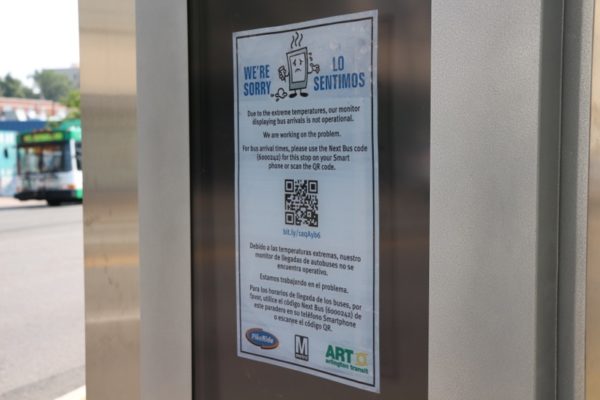
The screen is currently out of service, with a large note apologizing for the problem.
“Due to the extreme temperatures, our monitor displaying bus arrivals is not operational,” the sign says. “We are working on the problem.”

The Board acted in line with its Master Transportation Plan in lowering the speed limits on the key local arteries.
The speed limit on Wilson Blvd and Clarendon Blvd was lowered from 30 to 25 mph between Rosslyn and Washington Blvd.
Police are investigating a four-vehicle crash in East Falls Church.
The crash happened around 3:00 p.m. at the intersection of Lee Highway and Sycamore Street. A witness told ARLnow.com that the accident was caused when one of the drivers tried to make an ill-advised U-turn. Police on the scene tell us he’s being charged with reckless driving.
Update at 11:50 a.m. — All lanes are now back open.
Update at 11:35 a.m. — The Key Bridge is being reopened, D.C. police said via Twitter. Traffic is currently flowing from the D.C. to Virginia side of the bridge, but so far the inbound lanes have not reopened. NBC Washington is reporting that the closure was due to a phoned-in bomb threat.

In Virginia alone, nearly 72,000 DoD employees are affected by furloughs, which require one unpaid day off per week for 11 weeks. The state is expected to be particularly hard hit by the cuts due to the Pentagon being housed in Arlington.
It’s too early to definitively claim furloughs will ease traffic congestion, but AAA believes fewer people on the road could lead to less gridlock and fewer accidents. In fact, the organization suggests commutes could resemble those of July and August, when the region experiences its lowest traffic volume and rate of accidents.
Update at 4:45 p.m. — Firefighters report that the gas has been shut off. Police are attempting to open up a lane of traffic through the intersection.
Earlier: A gas line break may snarl the drive home for some Crystal City commuters.

The Department of Environmental Services conducted studies to examine the viability of changing speed limits on several streets. Information was gathered regarding factors such as vehicle speeds, collisions, traffic volumes, pedestrian and bicyclist activity and development patterns. Studies were performed in the following areas: N. Meade Street from Arlington Blvd to Marshall Drive (formerly Jackson Avenue), Clarendon Blvd from Washington Blvd to N. Oak Street, Wilson Blvd from Route 110 to Washington Blvd, and N. Sycamore Street from Washington Blvd to 17th Street N. and N. Roosevelt Street from 17th Street N. to the county line.
The studies indicated that speed limits along N. Meade Street, Clarendon Blvd and Wilson Blvd could be decreased from 30 miles per hour to 25 miles per hour. The N. Sycamore Street/N. Roosevelt Street studies indicated the speed limit could be lowered from 35 miles per hour to 30 miles per hour.

Memorial Bridge and Memorial Circle will be closed all day, from 6:30 a.m. to 11 p.m. Below are the other closures to expect.
From 3:00 to 11:00 p.m.: