


The demise of the GazetteLeader news organization in late September left Arlington with just a single weekly print news publication.
Should the survivor, the Arlington Connection, someday follow the trend of print publications moving online or disappearing entirely, that could be the end of the community’s legacy of physical newspapers — one that spans more than two centuries.
The history of local newspapering dates back to the Alexandria Gazette, when modern-day Arlington and Alexandria were joined together as a single political entity.
Among the newspapers that rose and fell across the region in the interval, some are gone but not forgotten. Others, however, may be forgotten, but are not gone — as long as one knows where to look.
Those back issues provide a treasure trove of information about where the community has been, and how it got to where it is today.
“Newspapers do serve as a historical record of sorts, and they cover a lot of ground,” said John Stanton of the Arlington Public Library’s Charlie Clark Center for Local History.
“It may seem like a bit of a cliché, but they are a window into the past and you can find a wide range of information via them, since newspapers covered and reported on so many different topics,” he told ARLnow.
One Publication Spanned Generations
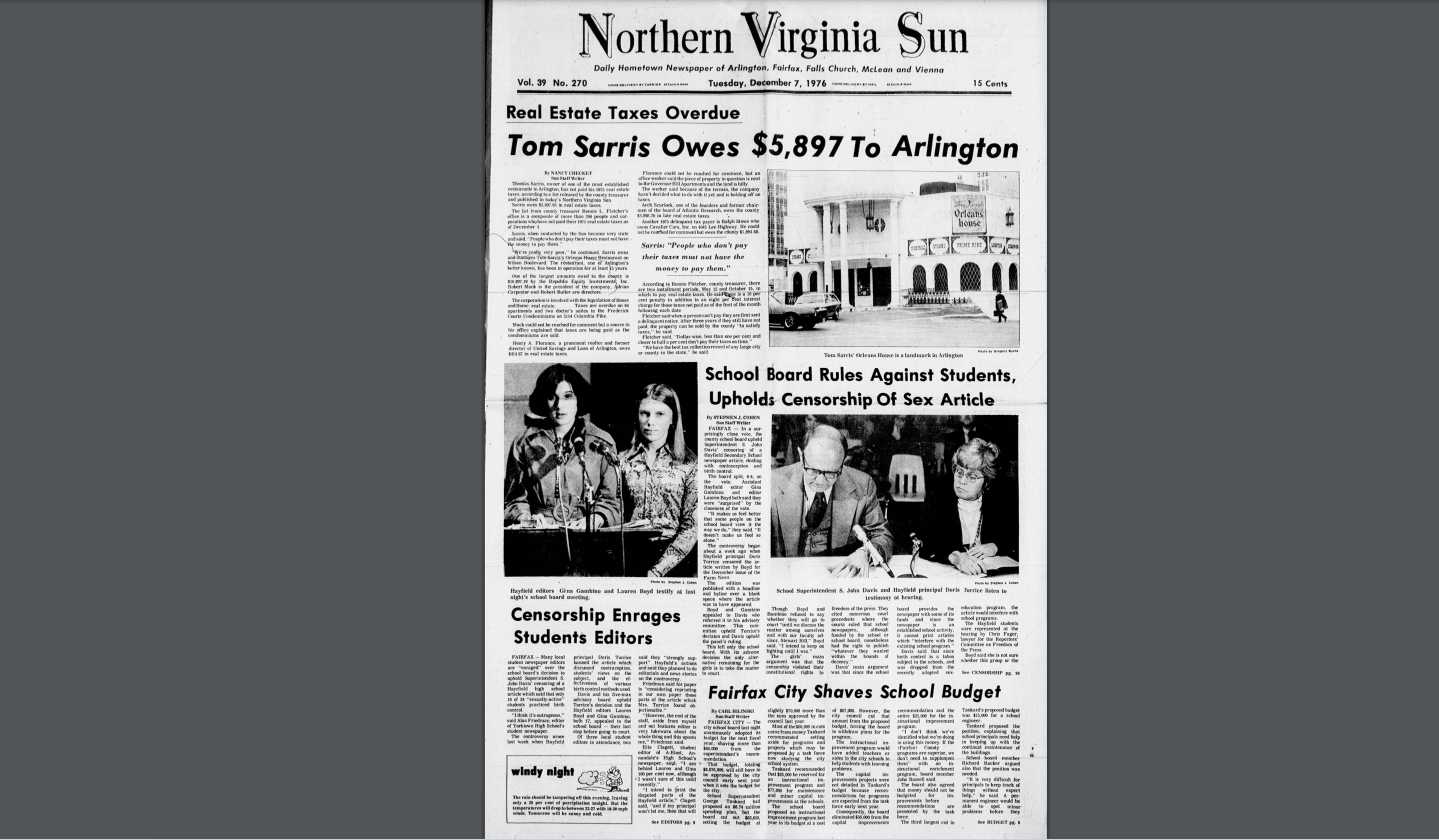
One publication that spanned much of the past century, chronicling Arlington with a variety of publication schedules from one to six editions per week, was the Northern Virginia Sun.
Established in December 1935, it absorbed competitors, was bought and sold multiple times, changed names and sizes on several occasions and, for its last quarter-century, covered Arlington as the weekly Sun Gazette.
The most contentious issue covered in its early editions was whether the community of East Falls Church should remain part of the town (later city) of Falls Church, or should be subsumed into Arlington. Arlington won out.
The paper also served as a repository for everything from coverage of local Little League and summer swimming to sermons of local ministers and the impact of national and world events on the local community.
Indeed, local was a highly dominant focus: One September 1939 front page recorded the beginning of World War II in Europe — but only below coverage of the installation of the Kiwanis Club of Arlington’s new president.
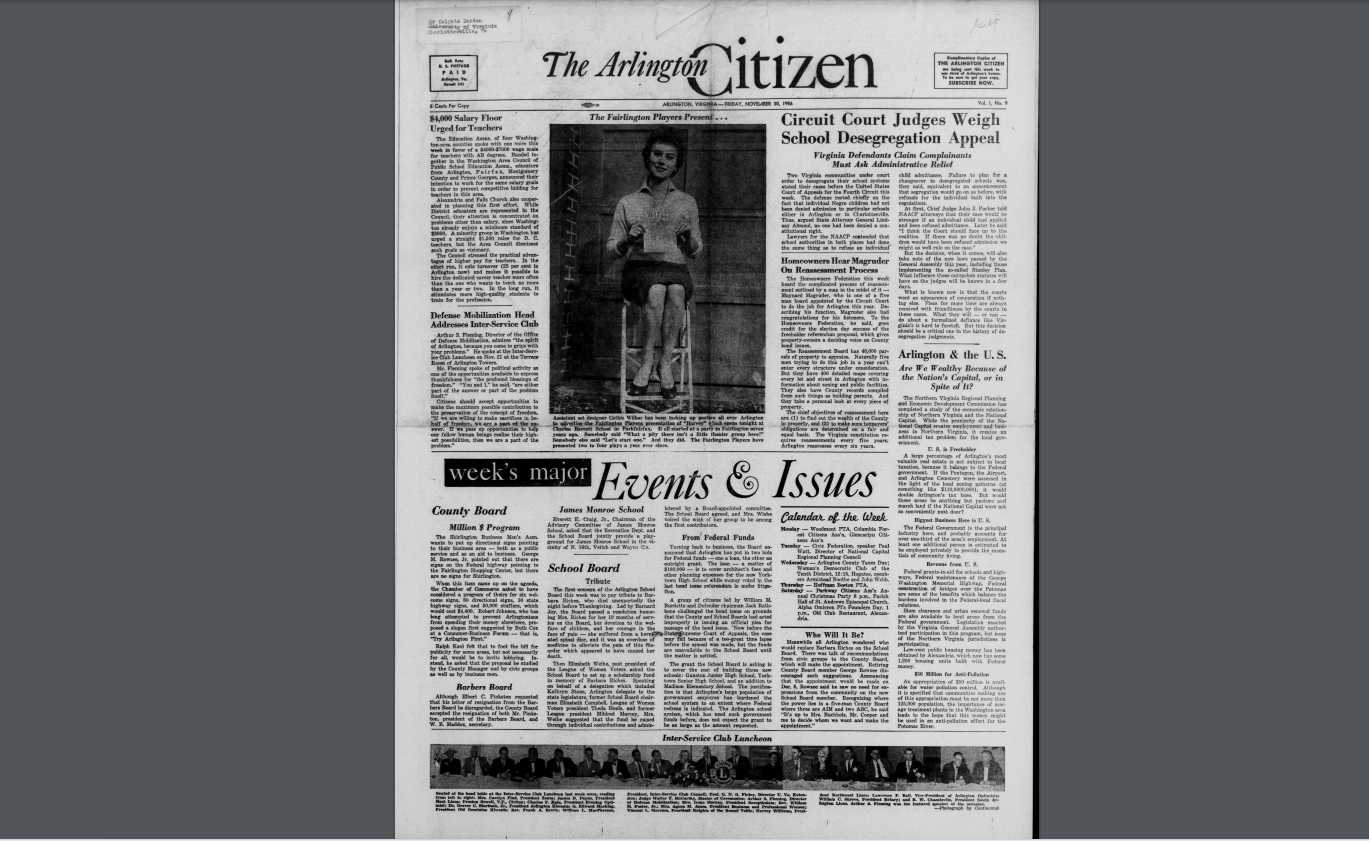
By the 1950s, the paper was a daily that distinguished itself with coverage of Virginia’s school-integration battles. In the 1960s, owner/editor Herman Obermayer took on the American Nazi Party, then based in Arlington.
Taking a page from one of his predecessors as editor, Obermayer penned a front-page column once a week. They were the blogs of their era.
Obermayer, who died in 2016, in the 1990s sold his publications and lucrative printing business to a Charlottesville investor. The business changed hands several times over the ensuing years, including a period of joint ownership and cohabitation with the daily Journal Newspapers.
The Northern Virginia Sun era effectively came to an end in early February 2023. The last edition of the Sun Gazette rolled off the presses, with its Texas-based owner not able to successfully navigate winds of change in evolving trends in readership and the economics of the news business.
The very next week, however, a new paper — the GazetteLeader — made its debut, featuring the same news and advertising staff but having no corporate connection to the Sun Gazette.
The ownership, Arizona-based O’Rourke Media Group, worked for about 18 months to align revenues with expenses before selling the paper’s assets to Local News Now, parent of ARLnow, FFXnow and ALXnow. Two editorial staffers — a news and a sports editor — were retained in the transaction, but the print edition and the separate GazetteLeader identity were discontinued.
Arlington Connection Is Sole Survivor
The demise of the GazetteLeader leaves the weekly-on-Wednesdays Arlington Connection as the lone county-specific print outlet. It is part of a media group that publishes other weekly Connection-named newspapers across Northern Virginia, as well as the Alexandria Gazette-Packet and Mount Vernon Gazette.
In Maryland, the parent company publishes the Potomac Almanac.
The Arlington Connection is heavy on feature stories rather than hard news. Its most distinctive feature may be a weekly column by advertising-sales representative Kenneth Lourie, chronicling many topics but often focused on his challenges surviving cancer diagnoses.
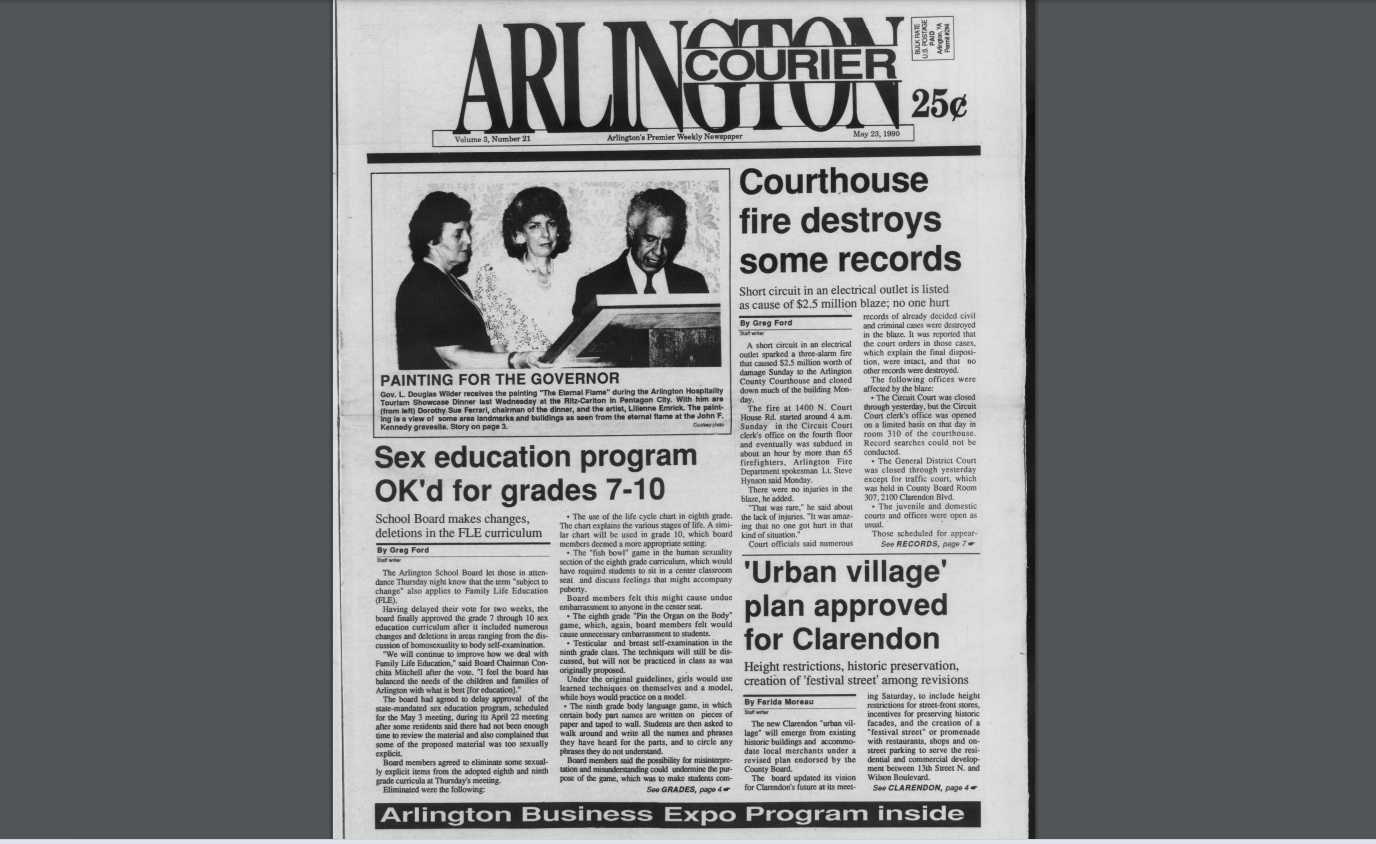
The Arlington Connection is the successor to the Arlington Courier, a weekly paper that in the late 1990s was absorbed by the Connection chain during an expansion phase and was rebranded with the Connection moniker.
The Connection newspaper group is facing its own financial struggles.
“Newspaper advertising is lagging, leaving our revenue very short,” the newspaper company said in the Dec. 4 Arlington Connection. “Without help, we won’t be able to continue publishing.”
Also still churning out weekly print editions is the weekly-on-Thursdays Falls Church News-Press, primarily focused on Arlington’s next-door neighbor.
The News-Press for many years published a weekly “Our Man in Arlington” news/commentary column, penned successively by Richard Barton and then Charlie Clark. After Clark’s death in 2023, the column did not return to the paper’s pages.
Many Past Editions Now Digitized
Those seeking online editions of historic Arlington newspapers have a major resource at their fingertips — if those fingertips are attached to a computer keyboard or similar device.
The Virginia Newspaper Program, sponsored by the Library of Virginia, since the 1990s has worked to “locate, describe, inventory, preserve and provide public access” to U.S.-imprint newspapers housed not only at the Library of Virginia but throughout the Commonwealth.
Arlington library officials worked collaboratively with the Library of Virginia to make local editions available, after securing copyright authority from past media owners who could be found.
“The sheer number of newspapers available has been a very important tool for me and the rest of the staff here … there is information that I previously would never have been able to find, or if I did find it, the effort involved in researching would have been much more taxing and time-consuming,” Stanton told ARLnow.
“But just like using Google and other search engines, the ability to find what you are looking for is dependent on one’s skills in keyword searching,” he noted.
Initially funded by the National Endowment for the Humanities, the state initiative also has the backing of the University of Virginia, the College of William and Mary and the Virginia Museum of History and Culture.
Its Virginia Newspaper Directory contains information on holdings not just of the Library of Virginia, but also by numerous other institutions.
In total, the collection contains more than 500,000 issues comprising nearly 5 million pages.
What Can Be Found Online?
Archives of much of the Northern Virginia Sun are among those found in electronic format. Arlington officials arranged to have the papers scanned into electronic form and presented to the Library of Virginia, where they are now available online both as individual editions and by keyword search.
The library’s collection of Northern Virginia Sun copies is comprehensive if not totally complete, with more than 6,000 dates available.
In addition to the holdings of the county library system, the number of editions available for preservation was augmented by the family of early publisher Howard Bloomer and by the Sun Gazette’s then-parent company, Northern Virginia Media Services.
But the Northern Virginia Sun is not the only holding. Among the local papers of decades gone by that can be found on the Library of Virginia website (with background information on each as it is available):
- Arlington Citizen, published in the 1950s. Editor was Anne Crutcher.
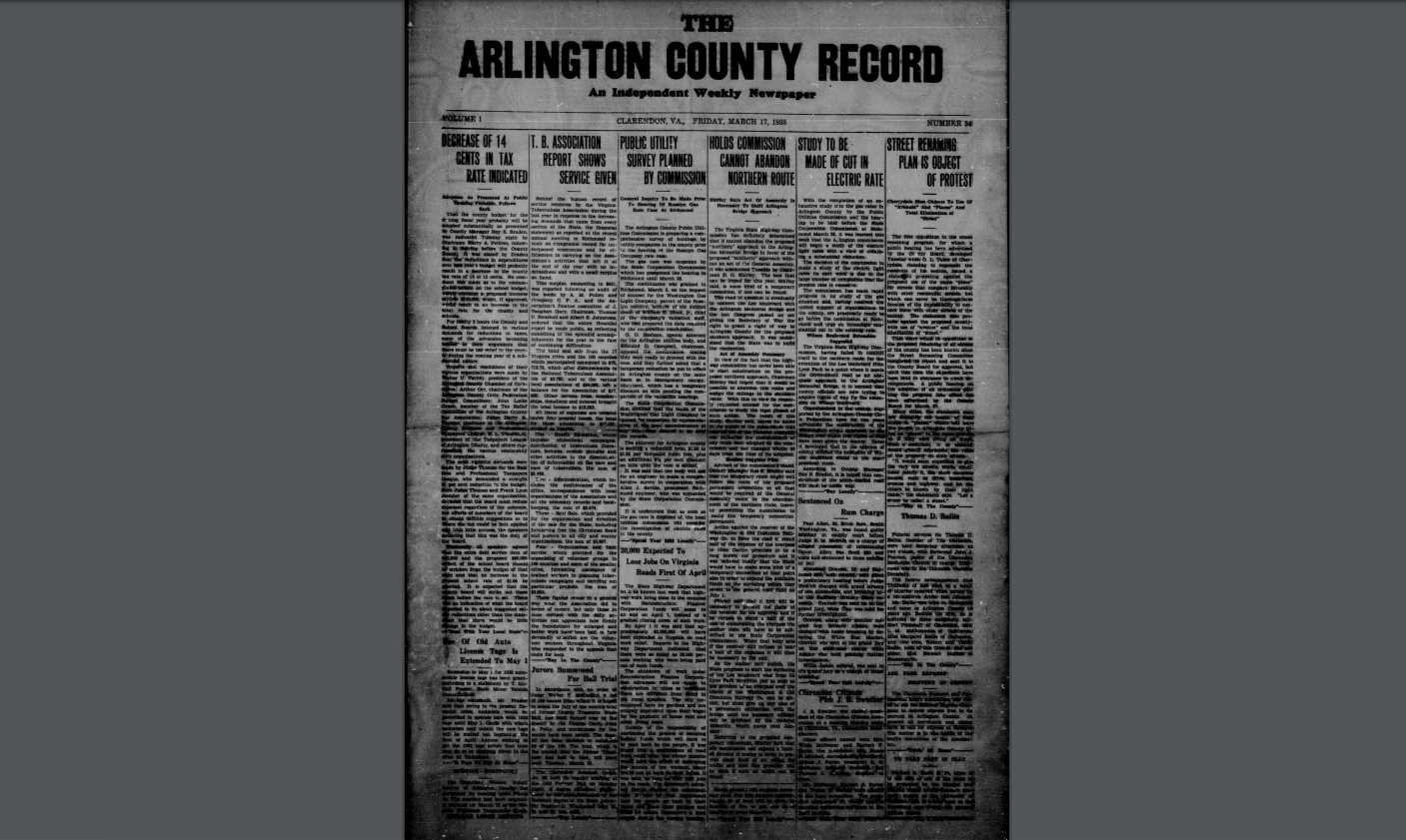
- Arlington County Record, published 1932-33 in Clarendon.
- Arlington Courier (I), published in the 1930s before being absorbed by what would become the Northern Virginia Sun.
- Arlington Courier (II), published in the 1980s-90s by David Dear Jr., who also published the Great Falls Current, before being absorbed by Connection Newspapers.
- Arlington Daily, published from 1939-51 by C.C. Carlin before merging with the Sun to form the Daily Sun.
- Arlington News-Gazette, published in the 1930s in Rosslyn.
- Arlington Chronicle, published from 1920-51 in Clarendon, ultimately converting to a magazine format.
- Columbia News, published 1941-45 by Eugene Bears.
- Rosslyn Rooster, published in 1938.
- Arlington County Record, published 1932-33 in Clarendon.
- Virginia News, published in the 1940s by E.N. Beard — which, despite the name, had an Arlington focus.
Who might need access to the information contained in the archives?
“Students, researchers, reporters, people doing genealogical research, estate and probate researchers looking for obituaries, law firms — the list is practically endless,” Stanton said.
“Often it comes down to personal memories and nostalgia … people looking for advertisements, pictures, and articles about restaurants and businesses they frequented when they were younger,” he said. “And sporting events from their school days.”
In addition, some people turn to the archives (and library personnel) to settle friendly disputes about events of years gone by.
More Options Exist in Microfilm Form
The digital compendium held in trust by the Library of Virginia represents just a portion of what exists.
Resting securely in filing cabinets at the Arlington Public Library’s Center for Local History are spools of microfilm holding archived editions available for perusal.
Some are duplicated in the Library of Virginia holdings, but others, as of yet, are not.
The Center for Local History’s records there go as far back as the Virginia Gazette of Williamsburg (then Virginia’s capital), with editions from 1731 to 1776 represented.
Other newspapers with a more local focus in the microfilm holdings include the Alexandria Gazette (holdings include editions from 1784-1965, primarily as a daily newspaper), Fairfax Herald (1886-1919), Arlington News (1960s-70s), Globe (1970s) and Arlington Journal (daily, 1974-2005).
Among other papers that rose and fell across the community in the 20th century but as yet are not included either in the Library of Virginia digital archives or the Arlington microfilm repository: the Northern Virginia Free Press (1940s), Arlington Times-Dispatch (1960s) and Arlington News (1970s).
The Arlington Monitor was published in the early part of the 20th century, as today’s Arlington was known until 1920 as Alexandria County.
In addition to the microfilm collection, the county library system’s holdings include print editions bound together, held at an off-site storage facility but available to researchers.
This reporting was made possible by the ARLnow Press Club. Join to support in-depth local journalism — and get an exclusive early morning email with a preview of that day’s planned news coverage.
