


The number of Arlington rental units that are financially accessible to those earning less than 80% of area median income (AMI) has skyrocketed rather than plummeted over the past decade.
Not because housing is becoming cheaper, but because incomes of local residents have risen faster than the cost of renting.
A total of 35,076 rental homes were affordable to those earning under 80% of AMI in fiscal 2025, based on an ARLnow analysis of data from the county government’s housing dashboard.
That represents 28% of the county’s entire housing stock of 124,000 units, and about 55% of all apartment units.
It also represents an increase of 64% from fiscal 2017, when there were 21,312 units affordable to those earning less than 80% AMI
The figures include both “committed-affordable” (subsidized) units, known as CAFs, and market-rate units, known as MARKs.
“A host of factors” have led to the increase on the MARKs side of the equation, county housing official Russell Danao-Schroeder said at the Nov. 6 meeting of the Housing Commission focused on the county’s Affordable Housing Master Plan.
Danao-Schroeder said a big factor was incomes rising faster than housing costs for those living in Arlington and across the local region.
The current local area median income ranges from $114,800 for a single-person household to $190,200 for six people, according to county officials. The overall median household income for the D.C. area is $162,000, according to Fannie Mae, or nearly double the national median household income of $83,700 reported by the Census Bureau.
The survival of market-rate apartments serving those making less than 80% of the area median income was something of a surprise to county housing staff.
“We thought it was likely we’d see those units disappear from the market,” Danao-Schroeder said. “What we’ve seen has been the opposite — they’ve come back and they’ve come back with some force.”
The number of those units now available in Arlington has risen 55% over the past decade for those earning under 60% percent of AMI and 70% for those earning 60% to 80% of AMI, he said.
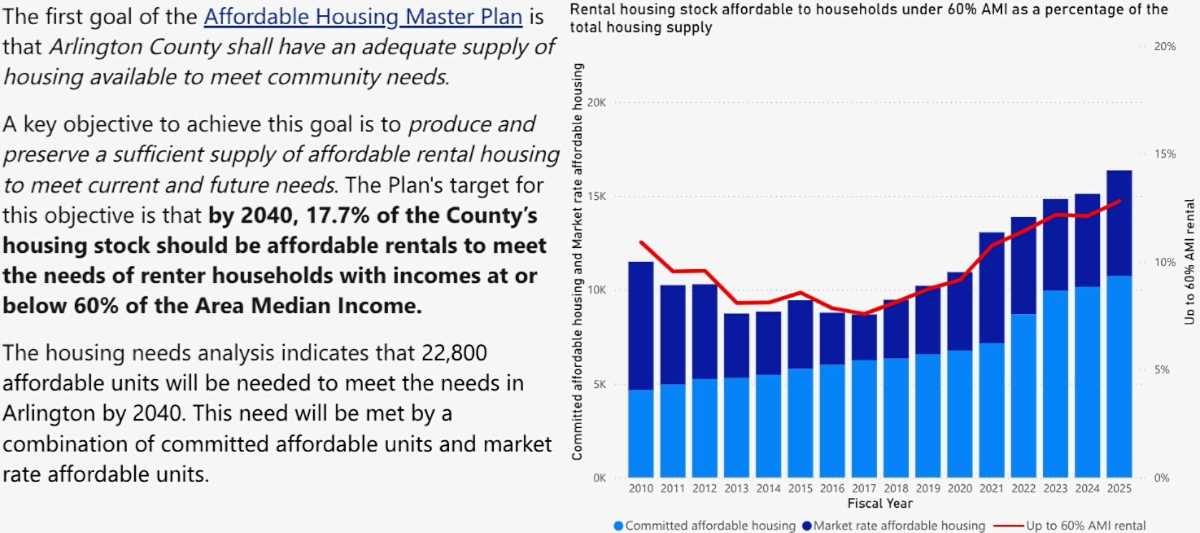
The increase in affordable MARKs would be even larger, except some buildings were converted to committed-affordable units and are no longer listed as market-rate properties.
While this is all potentially good news for those in the lower half of the earnings pool, the picture remains troubling — if slightly improving — for those at the very bottom of the economic spectrum.
In fiscal 2025, only 164 units across Arlington were financially viable to those earning 30% or less of AMI without government financial support.
Though up from just five units in 2015, the 2025 figure represents a small faction of the roughly 9,000 Arlington households with incomes less than 30% of the area median.
During a discussion accompanying the Nov. 6 presentation, Housing Commission member Bryan Coleman circled back on those earning 60% to 80% of median income, who typically are ineligible for some government financial help than those at 60% or less receive.
“We’re not really having a larger conversation around general affordability for individuals that are living over than 60% AMI threshold, who would not qualify for a lot of the great programs we have,” Coleman said.
County officials and others need to “identify where to target and try to think of more creative tools” to “make a dent in this,” Coleman said.
Some of those tools may be made available by the 2026 General Assembly and incoming Gov. Abigail Spanberger. The county’s draft legislative package for the year includes a number of key housing initiatives to address housing affordability.
Despite recent pullbacks, which are in part seasonal in nature, Arlington rents remain sky-high compared to the national and even regional levels.
According to Apartment List, the overall median apartment-rental rate in the county for October was $2,575, compared to $1,381 nationally and $2,166 in the Washington metro area.
Little market-rate housing across Arlington or the region is being built catering to those making less than 80% of AMI. In some cases, what’s described as “workforce housing” can have rents affordable only to those earning 120% of the median income.
According to current count data, there are just under 67,000 apartment units in Arlington: 47,147 in elevator buildings, 15,304 in garden-style layouts and 1,245 for seniors. That’s about 51% of overall housing stock.
In addition, about 13% of single-family detached homes, 24% of townhouses, 29% of garden-style condominiums and 37% of elevator condominiums are rented out. As a result, about 63% of Arlington households live in rental housing.
