

 This sponsored column is by Law Office of James Montana PLLC. All questions about it should be directed to James Montana, Esq., Janice Chen, Esq., and Victoria Khaydar, Esq., practicing attorneys at The Law Office of James Montana PLLC, an immigration-focused law firm located in Falls Church, Virginia. The legal information given here is general in nature. If you want legal advice, contact us for an appointment.
American immigration courts are civil, not criminal. Failure to appear in immigration court is not a criminal offense. If you fail to appear in criminal court, you can expect a bench warrant to be issued for your arrest, and you may later be charged with Failure to Appear. Immigration judges lack the power to order arrest, and failure to appear in immigration court is not a crime. So, how are immigrants incentivized to show up in court? It’s simple. If you show up for your court date, you have a chance of winning; if you don’t show up, you will be instantaneously ordered removed in absentia, and your chances of ever getting the case reopened are slim.
Until recently, therefore, the game-theoretical calculus was simple. The upside of appearing in court was that you might win; if you lose, you might be ordered removed. The downside of appearing in court was that, if you lost, you might fear being arrested and detained. But, again, until recently, the risk of detention at immigration court was slight.
The Trump Administration has, with its usual “these go to 11” subtlety, changed the calculus, by sending agents to arrest immigrants at immigration courthouses. The purpose of this article is to share information on how frequently this happens, and to offer some thoughts about the effects this is likely to have immigration law and enforcement.
How often do immigrants get detained at immigration court? This is not easy to say, because DHS has not released much data, but the hardworking bodgers at the Data Deportation Project suggest that the odds are about 1% – one in every hundred hearings.

You might think that isn’t a lot. It isn’t a lot, in absolute terms, but it absolutely is having an effect. Arrests of immigrants without criminal records are up 700%, and arrests in immigration court are almost certainly up by a much higher percentage. Before the second Trump Administration, I had never seen or heard of a client being arrested at an immigration court. Now, I’ve heard of clients being arrested in the middle of testimony, and, in one hair-raising case, a witness being arrested in open court.
So, the downside risk of appearing in immigration court is way up. What about the upside potential? Well, here’s a chart that we ought to republish here every week:
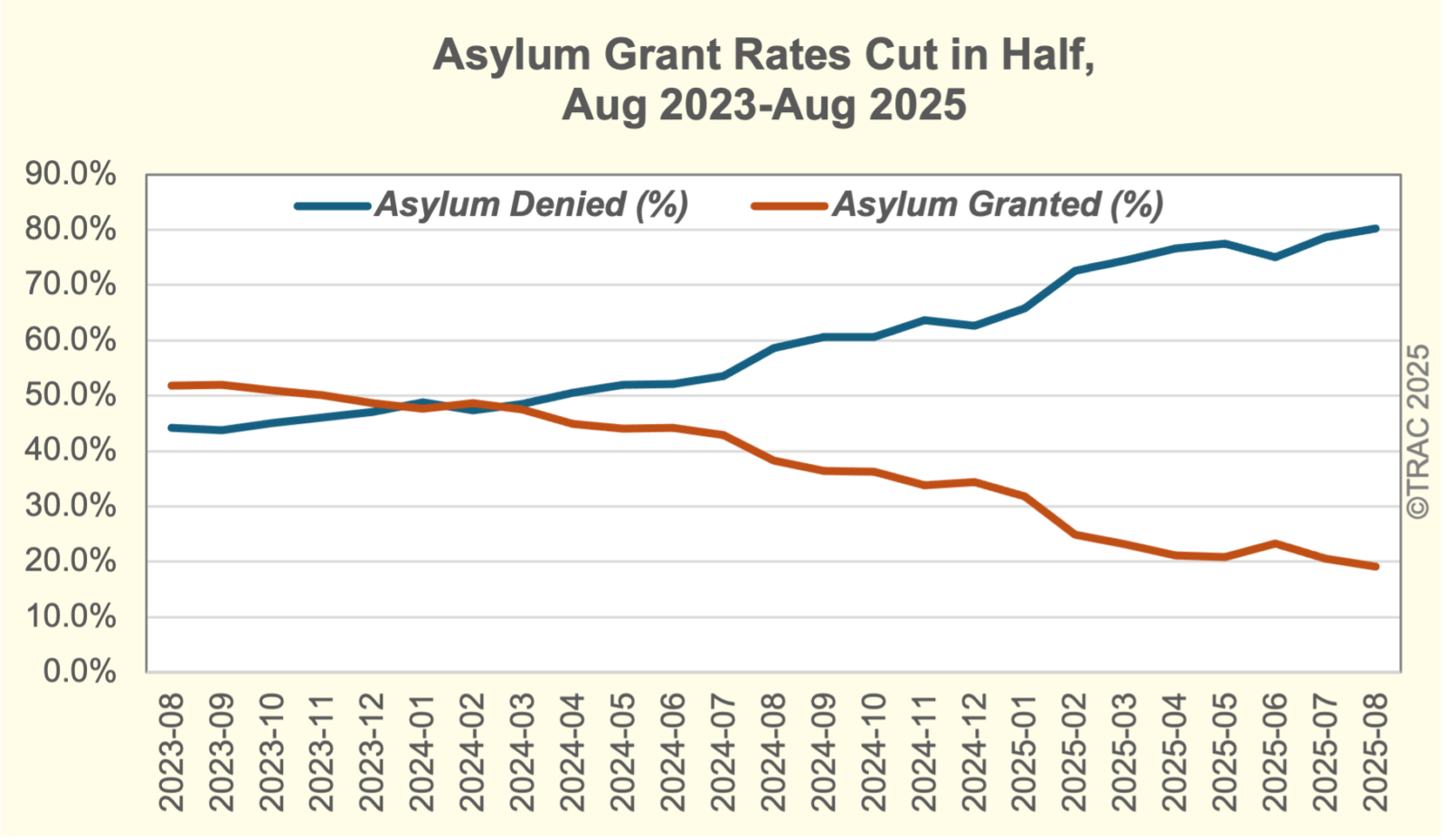
Two years ago, you had a 50-50 chance of winning asylum in Immigration Court. Now – with no change in the substantive law – you lose 80% of the time. Two years ago, the chance of being arrested in Immigration Court was near nil. Now, it is not insubstantial.
Immigrants are rational, and so they’re reacting to these changed conditions in a predictable way – by no-showing their hearings in greater numbers.
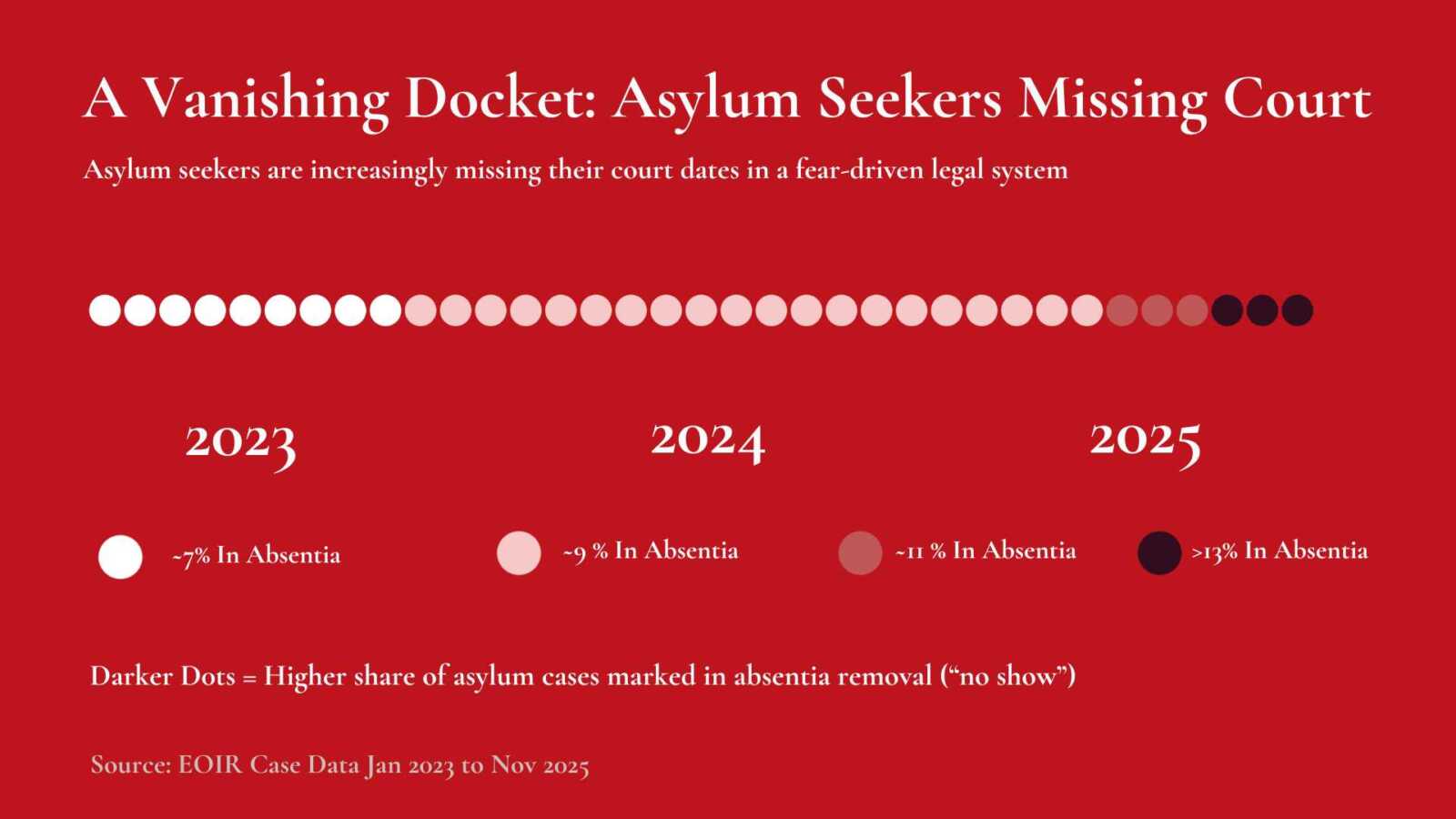
From a certain perspective, immigrants no-showing their hearings looks like a policy success for the Trump Administration – the immigrant is ordered removed in absentia, the court system’s ever-lengthening backlog eases, and the immigrant will not be able to petition for relatives to join him in the United States. But these considerations should not be decisive. The Immigration Courts – unlike the criminal courts – absolutely rely on the cooperation of immigrants to function. ICE does not have the manpower to pursue immigrants with in absentia removal orders in a numerically serious way. If the Immigration Courts cease to be safe places for immigrants to have their cases heard, they will become monuments rather than forums, and produce nothing other than in absentia orders of removal which are unlikely to be enforced.
