In the months of November and December 2025, the Trump Administration took four related actions: (1) they froze all adjudication of applications for nationals subject to a related travel ban, (2) they announced that being from one of those countries would be a ‘significant negative factor’ in benefits adjudication, (3) they froze adjudication of all affirmative asylum claims, and (4) they announced a ‘re-review’ of all immigration benefits granted to people from a list of thirty-nine countries since the beginning of the Biden Administration. We told you, as these policies were introduced, that they were going to be controversial – we told you that litigation would put an end to them, because “[s]ome federal judge, somewhere, will say ‘enough.'”

Last week, a federal judge, John J. McConnell of the U.S. District Court for the District of Rhode Island, said “Enough!” in vigorous language, striking down all four policies in a strongly worded decision. The purpose of this advertorial is to explain: (1) why the federal district court took this action, (2) what real-world effects we expect this to have, and (3) what the Trump Administration’s prospects on appeal are.

First, what did Judge McConnell’s decision say?

In short, Judge McConnell flatly rejected the government’s claim that its decisions were non-discriminatory and rooted in a reasonable desire to ensure security and accurate adjudication. It’s worth lingering over the language that Judge McConnell employs in his introduction.

“But the rule of law has to apply to everyone equally and, as evident here, USCIS has neither “followed the law” nor “done things the right way.” Indeed, the agency has violated the very immigration laws that Congress has charged it with administering, as well as the administrative laws that govern the agency’s actions. In enacting its latest immigration policies, USCIS: claims statutory and regulatory authority that it does not possess; makes decisions without the reasoned explanations that it must provide; acts without regard for the reliance interests of applicants that it must consider; and justifies its actions with pretextual concerns of “national security” that mask anti-immigrant sentiments that it is forbidden from letting influence its decision-making. In legal terms, that means USCIS’s actions are contrary to law and arbitrary and capricious.”

What Judge McConnell means, more or less, is that the Trump Administration can’t use the administrative apparatus of USCIS to accomplish its policy goals without either passing a statute or promulgating a regulation. As a reminder, the Trump Administration didn’t even try to promulgate a regulation concerning any of the above memoranda, it simply announced them, one ukase after another.

Now, what will the Trump Administration do?

Our prediction is cynical: The Trump Administration will do nothing. They’ll slow-walk any compliance with Judge McConnell’s order while they file an appeal to the First Circuit Court of Appeals, seeking an emergency stay of Judge McConnell’s order. If they lose at the First Circuit, they’ll seek another form of emergency relief, via the Supreme Court’s so-called “shadow docket.” Only if the Administration loses twice on appeal will they even contemplate compliance with this order.

What should applicants for benefits affected by these newly unfrozen orders do? The right answer depends on the individual case. The great majority of applicants, we suspect, will choose to wait and see what the outcome of the government’s appeal will be. We’ll report on that, too, when the next round of litigation is concluded.


This sponsored column is by Law Office of James Montana PLLC. All questions about it should be directed to James Montana, Esq., Janice Chen, Esq., and Victoria Khaydar, Esq., practicing attorneys at The Law Office of James Montana PLLC, an immigration-focused law firm located in Falls Church, Virginia. The legal information given here is general in nature. If you want legal advice, contact us for an appointment.

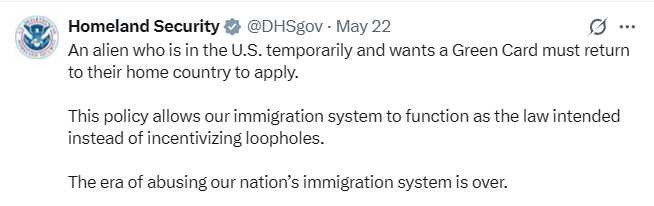
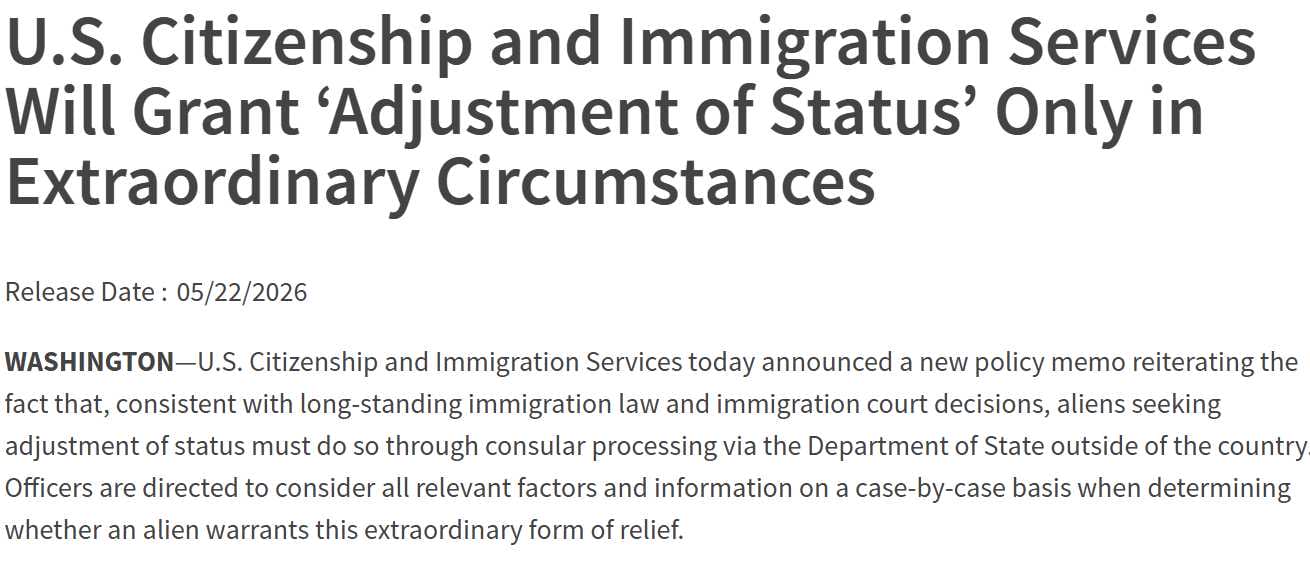
The government likes to release unpopular items on Friday afternoons, and, when the government has something really unpopular to say, the Friday afternoon before a holiday weekend is considered ideal. Last Friday, before the Memorial Day weekend, USCIS published a truly incredible policy reversal – PM 602-0199 (the “May 21 Memo”), which purports to upend the ability of most foreigners to apply for green cards from within the United States. DHS and USCIS’s respective public messaging on the memorandum is clear but wrong. The memorandum was more nuanced, but still, in our view, deeply misleading. The purpose of this advertorial is to explain what happened, why it matters, and offer some predictions about how this unforced error is going to be resolved.

First, here’s what DHS and USCIS said about their own memo.

What do these press releases mean? They mean to highlight the following distinction: some people apply for a green card from inside the United States, at USCIS field offices; others apply for a green card from outside the United States, at U.S. Embassies and Consulates abroad. Per both press releases, nearly everyone who applies from inside the U.S. is ineligible to become a lawful permanent resident. Almost everyone who applies for a green card should do so via U.S. Embassies and consulates abroad.

That might seem reasonable, and, ex ante, it could be, if our laws and institutions were set up properly. There are, unfortunately, a few problems with this new policy position, both practical and legal. (more…)


This sponsored column is by Law Office of James Montana PLLC. All questions about it should be directed to James Montana, Esq., Janice Chen, Esq., and Victoria Khaydar, Esq., practicing attorneys at The Law Office of James Montana PLLC, an immigration-focused law firm located in Falls Church, Virginia. The legal information given here is general in nature. If you want legal advice, contact us for an appointment.

Kremlin political intrigues are comparable to a bulldog fight under a rug. An outsider only hears the growling, and when he sees the bones fly out from beneath it is obvious who won.” – Winston Churchill.

The Trump Administration, in both its first and second iterations, has not lived up to that Churchill quotation, not least because its principals are so paranoid and unprofessional that they usually air their grievances in public. Sometimes, when facing unfriendly questioning before Congress, a leading Administration official bangs the table about how the Dow Jones Industrial Average has broken 50,000; sometimes, when a bottle of bourbon goes missing, a leading Administration official threatens to polygraph and prosecute FBI agents. This is not, as a general rule, a thin-lipped bunch of Silent Cals.

The Department of Homeland Security has been an honorable exception to that general rule; its personnel have been, at least by Trump Administration standards, fairly disciplined about airing their grievances in public. That’s where the Kremlinology comes in. The latest intel suggests that a real behind-the-curtain fight is happening between two factions at DHS – one, personified by policy majordomo Stephen Miller, and the other, by bureaucratic knife-fighter (and Cava enjoyer) Tom Homan. The Homanites appear to be winning. The purpose of this advertorial is tell you why we think that is true, and provide a bit of speculation about why.

First, why do we think it is true? Not every resignation means a change in policy; sometimes, when the chief of the Border Patrol resigns after widespread accusations that he flew to Thailand, Colombia, and Mexico to avail himself of the services of prostitutes, it’s just an HR thing. But some reshuffles are more significant, and we think the following four suggest a new policy direction.

(1) Kristi Noem is out, and Markwayne Mullin is in. Secretary Noem performed her duties in vapid, vigorous, indecent, indecorous style, and she consistently personified the most outré and bizarre actions by the immigration enforcement bureaucracy, from calling protesters ‘domestic terrorists’ to LARPing as a HSI agent during raids. Former Sen. Mullin has taken a different public tack. Secretary Mullin – echoing public comments from Tom Homan – has repeated in interviews that DHS is targeting “the worst of the worst” rather than engaging in broad sweeps, and has said that the Minnesota operation, which led to the deaths of several American citizens, will not occur again. ” Secretary Mullin recently remarked, “[m]y goal in six months is that we’re not in the lead story every single day.” We don’t think you’ll see him posing at CECOT in a Rolex. (more…)


This sponsored column is by Law Office of James Montana PLLC. All questions about it should be directed to James Montana, Esq., Janice Chen, Esq., and Victoria Khaydar, Esq., practicing attorneys at The Law Office of James Montana PLLC, an immigration-focused law firm located in Falls Church, Virginia. The legal information given here is general in nature. If you want legal advice, contact us for an appointment.

Asylum is not granted as a matter of routine. To qualify for asylum, you have to have an objectively reasonable, subjectively genuine fear of persecution if returned to your home country; and, moreover, that fear must be based on a limited number of ‘protected grounds’ – race, religion, political opinion, nationality, or membership in a particular social group. On top of that, even if you do have the aforementioned fear of persecution based on a protected ground, you still have to qualify for asylum as a matter of discretion.

In previous administrations, discretionary denials of otherwise qualifying asylum claims were extremely rare. In the new Trump Administration, of course, all bets are off.

The purpose of this article is twofold: (1) to inform asylum applicants about these new ‘discretion’ questions so they can think carefully about how to answer them, and (2) to inform our fellow citizens about what the current Administration is doing in their name.

Immigration attorneys report that new questions are being asked at asylum interviews which touch on anti-Semitism, anti-Americanism, an asylum applicant’s poverty, health conditions, and wealth, and the applicant’s engagement in the community. Some of these questions aren’t unreasonable, but some are completely bonkers. Here are some of the topics and reported questions for each topic.

Anti-Semitism

  • Do you hold any anti-Semitic views?
  • Have you held anti-Semitic views in the past?
  • Do you plan to hold any anti-Semitic views?
  • Have you or your family expressed anti-Semitic opinions on Social media, at home, in public or private? (more…)

This sponsored column is by Law Office of James Montana PLLC. All questions about it should be directed to James Montana, Esq., Janice Chen, Esq., and Victoria Khaydar, Esq., practicing attorneys at The Law Office of James Montana PLLC, an immigration-focused law firm located in Falls Church, Virginia. The legal information given here is general in nature. If you want legal advice, contact us for an appointment.

On April 16 – just yesterday – The Board of Immigration Appeals (BIA) publicly released its precedent decision in Matter of M-K-, 29 I&N Dec. 556 (BIA 2026), the immigration case of Palestinian activist and former Columbia University graduate student, Mahmoud Khalil. Though the decision was originally issued on April 9, 2026, its designation and publication today as binding BIA precedent makes it significantly more consequential, because the ruling now is binding precedent within the immigration court system. (more…)


This sponsored column is by Law Office of James Montana PLLC. All questions about it should be directed to James Montana, Esq., Janice Chen, Esq., and Victoria Khaydar, Esq., practicing attorneys at The Law Office of James Montana PLLC, an immigration-focused law firm located in Falls Church, Virginia. The legal information given here is general in nature. If you want legal advice, contact us for an appointment.

In January 2025, we told you that the Trump Administration was trying to abolish birthright citizenship by executive order. We predicted that the order would be subject to an immediate injunction, and we predicted further that the litigation would proceed, through the appellate process, to the Supreme Court, and, once there, the Trump Administration would lose 9:0.

Yesterday, the Supreme Court heard oral arguments in Trump v. Barbara, in which the question of birthright citizenship was placed squarely before the Court. Clearly, this was an important case for the Trump Administration; President Trump put in a personal appearance at the Supreme Court, left in the middle of oral argument, then ‘truthed’ his view that “We are the only Country in the World STUPID enough to allow ‘Birthright’ Citizenship!” (more…)


Article Banner

This sponsored column is by Law Office of James Montana PLLC. All questions about it should be directed to James Montana, Esq., Janice Chen, Esq., and Victoria Khaydar, Esq., practicing attorneys at The Law Office of James Montana PLLC, an immigration-focused law firm located in Falls Church, Virginia. The legal information given here is general in nature. If you want legal advice, contact us for an appointment.

In court, one side wins and one side loses. Immigration Court is no different. Sometimes, the side that lost ought to have won. In order to correct errors at the trial level, immigration court cases are appealable to the Board of Immigration Appeals, which sits right here in Falls Church, Virginia.

The Trump Administration has proposed a massive change to how the Board of Immigration Appeals works. It is no exaggeration to say that it effectively abolishes the right of appeal for immigrants facing deportation. (Jason Dzubow, who for our money is the preeminent asylum lawyer in DC, has dubbed the new appellate court “The Board of Imitation Appeals,” and we wish we were that clever.)

The purpose of this advertorial is to explain our readers how, and why, the Trump Administration is effectively abolishing the right of appeal.

By way of background, the Board of Immigration Appeals is just one court, with just eighteen judges. There are seventy-four immigration courts in the United States. This is an unworkable ratio. Each individual Appellate Immigration Judge is individually responsible for handling the appellate output of four immigration courts, which might be staffed by a dozen trial judges each. Unsurprisingly, wait times for appeals are measured in years, and the case backlog is in the hundreds of thousands.

Nobody likes the current system. We can imagine constructive suggestions for improvement. The Trump Administration, with its usual flair for the quickest, most destructive solution, has decided to do its best Miley Cyrus impression and come in like a wrecking ball. How? It’s simple: according to The New Rules, the Board of Immigration Appeals won’t review almost any decisions by the immigration courts, because “The Board cannot—and does not need to—adjudicate every case on the merits.” (Note well, kids: When you don’t feel like doing your algebra homework, simply tell your teachers that children cannot—and do not need to— solve quadratic equations.) Instead of actually adjudicating cases, the Board of Immigration Appeals will dismiss every single appeal by default, within fifteen days of receiving a Notice of Appeal, unless a majority of current board members – ten, at current staffing levels – vote to accept the appeal. A majority of the current Board was appointed by President Trump. If this regulation goes into effect, rely on it: the Board will vote to dismiss the vast majority of appeals.

So, imagine you’re an asylum applicant. What happens after the New Board of Immigration Appeals rubber-stamp denies your appeal? Under the new regulation, you appeal again, directly from the Board of Immigration Appeals to the Federal Circuit Courts of Appeals. Lawyers in the audience will recognize how wild that is: the Federal Circuit Courts of Appeals are the last stop before the U.S. Supreme Court, and reviewing the output of the immigration courts would, by our rough estimate, double their caseload.

Immigrant legal advocacy organizations have already sued to block the new rule. Our bet is that they’ll succeed in getting an injunction. What happens after that is anyone’s guess. The Trump Administration has a peculiar habit of thumbing its nose at court orders. (A little Easter Egg: lead counsel for the plaintiffs in the lawsuit is one Erez Reuveni, who would be working at the Department of Justice at this very moment if the Trump Administration obeyed court orders.)

As always, we are happy to answer any questions from the commentariat.


This sponsored column is by Law Office of James Montana PLLC. All questions about it should be directed to James Montana, Esq., Janice Chen, Esq., and Victoria Khaydar, Esq., practicing attorneys at The Law Office of James Montana PLLC, an immigration-focused law firm located in Falls Church, Virginia. The legal information given here is general in nature. If you want legal advice, contact us for an appointment.

Welcome, Diego! (L.: Victoria Khaydar, Esq., R.: Diego Lowe, Future Esq.)

Diego Lowe, a high school senior, has joined us as a Law Clerk! We are thrilled to introduce him to the ARLnow readership, and, of course, the commentariat. 

By way of introduction, here is a brief Q&A between Diego Lowe and our august founder. (more…)


This sponsored column is by Law Office of James Montana PLLC. All questions about it should be directed to James Montana, Esq., Janice Chen, Esq., and Victoria Khaydar, Esq., practicing attorneys at The Law Office of James Montana PLLC, an immigration-focused law firm located in Falls Church, Virginia. The legal information given here is general in nature. If you want legal advice, contact us for an appointment.

American immigration courts are civil, not criminal. Failure to appear in immigration court is not a criminal offense. If you fail to appear in criminal court, you can expect a bench warrant to be issued for your arrest, and you may later be charged with Failure to Appear. Immigration judges lack the power to order arrest, and failure to appear in immigration court is not a crime. So, how are immigrants incentivized to show up in court? It’s simple. If you show up for your court date, you have a chance of winning; if you don’t show up, you will be instantaneously ordered removed in absentia, and your chances of ever getting the case reopened are slim.

Until recently, therefore, the game-theoretical calculus was simple. The upside of appearing in court was that you might win; if you lose, you might be ordered removed. The downside of appearing in court was that, if you lost, you might fear being arrested and detained. But, again, until recently, the risk of detention at immigration court was slight. (more…)


This sponsored column is by Law Office of James Montana PLLC. All questions about it should be directed to James Montana, Esq., Janice Chen, Esq., and Victoria Khaydar, Esq., practicing attorneys at The Law Office of James Montana PLLC, an immigration-focused law firm located in Falls Church, Virginia. The legal information given here is general in nature. If you want legal advice, contact us for an appointment.

For years, we have told immigrants what any lawyer would: If the police knock on your door, you should not open the door unless the police present a valid warrant. A valid warrant means a warrant issued by an independent magistrate – a judge, not an executive branch official. This is a critical check on the power of the executive branch.

ICE seems to disagree. According to an extremely well-sourced set of whistleblowers, the Acting ICE Director, Todd Lyons, issued a memo stating that administrative warrants may be used to enter homes by force in order to effect an arrest. Here is the text of the leaked memorandum, in relevant part. (Our highlights are in bold below.)   (more…)


This sponsored column is by Law Office of James Montana PLLC. All questions about it should be directed to James Montana, Esq., Janice Chen, Esq., and Victoria Khaydar, Esq., practicing attorneys at The Law Office of James Montana PLLC, an immigration-focused law firm located in Falls Church, Virginia. The legal information given here is general in nature. If you want legal advice, contact us for an appointment.

ArlNow readers, like the reckless scientists of Jurassic Park, need to be told, occasionally, to hold onto their butts. We told you to do so, and we were right. On January 1, USCIS Director Joe Edlow released another profoundly silly memo adding another twenty countries to the Trump Administration’s domestic immigration freeze. In this advertorial, we’ll tell you (1) what countries have been added, (2) possible reasons why, and (3) how this is affecting our clients. (more…)


This sponsored column is by Law Office of James Montana PLLC. All questions about it should be directed to James Montana, Esq., Janice Chen, Esq., and Victoria Khaydar, Esq., practicing attorneys at The Law Office of James Montana PLLC, an immigration-focused law firm located in Falls Church, Virginia. The legal information given here is general in nature. If you want legal advice, contact us for an appointment.

Make some dough! (Photo credit, if credit is what the photo deserves: James Montana)

Our little law office is hiring for at least one position: Legal Intern (Spring Semester). The details and tips on how to apply are below, in Q&A style. We are also interested in bringing on another staff member – perhaps a law graduate studying for the bar, or a lawyer who is interested in part time work. For details, see below.

Q: Hiring, eh? How much cash on the barrel?

A: Depends on the position. The Law Clerk position is paid hourly, and the amount depends on your background. (Certain local law schools won’t give you class credit if we pay you. We prefer to pay you $25/hour, but we can forgo paying you if that’s what you need.)

Q: What? I thought that lawyers dove into piles of gold coins all day, like Scrooge McDuck!

A: It depends. On Wall Street, we are reliably informed that big law firm partners can make more than $15,000,000 per year – more than the bankers who pay them! Immigration lawyers are much more modestly compensated.

Q: Why should I work for you? ICE pays a $50K starting bonus and I want to deport illegals with my absolute boys!

A: We offer great benefits and a wonderful place to work.

(more…)


View More Stories