

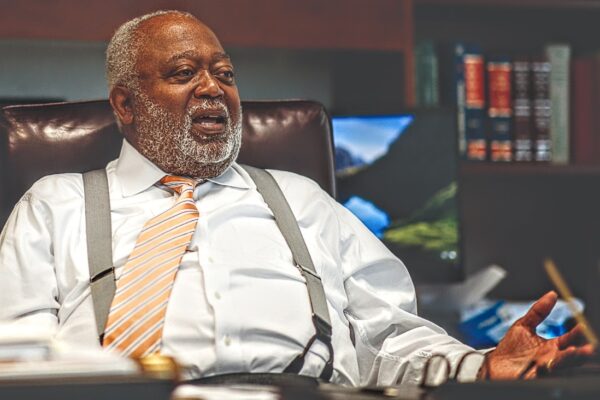
William Newman Jr., who served as Arlington’s first Black County Board member and as chief judge of the county’s circuit court, has died.
Newman died at his home yesterday (Tuesday), leaving an enduring legacy that some consider one of the most consequential in Arlington’s recent history. As word has spread, tributes have poured in.
The Arlington County Board remembered him as “a pillar of our community” in a joint statement.
“Judge Newman was a remarkable Arlingtonian, whose contributions to our community are groundbreaking, vast and inspiring,” Board members said. “His legacy will continue to serve as a beaming example of public service, leadership and dedication to Arlington.”
One of the first to be informed of the judge’s death was Clerk of the Court Paul Ferguson. Ferguson, who, like Newman, served on the County Board, told ARLnow that Newman occupied a unique place in local civic life.
“The totality of Bill Newman’s career makes him the most consequential leader in Arlington’s modern history,” he said. “Arlington will miss him and he will always be remembered.”
Using segregation as motivation
Newman grew up in the 1950s and 60s in the African-American enclave of Nauck, now known as Green Valley. His school years spanned the period when Arlington and the rest of Virginia moved from segregation to integration in public education.
In 2013, when Newman was honored with the William Winston Award, the highest accolade of the Arlington County Board Foundation, a story was relayed about his early experiences with injustice — and how he turned that into a passion for service.
According to coverage from the 2013 event:
The story goes this way: When 12-year-old William Newman, Jr., learned that the U.S. Congress in 1964 had passed the Civil Rights Act, he jumped on his bicycle, traveled to a drugstore down the way in Arlington, went directly to the lunch counter (where black patrons previously hadn’t been permitted to sit), and ordered a hamburger.
Perhaps he didn’t know it at the time, but young Billy Newman had reached a crossroads in his life.
“He could have turned back from the experience [of segregation] very bitter, but that’s not who Judge Newman is,” said David Oblon of the law firm Albo & Oblon, president of the Arlington County Bar Foundation.
Oblon would later follow Newman onto the bench, serving as a Circuit Court judge in Fairfax County.
A legal career, politics, then judicial robes
Embracing his passion as an actor, the Wakefield High School Class of 1968 graduate went on to earn a bachelor of fine arts degree from Ohio University in 1972. In 2024, he was invited back to the university, delivering the keynote address at its undergraduate commencement.
After graduation, Newman supported himself with acting jobs until he had the funds to attend Catholic University’s Columbus School of Law.
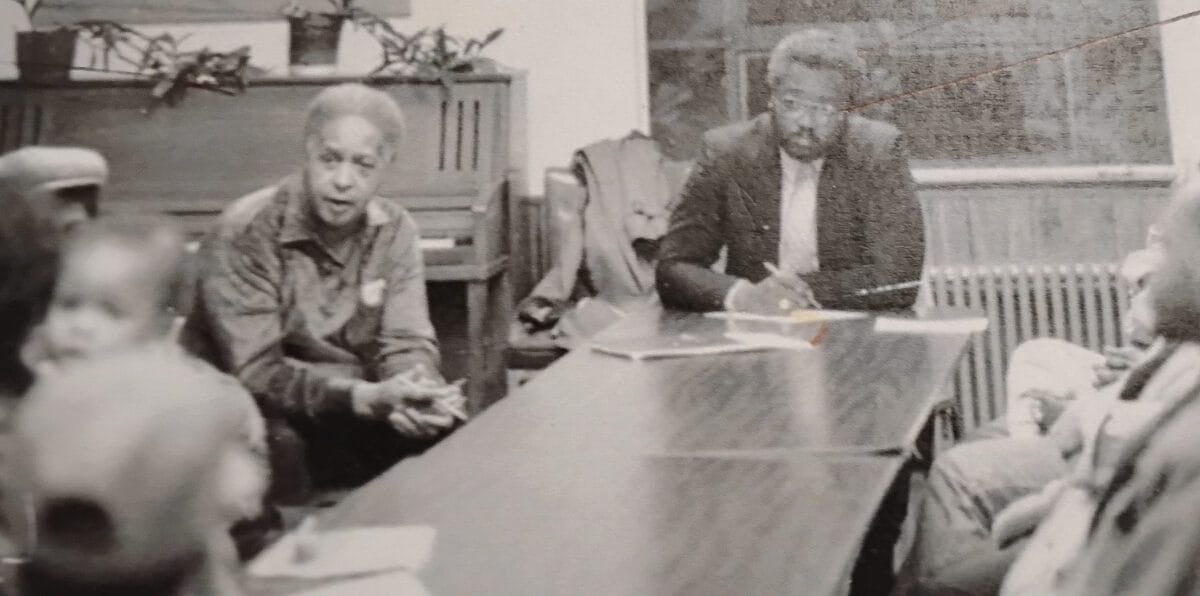
Upon graduation, Newman toiled as a trademark attorney with the U.S. Department of Commerce before entering private practice. He would go on to found the Northern Virginia Black Attorneys Association.
In 1987, when two County Board seats were on the ballot, Democrats Newman and Albert Eisenberg defeated Republican-leaning independents Jane Bartlett and Dorothy Grotos. In 1991 re-election bids, they defeated a trio of opponents.
Newman was the first Black Arlingtonian to serve on the County Board since its establishment in the 1930s.
While serving on the Board in 1993, Newman was encouraged by colleagues to put his name forward as a contender for an open 17th District Circuit Court seat, serving Arlington and Falls Church. In Virginia, the selection of judges is in the hands of the General Assembly, with local bar associations often having significant impacts on the decisions.
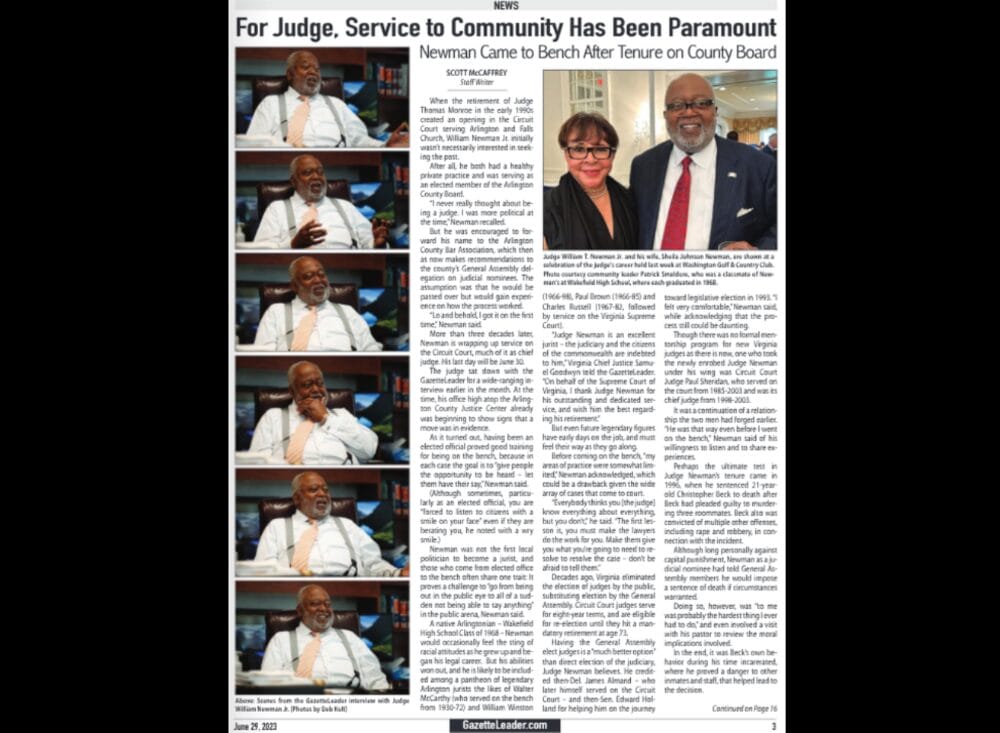
“I never really thought about being a judge,” Newman told the GazetteLeader in an interview just days before his retirement in June 2023. “Lo and behold, I got it on the first time.”
In 2003, after a decade on the bench, Newman was elected by his colleagues as chief judge. He would hold the post until his retirement in mid-2023.
His most difficult decision on the bench
At the time of his retirement, Newman was praised by then-Virginia Chief Justice Samuel Goodwyn as “an excellent jurist.”
“The judiciary and the citizens of the commonwealth are indebted to him,” Goodwyn said.
In the GazetteLeader interview, the retiring judge said his most difficult moment on the bench came in 1996, when he had to decide whether to sentence 21-year-old Christopher Beck to death for a 1995 case that involved triple homicide, rape and robbery.
Newman was philosophically opposed to capital punishment, but had promised the legislature when first appointed that he would impose it if warranted.
After speaking with his minister for guidance, Newman concluded the penalty was appropriate. He imposed the sentence; Beck was executed by lethal injection in 2001.
In the GazetteLeader interview, Newman said he was pleased that the General Assembly had abolished the death penalty. No judge or jury should be compelled to decide between life and death, he said.
Serendipitous reunion leads to wedding bells
William Newman had met Sheila Crump Johnson when they were members of the Negro Ensemble in the theatrical production “Ceremonies in Dark Old Men.”
Years later, Newman was the judge presiding over the 2002 divorce proceedings between Johnson and her then-husband, Robert Johnson, with whom she had cofounded Black Entertainment Television.
After their chance courtroom reunion, a three-year courtship ensued.
The couple married in 2005 in a lavish affair at Salamander Farm, Sheila Johnson’s 200-acre estate venue in Virginia’s Hunt Country. More than 700 friends and families attended.
According to coverage from Inside Weddings:
“Escorted by her son, Brett Johnson, Sheila beamed as she walked down the aisle wearing a honey-colored silk beaded gown with a magnificent hooded train designed by Bob Mackie. The 30-piece Salamander Strings orchestra, a quintet of off-duty musicians from ‘The President’s Own’ U.S. Marine Band and an organ all accompanied the way.”
The ceremony merited coverage from the New York Times, Washington Post and a host of society publications. Their partnership lasted until Newman’s death.
William Newman Jr. managed to intersperse his political and then judicial career with occasional stints on local stages.
The County Board message about his life noted: “As if Mr. Newman’s talents could not stretch further, he was also a gifted actor and member of Actors’ Equity and Screen Actors Guild.” In 2021, he portrayed playwright August Wilson in the autobiographical “How I Learned What I Learned” at Avant Bard Theatre.

What made Newman special?
Ferguson, in comments to ARLnow, said Newman lived life to its fullest:
“I will remember the kindness he showed to everyone he came across, whether in person or in the courtroom. His favorite stories were those from when he was practicing law, including representing clients who were unable to pay. He also remembered those who assisted him as a young attorney.”
“His passion for the theater was always with him. It amazed me that he could sit in trial all day, then go to a practice or performance at night for months at a time.”
“His devotion to his wife, Sheila Johnson, was absolute. When I asked him a few years ago what his favorite book was, he said, ‘You are going to laugh, because it is Sheila’s book [“Walk Through Fire”].’ It is a book that also influenced me, and I enjoyed reading the details of their wonderful love story.”
On a personal note, Ferguson relayed the time he and the then-new judge were attending a party in 1994 hosted by a law clerk.
“He mentioned to me that ‘the attorney over there did a good job in my courtroom the other day.’ I decided to introduce myself, and that is how I met my wife, Karen Keyes,” Ferguson said.

Founding the Arlington Community Foundation
In January 1991, when Newman’s colleagues selected him to chair the County Board, he announced plans for what would become the Arlington Community Foundation.
“Let us resolve to give a little more of our time, our money and our talent back to the community,” he said in remarks at what then was the Board’s tradition of New Year’s Day organizational meetings.
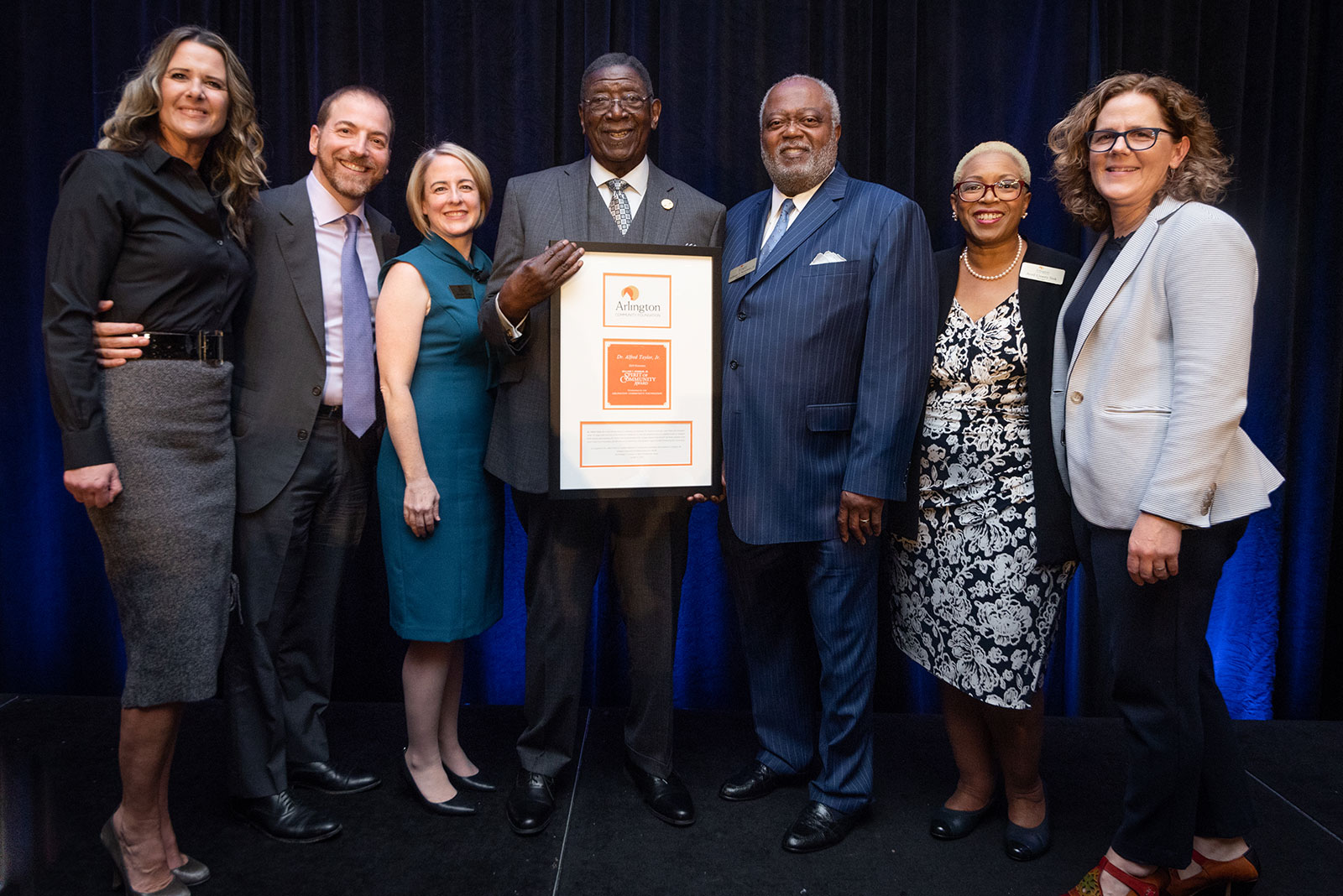
Newman served as the foundation’s chairman for many years, and the organization’s annual William T. Newman Spirit of Community awards are named in his honor.
Jennifer Owens, president/CEO of the community foundation, told ARLnow that Newman “was motivated by his deeply held belief that Arlington has all the ingredients necessary to be a shining example of a just, generous and compassionate place where everyone can thrive.”
She added:
“As a trailblazing member of the Arlington County Board, a tireless judge, and the founder of Arlington Community Foundation, he touched virtually every corner of this community. When he spoke, everyone in the room listened. When he acted, people followed his example. He put in the work to build and steward the foundational elements of a strong community that will benefit this place he loved for generations to come. The deep loss we feel today is a testament to the depth and breadth of the legacy he leaves behind for all of us.”
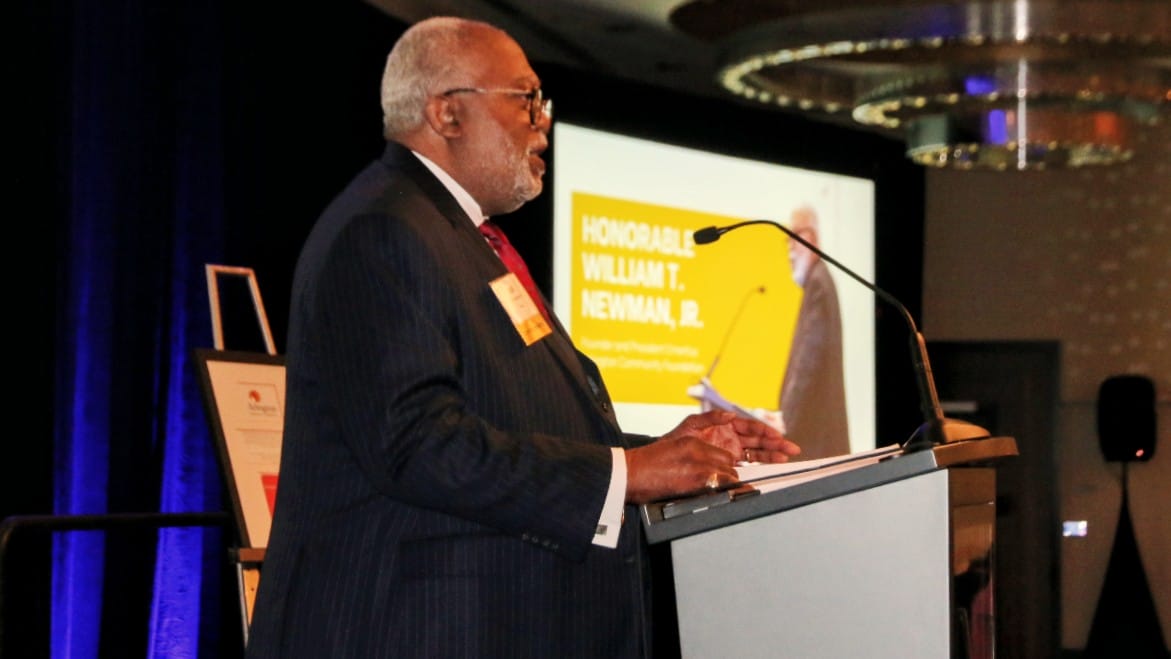
Last November, more than 550 community leaders gathered at the Renaissance Arlington Capital View Hotel for the presentation of the 2025 William Newman Jr. Spirit of Community Awards.
“The heart of our community is our people,” Newman said in introductory remarks at the event.
Speaking at the same event two years earlier, Newman recalled his own childhood under segregation.
“It was a disorienting experience for a child,” he said. “Just across the river was Washington, D.C., which was integrated.”
While across the Potomac in D.C. on trips with his mother, they would visit a lunch counter for cheeseburgers and Cokes, he told the audience. In Arlington, no such service was available to Black patrons, he said, remembering the confusion he felt in being denied service at the restaurant in the basement of Kann’s Department Store in Virginia Square.
That experience never left him, Newman said, but motivated him to work for better tomorrows.
“We are called to continue fighting the good fight, [to] create a future we can be proud of,” he said at the 2023 event.
