

For nearly 65 years, Arlington County Board members rang in the new year with a Jan. 1 organization meeting.
Often drawing large crowds and extensive media coverage, the event was a chance for county leaders to lay out their priorities for the coming year after first voting in a chair to serve for the 365 — sometimes 366 — days ahead.
While a number of her colleagues and some in the community objected, the tradition came to an end in 2017 at the behest of 2016 County Board Chair Libby Garvey. Her view was that having staff come in on the holiday for the meeting was unreasonable.
To date, there has been no push to resume the gatherings on Jan. 1. But just because the tradition is gone does not mean it’s forgotten.
With the help of media archives and some of the participants themselves, some of the more interesting tidbits from New Year’s Day meetings can be brought back to life.
A history shrouded slightly in mystery
The newspaper archives proved a little murky on when, precisely, Jan. 1 became the date of County Board organizational meetings. One of those who has a grasp on the history of the tradition is former County Board member John Milliken.
Milliken was elected in 1980, chaired the Board twice in 1985 and 1988 and served until his appointment as Virginia’s secretary of transportation in 1990.
Milliken told ARLnow he first became involved in local governance in 1973, and even then, “the tradition of holding the annual organizational meeting of the County Board on New Year’s Day was already a part of the annual rhythm of county politics.”
Milliken researched the issue and found that the tradition of a New Year’s Day meeting dated back to 1953. Before that, “the organizational meeting occurred as early as the 1st and as late as the 13th,” he said.
The one exception to the New Year’s Day rule came if Jan. 1 occurred on a Sunday, when the meeting would be held on Monday, Jan. 2.
During the years that tradition was in place, the never-on-Sunday rule impacted organizational meetings in 1961, 1967, 1978, 1989, 1995 and 2006.
In 1981, the County Board members temporarily abandoned the New Year’s Day tradition. But after four years, “sanity was re-established,” Milliken said, and the Jan. 1 meetings resumed in 1985.
While Milliken said there were good reasons to ring in the new year with a meeting, it doesn’t appear the tradition’s elimination either in the 1980s or in 2017 caused him any lost sleep.
“Each political generation has to find its own rhythm,” he told ARLnow.
There is also some murkiness over whether 11 a.m. had always been the start time for the New Year’s Day meeting. Some references from decades ago suggest there may have been an earlier start, but it had been 11 a.m. since at least the 1960s.
The New Year’s Day events typically drew a good media turnout, given the limited number of newsworthy items on Jan. 1. News reports often described attendance as “more than 100” or “a full house.”
Some years, there would be a modest, government-sponsored reception outside the Board room. After that, a Democratic leader would host an open house for the party’s rank-and-file and leadership, along with those in the nonpartisan but Democratic-leaning Arlingtonians for a Better County (ABC).
At various times, Joseph Fisher, Larry Roberts, Jay Fisette and Mary Hynes opened their homes to the gatherings.
“Many people brought bread, butter, cheeses, hot cider (and other goodies), and good cheer abounded,” Milliken recalled. “While it was a celebration for the Democrats and ABC, several of the active Republicans often attended.”
Did Board members like the tradition?
ARLnow contacted several former County Board members to gather their perspectives on the tradition.
Mary Hynes: “I always thought the New Year’s Day organizational meeting was a good way to start the year. As a School Board member for 12 years, I listened carefully to see where APS would stack up in the Board member remarks. And, once I joined the County Board, I found coming together to talk as a Board about what we hoped to accomplish in the next 12 months did indeed set the stage for the public.”
“Outweighing all the angst over the holiday week about delivering a succinct, focused message, was the fact that not much news was made elsewhere on Jan. 1! That meant that what we said was regularly reported on — it was, in my opinion, hard for most Arlingtonians to miss what their local-government leaders were setting out to do.”
Libby Garvey: “It is my understanding that the tradition came about as a way for Arlington County to get some press, because that meeting was about the only government news happening on New Year’s Day. With the rise of social media and the 24/7 news cycle, that timing lost its purpose.”
“What stayed was the way it demanded hardworking people, both staff and Board members, to lose one of the most important holidays of the year, which is a much-needed day to relax and be with family and friends: New Year’s Day. When I was chair, I saw no benefit and a lot of harm in the New Year’s Day meeting, so I moved it to the first business day after New Year’s.”
Paul Ferguson: “Preparing remarks for the Jan. 1 Board meeting and having to cut short family visits (on my wife Karen’s side, as my family was and is still local) was always difficult. However, during the Jan. 1 meetings I always felt part of a special tradition.”
“Also, since it was a slow news day, there was always the possibility and thrill of being on the front page of The Washington Post, which happened to me during my last year on the County Board in 2007.”
Jay Fisette: “I always accepted, and came to enjoy, Arlington’s unique tradition of meeting on Jan. 1. Though it severely constrained any personal desire to celebrate late into the night when ushering in the new year, any personal sacrifice seemed balanced out by the community cohesion and camaraderie that the tradition enabled.”
“It was one more way that Arlington is special.”
Barbara Favola: “My first full year on the Arlington County Board started in January 1998. At that time I was advised that our Jan. 1 organizational meetings gave our constituents and the press the opportunity to imagine a new year in county government that would be shaped by the priorities of the incoming Board chair.”
“For years, the progressive members of the County Board (often in a 3-2 majority) felt the Jan. 1 meetings gave them a unique opportunity to garner outsized press coverage, since the news cycle around the holidays was slow and reporters were looking for items to fill their columns.”
“I have to say that at this point in Arlington’s political evolution, the past reasons for a Jan. 1 organizational meeting are not as relevant. Personally, I am supportive of the new approach adopted by the County Board. I know that the Jan. 1 meetings were very inconvenient for county staff, and with numerous social-media platforms now available, County Board members have plenty of avenues to engage constituents and offer a vision for future policies.”
John Milliken: “Why Jan. 1? In policy terms, it allowed a public and press focus on the Board and, in particular, on the policies laid out in the chairman’s remarks. Local newspapers and The Washington Post attended regularly, joined, on a number of occasions, by a TV crew or two. Unless there was a cat being rescued from a tree somewhere, there wasn’t much else going on that day.”
“The times were different. Politics was less brittle. Most Board members were friends and, for the most part, maintained cordial relationships with those in the other party.”
John Vihstadt: “I fully supported 2016 County Board Chair Libby Garvey in her move to change the decades-long tradition of the annual organizational meeting from New Year’s Day to the next business day following Jan. 1.”
“In my view, the New Year’s Day meeting was an anachronistic and egotistical way for the Board to gain outsized attention by convening on a slow news day. Yet for most Arlingtonians, apart from political groupies, Jan. 1 is always a day when family, friends and New Year’s resolutions are top of mind — not politics and politicians.”
Highlights from some of the meetings
Drawn from the archives of the Northern Virginia Sun, here are some highlights from Jan. 1 meetings of years gone by.
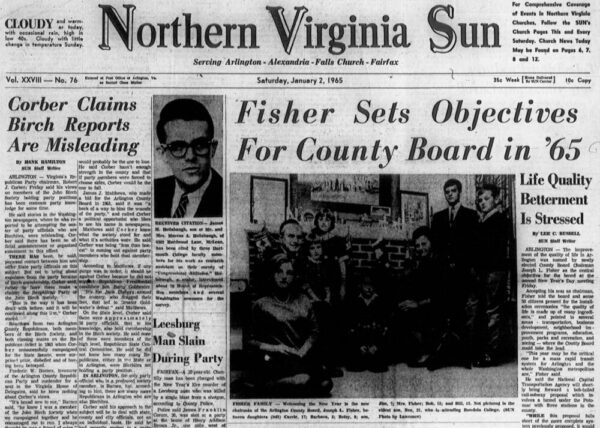
1965: Time to get rolling on transit
The front page of the first Northern Virginia Sun edition of 1965 showed new Board Chair Joseph Fisher, his wife Peggy and six of their seven children (the seventh being away at college).
Upon his elevation to chair, Fisher used his Jan. 1 remarks to press for improving the local quality of life.
He said the coming year would be a critical one for developing a planned regional mass-transit system that included subway service. “Arlington must support this,” Fisher said, though he noted that the proposal under consideration wasn’t everything county leaders desired.
Fisher said he would support continued redevelopment efforts in Rosslyn and push for similar initiatives in Clarendon through a joint initiative with the business community.
He also voiced support for growing the Northern Virginia Regional Park Authority, and suggested either the county government or a regional consortium should purchase the Arlington Hall site from the federal government, using it for higher-education facilities.
Noting that the five County Board members had differing views on various issues, “we shall continue to agree on the proposition that the welfare of the Arlington people is of the first importance,” the new chair said.
Fisher would continue on the Board until elected to Congress in 1974, unseating venerable incumbent Republican Joel Broyhill. Fisher himself would be unseated by Republican Frank Wolf in 1980, a victim of the region’s discontent over the economy and the Carter administration.
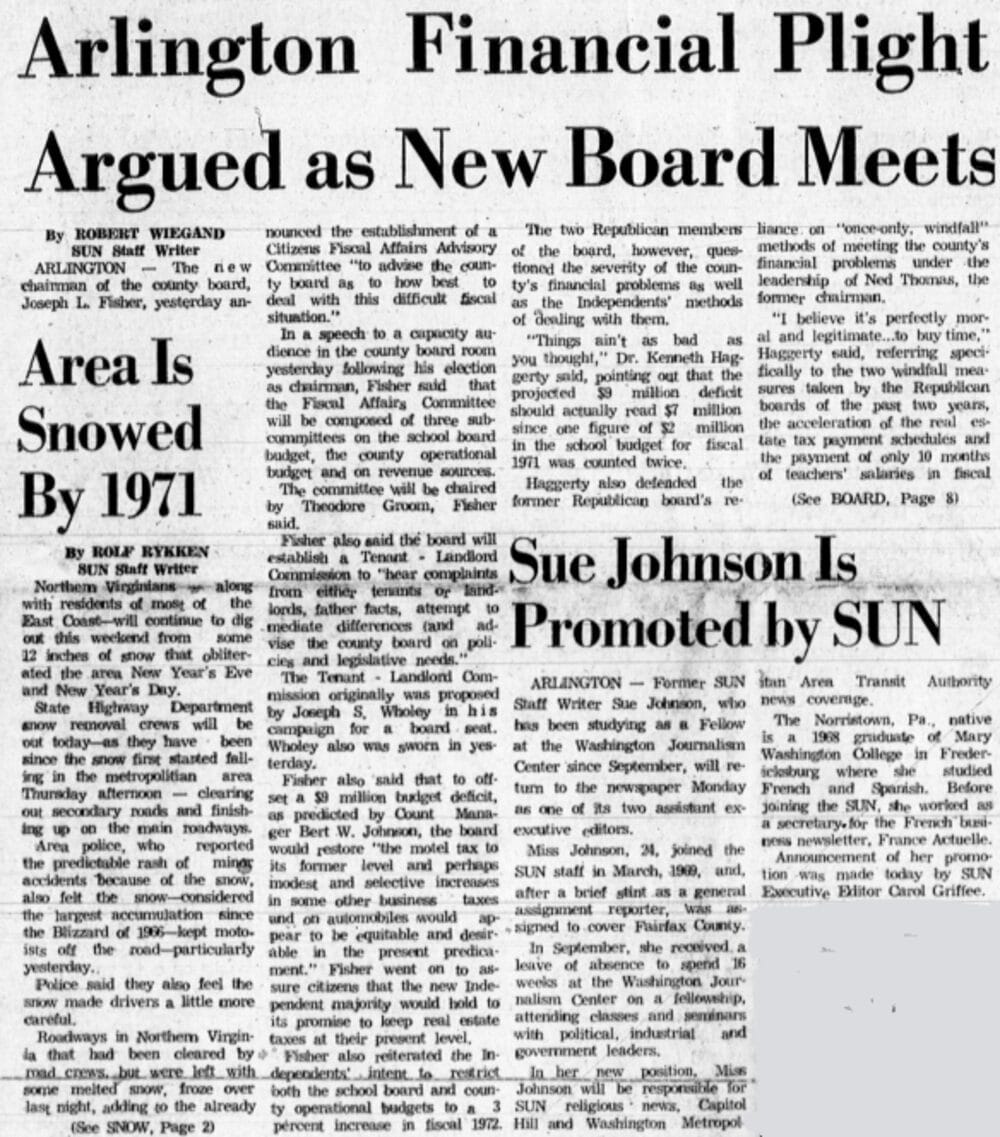
A snowy start to governance in 1971
The Board’s New Year’s Day meeting took place despite what, over the preceding two days, had been the snowiest period for the local area since the blizzard of late January 1966.
Joseph Fisher, back for a new term as chair, used the meeting to announce several new advisory panels, including the Fiscal Affairs Advisory Commission and Tenant-Landlord Commission.
He pushed for a solution to the controversial Interstate 66 proposal, seeking ways to design the project to avoid increasing air pollution.
Fisher noted that the county government faced a projected $9 million budget gap for the coming fiscal year, and recommended rescinding various previously enacted cuts to business taxes. The new chair urged “modest and selective” increases in tax sources.
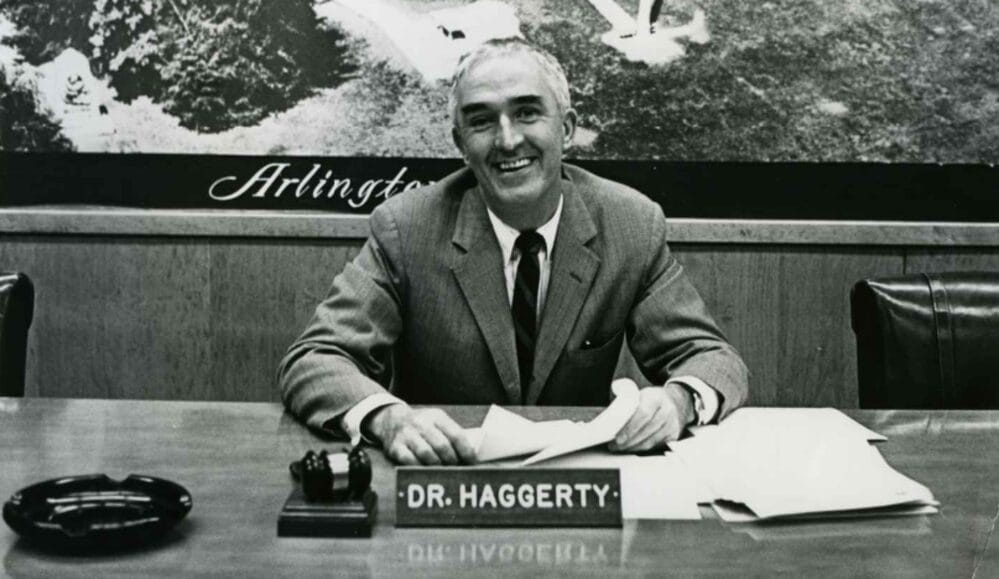
That position drew rebukes from the two Republicans on the Board — A. Leslie Phillips and Dr. Kenneth Haggerty — who suggested the Democratic/ABC majority was crying poverty unnecessarily and in order to raise taxes on an overtaxed public.
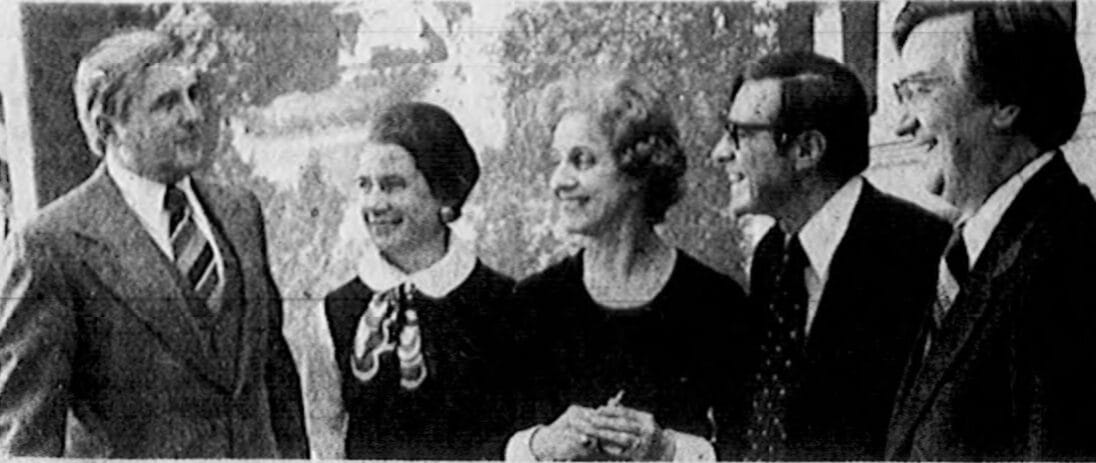
The ‘Bicentennial Squeeze’ of 1976
Elected in November 1973 as an ABC candidate, Ellen Bozman was tapped to serve as Board chair on Jan. 1, 1976.
While the year would be remembered as the nation’s 200th birthday, it also became known for what Bozman termed the “Bicentennial Squeeze” of inflation and a stalled national economy.
“There’s no easy way out of it,” the new chair said on Jan. 1 before what the Sun reported was a standing-room crowd.
Bozman was only the fourth woman in county history to chair the County Board, preceded by Elizabeth Magruder, Florence Cannon and Leone Buchholz. She was the first female Board chair in 22 years.
Bozman was presiding over a body that had seen the election, just two months before, of two Republicans: Dorothy Grotos and Walter Frankland. That narrowed ABC/Democratic representation on the body to three: Bozman, John Purdy and Joseph Wholey.
In her remarks, Bozman called on the General Assembly to give localities more autonomy in determining how to raise revenue, and sought additional funding sources for the Metro system. Both those topics will be part of the 2026 General Assembly session just as they were in 1976.
Bozman said 1976 would prove a year for “perfecting old systems and trying new arrangements to accomplish community goals.”
Bozman ultimately held office for six terms totaling, 24 years. The longest County Board tenure in Arlington history, it was one reason the county government’s headquarters building is named in her honor.
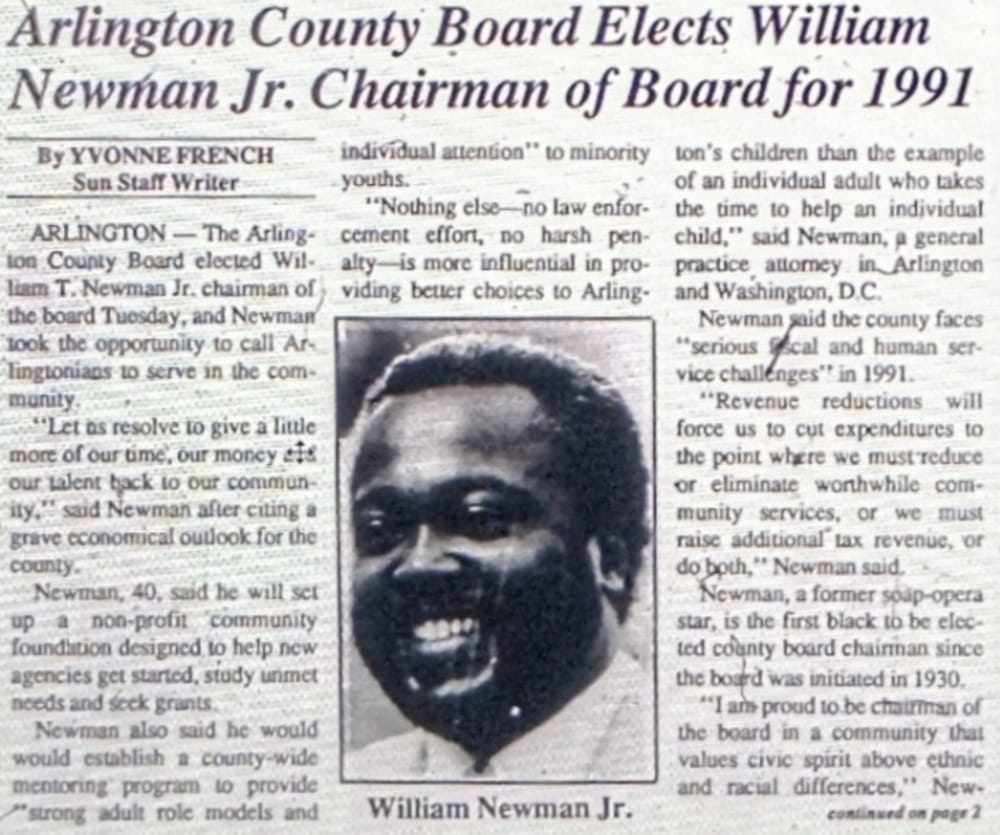
Commitment to community service in 1991
As a child, William “Billy” Newman Jr. grew up in a segregated neighborhood of Arlington, but rose above the challenges to become a standout leader in his hometown.
On Jan. 1, 1991, Newman rotated in as Arlington’s first Black Board chair, welcomed by a crowd of more than 100 and calling for local residents to commit themselves to serving Arlington.
“Let us resolve to give a little more of our time, our money and our talent back to the community,” he said in New Year’s Day remarks.
Newman backed up those words with an announcement that he planned to create the Arlington Community Foundation, which could serve as a repository for community-service dollars and scholarship funds to help those in most need.
Local efforts would be needed in a year that presented “serious fiscal and human-services challenges,” Newman said in his Jan. 1 address.
The meeting marked the first on the Board for James Hunter III. Also an Arlington native, Hunter had long been a civic leader before seeking public office.
In his remarks, Hunter said that “each of us has something to contribute, regardless of our age, race or economic status.”
Hunter would remain on the Board until 1997, when he resigned due to ill health. He died in January 1998, having been succeeded by Barbara Favola in a late-1997 special election.
The General Assembly elected Newman as a judge of the 17th Circuit Court in 1993. He became chief judge in 2003 and remained on the bench until retiring in 2023, earning accolades for his demeanor and skills.

2001: A year ends far differently than it began
Elected in 1997 as Virginia’s first openly gay local official, Jay Fisette rotated in as Board chair in 2001 with a focus on harnessing the ongoing technological revolution for the betterment of civic life.
Fisette said he wanted the local government to be more responsive and accessible to the public.
“Technology is simply a tool, and technology is meaningless without a purpose,” Fisette said in Jan. 1 remarks. “We must provide digital opportunity for all.”
The year 2001 was also celebrated as Arlington’s bicentennial, in a way. It marked the 200th anniversary of the incorporation of what today is Arlington County and neighboring Alexandria into D.C. Both were returned to Virginia sovereignty in 1847.
Celebrations throughout the community were planned for the entire year, led by a task force under Margaret Lampe and Talmadge Williams.
From a community parade to special events of all kinds, the celebration was extensive. But business as usual in local life ended abruptly on Sept. 11, 2001, when Arlington was among the localities most impacted by the 9/11 terrorist attacks.
That was all in the future at the Jan. 1 meeting, however, when civic leaders gathered to cut a ceremonial cake ringing in the new year and the county’s bicentennial celebrations.
Fisette became a public face of Arlington’s resilience in the months after 9/11. He served in office until 2017, the second-longest Board tenure in county history.
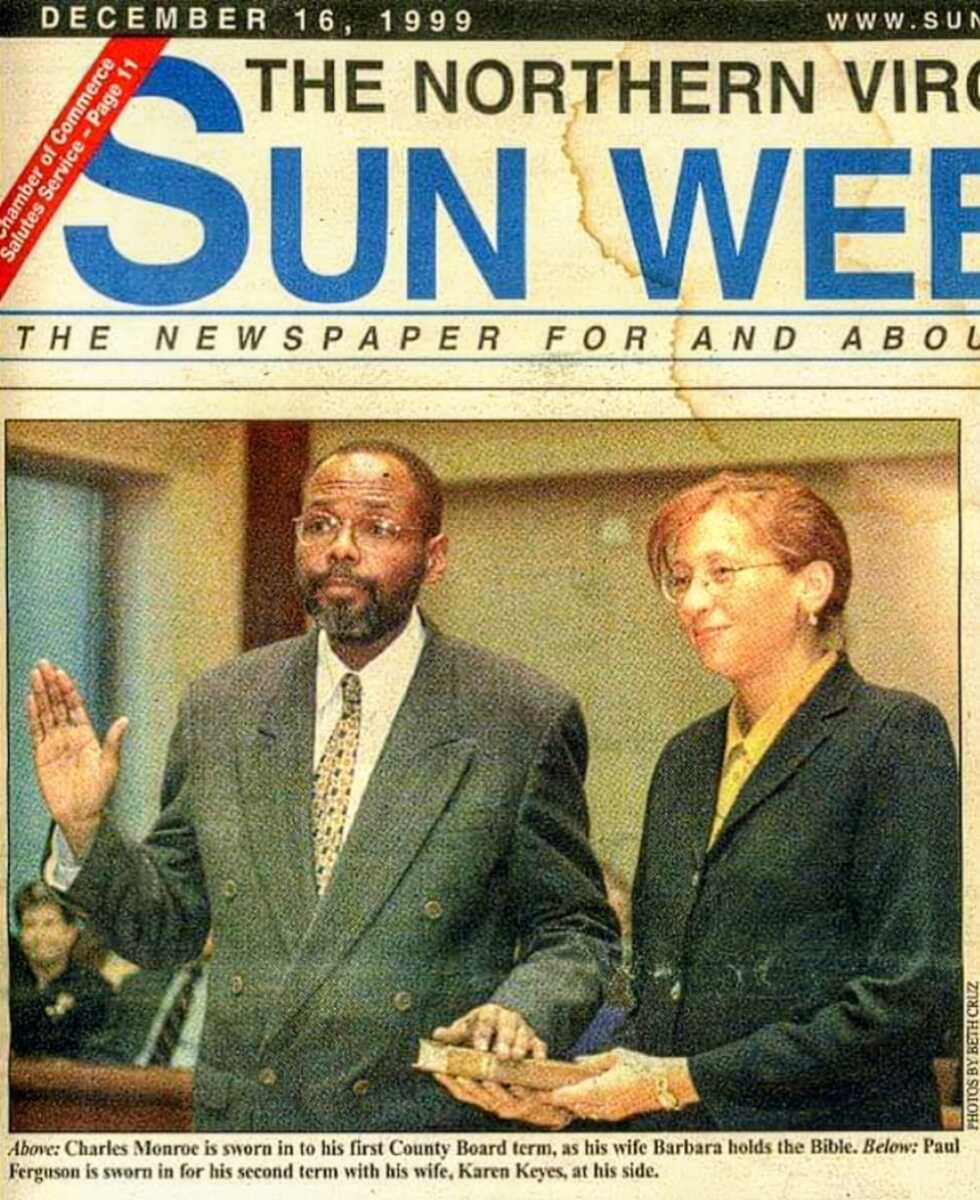
Leadership opportunity cut short in 2003
Arlington native Charles Monroe’s colleagues chose him to serve as Board chair in 2003, and on Jan. 1 laid out an agenda that included economic development with a special focus on South Arlington’s “Main Street.”
“Progress toward the rebirth of Columbia Pike has been breathtaking,” Monroe said, praising the “fervor of excitement” surrounding opportunities in that corridor.
Monroe also said he would be a champion of the “Shop Arlington” initiative and efforts to collaborate with the Arlington Chamber of Commerce on business-friendly activities.
Monroe, an attorney, came from one of the most acclaimed Arlington families. His father, Thomas, had been a judge and his mother, Eleanor, had served on the School Board. He had attended segregated elementary schools and then Yorktown High School.
“Our vision is driven by our values,” he said at the Board meeting. “We respect the dignity of those around us. We want to make sure each person is important.”
Unfortunately, Monroe’s tenure as chair was the shortest in county history.
Just three weeks later, in the middle of chairing the Board’s January meeting, Monroe collapsed and died of a stroke. He was just 46 years old.
Deaths among incumbent County Board members have been rare.
In January 1960, Board member David Krupsaw was among 37 victims when an Avianca airliner crashed at Montego Bay, Jamaica. And in April 2020, Board member Erik Gutshall died after a battle with brain cancer. He had announced his intention to resign but the paperwork appears not to have been completed at the time of his death.

2007: The first Jan. 1 spotlight for third-time chair
Paul Ferguson had twice before served as County Board chair, each time rotating into the post after the year had begun:
- In 1999, the then-Vice Chair Ferguson had stepped in as chair when, in February, Albert Eisenberg resigned in order to take a post in the Clinton administration
- In 2003, he took on the position after Monroe’s unexpected death, serving the remaining 49 weeks of the year as chair
For 2007, Ferguson was stepping into what county officials termed a challenging budget environment.
“The real-estate boom is over,” his colleague, Fisette, pronounced.
The end of that boom meant belt-tightening in county government, Ferguson said.
“There are many things we would like to do but are not going to be able to do,” he predicted.
Not that the county government’s pockets were empty. Coverage of his Jan. 1 remarks noted that 2007 was likely to be the year the county’s overall budget surpassed $1 billion for the first time.
Ferguson noted his desire to focus on issues like affordable housing, neighborhood conservation and stormwater issues — still common topics of discussion at Board meetings.
Like Monroe and Newman before him, Ferguson had grown up in Arlington. “He is a local boy who made good,” said his Board colleague, Chris Zimmerman.
Though the most senior Board member in terms of service in 2007, Ferguson that year was the youngest Board member.
Later in the year, he would be elected Clerk of the Circuit Court to succeed David Bell. It is a position he continues to hold today.
2013: A Latino-Latina county leadership duo
Walter Tejada had been elected to the County Board in 2003 to fill the seat of the late Monroe, and previously had chaired the Board in 2008.
But his ascension to the top spot again in 2013 gave Arlington a Virginia first: For the first time in any locality, the chairs of both the governing body and School Board were Latino.
Coverage of the Jan. 1 organizational meeting noted that, for the preceding six months, Emma Violand-Sánchez had chaired the School Board, which unlike the County Board sees leadership positions rotate in July.
As had been the case five years before, when Tejada became the first Latino leader of any Virginia locality, the Jan. 1 meeting brought out a large contingent of Spanish-language media.
“This is an important milestone for our county,” said Libby Garvey, who had served with Violand-Sánchez on the School Board and was then serving with Tejada on the County Board.
In his remarks, Tejada said he was proud to help the community “celebrate the ethnic and cultural diversity that makes Arlington such a fascinating and exciting place to live.”
Rebuilding frayed County Board relationships in 2015
Mary Hynes had served on the School Board before election to the County Board, and first chaired the latter in 2012.
But chairing the Board in 2015 would require special diplomatic skills, as the five-member body remained scarred by events of the preceding few months.
In November 2014, the body shocked the region by announcing it was dropping plans for the Columbia Pike streetcar project.
Hynes and (2014 Board chair) Jay Fisette had been supporters of the project. But after streetcar skeptic John Vihstadt was elected to the Board in a springtime special election and then the November general election, they switched sides to oppose it.
With Vihstadt and Libby Garvey already in opposition, the Board swung from 3-2 support to 4-1 opposition, with only Walter Tejada still backing the 5-mile-long, $350 million transit project.
Hynes said her goal for the new year was to “move beyond our recent discord — and work together.”
“Our future seems a little unsettled. 2015 will be a year of change, a year of challenges and a year of limits,” she forecast.
Acknowledging the fractures that had split Board members over the preceding year, Hynes said they hadn’t diminished her enthusiasm for the job.
“These are labors of love,” she said. “It isn’t always easy or fun, but nothing that’s really important is.”
Hynes and Tejada each opted against reelection bids in 2015. Hynes later would be appointed to the Commonwealth Transportation Board, while Tejada would serve on the board of directors of the Metropolitan Washington Airports Authority.
Thanks to the Charlie Clark Center for Local History and Library of Virginia for support with research.
