


Proposed zoning changes headed to County Board members by summer may make it easier to install electric-vehicle charging facilities across Arlington.
Proposed zoning changes include:
- For all but industrial-grade charging stations, chargers would be allowed up to the property line in all zoning districts, eliminating existing setback requirements
- Signs would be permitted on both public and private parking areas to designate spaces for EV charging only
- Spaces labeled as “EV charging only” would count toward the minimum number of parking spaces required of property owners
The goal, in the words of one county staff member, is “getting the zoning ordinance out of the way of some of these basic stumbling blocks” currently being encountered.
Members of the Zoning Ordinance Committee and Long Range Planning Committee of the Planning Commission were briefed on staff proposals at a joint March 11 meeting.
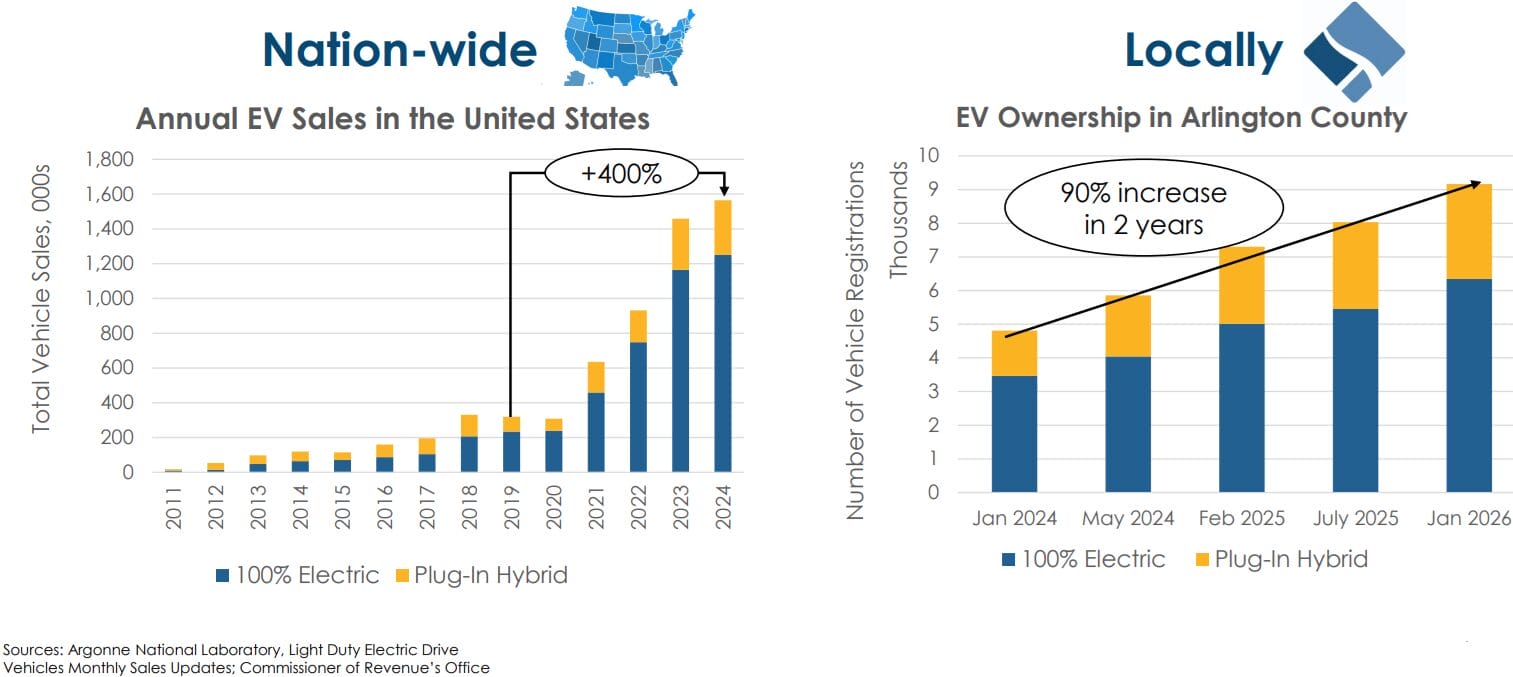
While electric vehicles represent just 5% of all vehicles registered in Arlington, the number of electric and plug-in hybrid vehicles has grown 90% in the past two years, county staff said.
Most belong to residents of single-family homes, where charging stations can be added to a garage interior relatively easily. While those living in multifamily properties make up 73% of county households, they account for only 19% of EV registrations.
The disparity represents a “stark contrast” that needs to be addressed, said Emily Nachbar of the county’s Department of Environmental Services, who conducted the March 11 briefing.
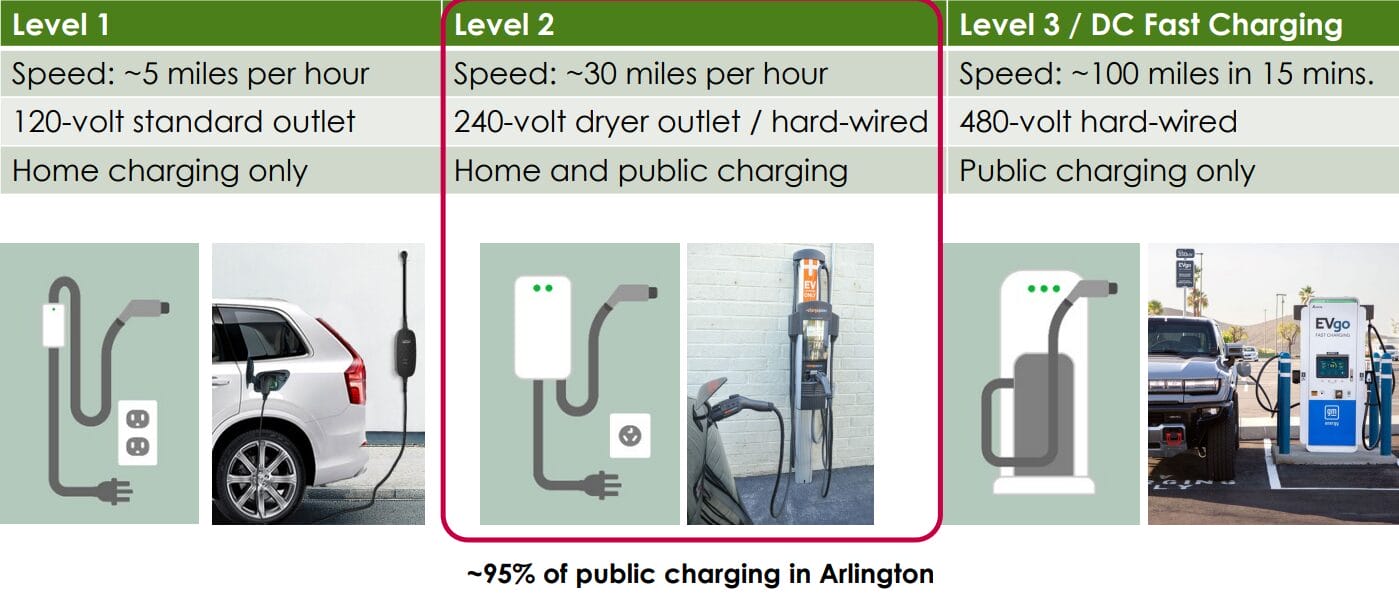
More than nine in 10 EV-charging stations in Arlington are the mid-range “Level 2” variety, which use 240 volts of electricity that can provide about 30 miles of use for every one-hour of charging.
Level 3 chargers, typically found only in high-volume public areas, use 480 volts and can provide 100 miles’ worth of charging in as little as 15 minutes.
Allowing EV charging facilities up to the property line for Level 2 stations would provide much more flexibility for owners of businesses and multifamily housing than currently exists, Nachbar said.
That would benefit those like Planning Commission member Adriana Torres.
“My building has two EV stations, but there’s 500 units,” she said.
The proposed language change allowing the placement of “EV Charging Only” spaces would permit the county government to ticket vehicles improperly occupying those spaces on public property.
That could solve a problem found at Central Library and some other county facilities. Such sites have designated EV spaces, but they can be used either by those charging or simply by those driving EVs.
If the county government started converting spaces to EV-charging only, there should be a degree of leeway during a phase-in period, Planning Commission member Tenley Peterson said.
“Maybe we put [warning] notes on people’s windshields in the first six months,” she said.
County officials do not have the ability to ticket improperly parked vehicles on private property. The likely remedy for those property owners would be towing.
Tony Striner, who chairs the Zoning Ordinance Committee, supported moving forward with considering the zoning proposals.
“This is an interesting and a very good set of changes,” he said, noting that the effort evolved out of concerns raised by community members that regulations have not kept pace with the growth in EV use.
“The community wanted us to do more,” Striner said.
Planning Commission member Peter Robinson said that despite being a proponent of EVs, he was concerned that efforts undertaken by the Trump administration and Congress could undermine momentum.
Changes over the past year included elimination of the federal tax credit for EV purchases late last year. Nachbar said that had temporarily reduced EV sales, but there seems to have been a comeback in recent months.
Robinson feared that momentum might not be permanent.
“I’m afraid that the slight rebound we’ve seen in electric-vehicle purchases may be only temporary,” he said, expressing hope that staff and county leaders were “taking that into account as we think through this.”
Striner said that having the appropriate zoning rules would provide support for those who choose to go the electric-vehicle route, no matter what that percentage is over the long term.
“We’re not forcing EVs down people’s throats, but we’re opening the door if people want to use it,” he said.
