

The “Yes in God’s Backyard” movement is celebrating after the Faith in Housing bill, supporting expedited church-based affordable housing development, has been signed into law.
Gov. Abigail Spanberger (D) signed state Sen. Jeremy McPike (D-29)’s SB 388 and Del. Joshua Cole (D-65)’s HB 1279, which will eliminate the rezoning step for faith-based organizations and other tax-exempt nonprofits to develop affordable housing on their properties. The law will take effect on Jan. 1, 2027 and will sunset on Jan. 1, 2031 unless reenacted by a future General Assembly.
Jessica Sarriot, co-executive director of Virginians Organized for Interfaith Community Engagement (VOICE), said the coalition is “thrilled” to see Faith in Housing let churches serve their neighbors with affordable homes.
“For us, this is a huge step forward in addressing a housing shortage where Virginia is missing over 300,000 homes,” Sarriot told ARLnow. “It really shows that when communities organize and leaders listen, government can actually deliver real solutions at scale, which is something I think many of us are very hungry to see in these days.”
The Faith in Housing law will allow eligible faith-based organizations who have owned the property for at least five years to pursue development by-right. The housing must be at least 60% affordable for households making up to 80% of the area median income. It also restricts development to areas where existing public water and sewer lines are within 500 feet and makes projects subject to local environmental, historic and archaeological standards.
Before signing the final bill, Spanberger offered amendments that the General Assembly accepted. One of the major amendments changes the maximum building height from the tallest building within a 500-foot radius to the tallest one not approved with a special exception. Sarriot said VOICE is looking for additional clarity on the rule.
“What that means is in places like Northern Virginia and some parts of Richmond, a lot of the significant building has been approved through a special exemption process,” Sarriot said. “So that does unfortunately lead to some ambiguity, or it’s just harder to then know what you’re able to build.”
Another amendment encourages localities to consider higher minimum densities in transit-oriented areas. Sarriot says this is something localities could include in their ordinances they will adopt to meet the law’s requirement.
“I think one hope we would have in working with our local governments in Northern Virginia is they know how needed affordable homes are, particularly in those revitalization and transit areas,” Sarriot said. “We would hope that in their ordinances, which they’re going to be working on between now and January, they would include those higher minimum densities in those kinds of areas so that projects could serve as many families and and workers as possible.”
Arlington County Board Member J.D. Spain, who advocated for the legislation, told ARLnow the end result wasn’t perfect but helps unlock unused land for attainable housing.
“Now that we’re at a point where perhaps it makes it much easier to build attainable housing through nonprofits and also with some of our religious organizations by right,” Spain said. “It helps them because this is what a lot of folks have talked about … the lengthy rezoning that was taking place was really difficult, especially in places in Northern Virginia, in Arlington. It removes, I think, one of the biggest barriers, which is the zoning delays.”
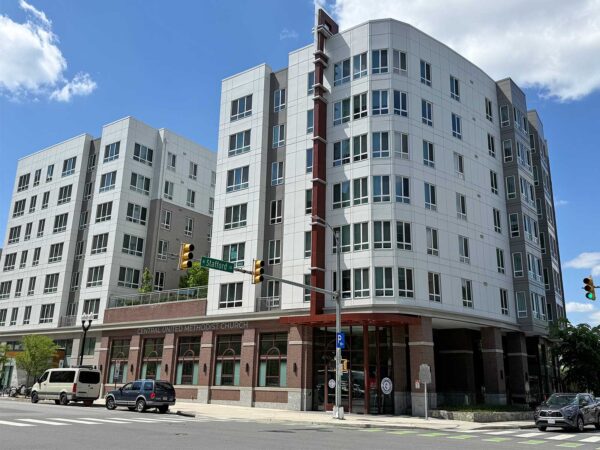
The Rev. Alice Tewell of Clarendon Presbyterian Church, which faced challenges trying to develop affordable senior housing, told ARLnow the bill eliminates a key barrier for faith-based organizations that want to pursue affordable housing — following in the footsteps of Arlington churches like Arlington Presbyterian Church and Central United Methodist Church.
“We heard from a broad coalition of school teachers, law enforcement, sanitary workers, retired people, families and young professionals seeking more housing affordability,” Tewell said. “We heard from clergy and faith leaders of virtually every Christian, Muslim and Judaic tradition speaking up that their faith calls them to help to build housing.”
Spain said county staff are analyzing the law to determine how it will be implemented in Arlington County. He believes the element of community input will remain through the planning process, despite the rezoning step being cut.
“I would just encourage folks to have an open mind about this law, find ways to work together in unity but also voice their concerns, should they have any,” Spain said. “But this is the law, at least for the next couple years, until if and when it’s sunset.”
Looking forward, VOICE is going to continue its advocacy on the local ordinances and ensure church leaders are informed about the law. Sarriot said churches in the development process could choose to start a new application when the law takes effect in 2027, or use it to catalyze an existing proposal.
While Clarendon Presbyterian Church has not decided if it will bring back its development proposal, Tewell has one ask of elected officials to foster church-based affordable housing.
“One of our next steps is for the governor, the General Assembly, and local governments to work together to budget for more financing for these homes for the public good,” Tewell said. “I hope to see a collaborative effort for more financial investment in building homes for Virginians across the commonwealth.”
