

Nearly 48,000 Arlington vehicles will not be charged any car tax this year, an increase of 32% from 2025, based on tax changes made by County Board members during the fiscal 2027 budget process.
For those that will be taxed, some owners will pay less while others — particularly those owning clean-energy vehicles — will pay more.
“It is a complicated subject, with lots of moving parts,” county Treasurer Carla de la Pava told ARLnow.
The county government again this year will receive about $31.2 million from Richmond to offset taxes on vehicles for personal use. The funding dates back to 1997, when Republican Jim Gilmore won election as governor under a “no car tax” slogan.
That $31.2 million sent from the state government to Arlington has been unchanged for two decades. Over that time, County Board members have made changes to how the funding is allocated.
Major alterations for this year include the following:
- The first $4,000 of a vehicle’s value will be exempt from tax, up from a $3,000 exemption last year
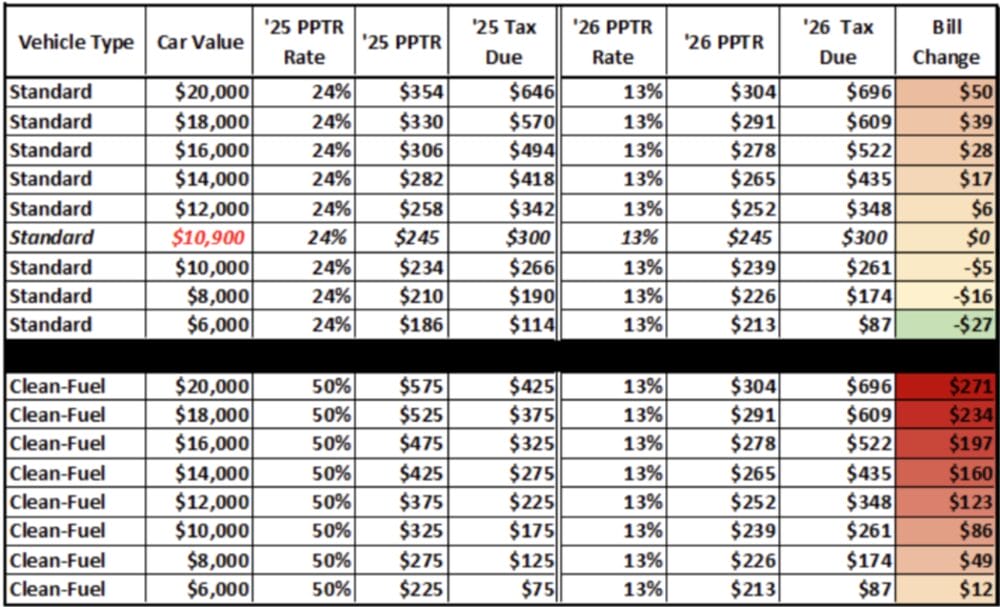
- The rebate for the next $16,000 of value will be 13% — a decline from 2025 subsidies of 24% for gas/diesel powered vehicles and 50% for clean-energy vehicles
The value of vehicles in excess of $20,000 will be billed the full tax local rate of $5 per $100 valuation, as assessed by the Commissioner of Revenue’s office.
The upshot? “The owner of a standard fuel vehicle below a value of $10,900 will actually pay less tax in 2026 than they did in 2025,” said de la Pava, whose office is responsible for collecting the taxes, but has no role in setting the rates.
Owners of approximately 25,000 clean fuel vehicles who are eligible for Arlington’s tax relief will not be so lucky.
Since the subsidy is reducing from 50% to 13% in that category, all clean fuel owners with vehicles assessed at $6,000 or more will be paying more tax.
The owner of a clean fuel vehicle assessed at $20,000 will pay $696 this year, up 64% from $425 in 2025. For the owner of a standard vehicle assessed at $20,000, the tax would also be $696, but it would represent a year-over-year increase of just 7.7% from $646 in 2025.
For more expensive vehicles, the tax burden can be significant, according to an online calculator offered by the Commissioner of Revenue’s office:
- The 2026 tax due on a a $30,000 vehicle is estimated at $1,196
- Tax due on a $50,000 vehicle is $2,196
- Tax due on a $75,000 vehicle is $3,446
Overall, subsidies through the state’s Personal Property Tax Relief Act of 1998 will mean no taxes on an estimated 47,800 vehicles in Arlington, de la Pava said. That’s an increase from 36,300 last year, and represents nearly one in four vehicles garaged in the county.
After Gilmore defeated Democrat Don Beyer for governor in 1997, it transpired that turning the “no car tax” slogan into public policy was not as easy as Republicans might have hoped.
Because localities rely on the tax for significant revenue — more than $150 million annually in Arlington’s case — local-government leaders statewide successfully lobbied the General Assembly not to abolish it. Instead, the state government annually provides localities grant funding to offer tax rebates.
In his fiscal 2027 budget proposal, County Manager Mark Schwartz recommended increasing the tax exemption from $3,000 to $4,000 while providing rebates of 14% for conventional vehicles and 40% for clean fuel vehicles for the next $16,000 of value.
During the budget process, County Board members asked for a range of options, ultimately settling on the 13% rebate for both types of vehicles.
The decision represented a triumph of the Board’s equity goal — lowering the tax burden on those of lesser means, who typically own less costly vehicles — over its longstanding support for clean fuel vehicles.
When the state grant funding began in the 1990s, it was able to cover 70% of taxes on eligible Arlington vehicles. But because the $31.2 million in funding to Arlington has not increased since 2006, that subsidy rate has declined through the years.
In Arlington, the Commissioner of Revenue’s office recently updated vehicle valuations for 2026. Tax bills, which will be sent out later, are due Oct. 5.
Photo via Marek Studzinski/Unsplash
