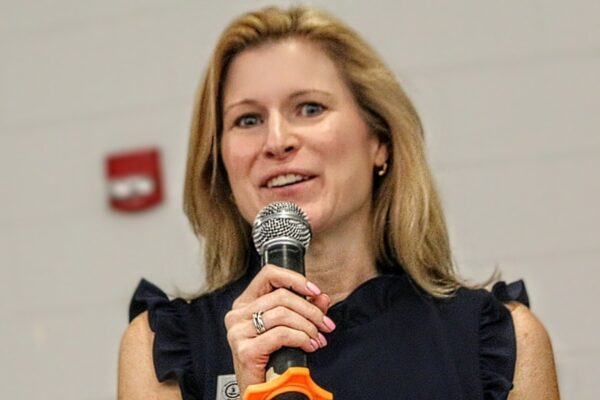
Treasurer Kim Rucker speaks to Arlington Democrats (staff photo by Scott McCaffrey)
Arlington’s tax-delinquency rate ticked up slightly over the past year, but remains at a level the county’s new treasurer says is not cause for worry.
The county’s 0.2% delinquency rate for fiscal year 2026 was up just a hair from 0.18% in 2025 and 0.17% in 2024, Treasurer Kim Rucker told ARLnow on Sept. 21.
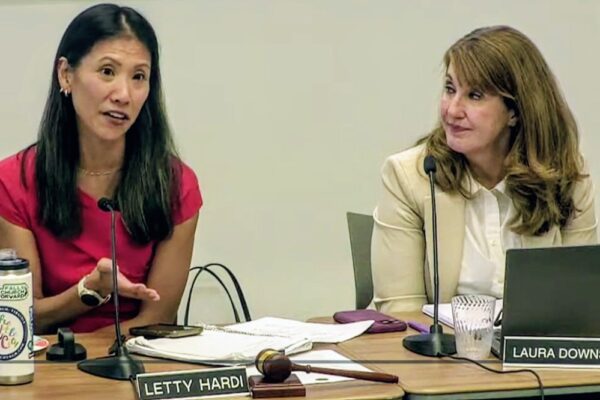
Mayor Letty Hardi and Council member Laura Downs (screenshot via City of Falls Church)
Falls Church City Council members have begun cautious discussions about a possible new tax on commercial and industrial property owners.
Under state law, the city has the ability to levy a surcharge of up to 12.5 cents per $100 assessed valuation on non-residential properties, so long as the funding supports new transportation initiatives.
Rosslyn skyline and the Potomac River, as seen from Georgetown (staff photo by Angela Woolsey)
Arlington’s commercial real estate market has many challenges, but one factor working in its favor may be D.C.’s tax code.
Taxes across the Potomac have come into the crosshairs of Republican lawmakers since a wave of progressive politicians swept the Democratic primaries in D.C.
Shopping for back-to-school supplies and other items will be cheaper in Arlington during a statewide sales tax holiday this weekend.
The three-day holiday, which lasts from Friday to Sunday, temporarily lifts the sales tax on clothing, footwear and school supplies, as well as emergency preparedness products and some appliances.
Electric-vehicle charging (via Marek Studzinski/Unsplash)
Owners of electric vehicles may have to pay more for a charge at Arlington County facilities starting later this year.
The County Board has directed staff to prepare an ordinance to increase charging rates from the current 17.46 cents per kilowatt-hour (kWh) to 30 cents per kWh.
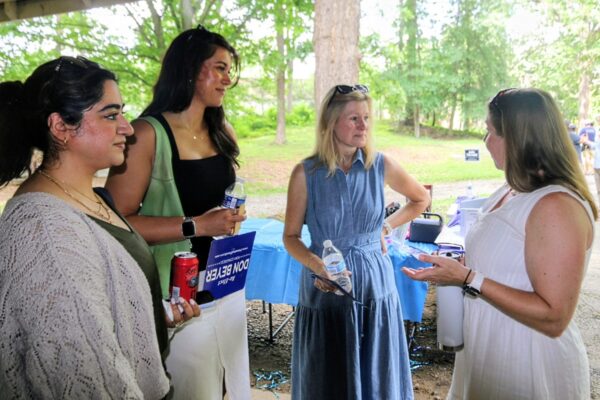
County Treasurer Kim Rucker, second from right, speaks with Commissioner of Revenue Kim Klingler, right, and constituents at Democratic Committee's July 11 picnic (staff photo by Scott McCaffrey)
Arlington’s new treasurer expects the county’s numbers on tax delinquency to remain on par with last year’s.
Given the region’s challenging current economic realities, “it will be a great accomplishment to keep it where it was,” Treasurer Kim Rucker told members of Arlington Senior Democrats at a July 14 luncheon.
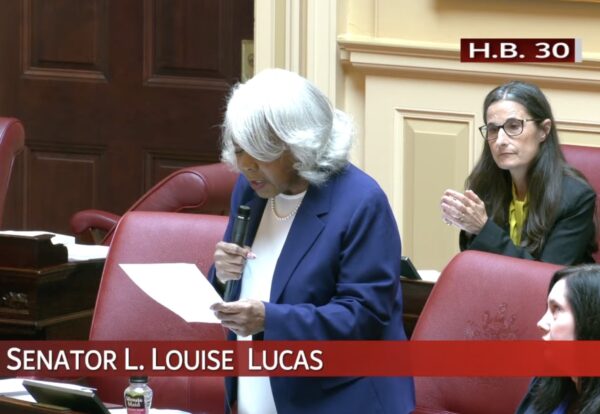
Virginia Senate President Pro Tempore L. Louise Lucas speaks on the budget bill (HB 30) on June 22, 2026 (via Virginia Senate)
Democratic leaders in the Virginia General Assembly reached an agreement on a state budget with a compromise on taxing data centers.
The proposed budget agreement, announced last Friday evening, kept the sales and use tax exemption for data centers, which has divided lawmakers in the Virginia Senate and House of Delegates. However, it adds a new data center electricity consumption tax, which would charge a rate of $0.011 per kilowatt hour based on the electricity a data center uses each month.
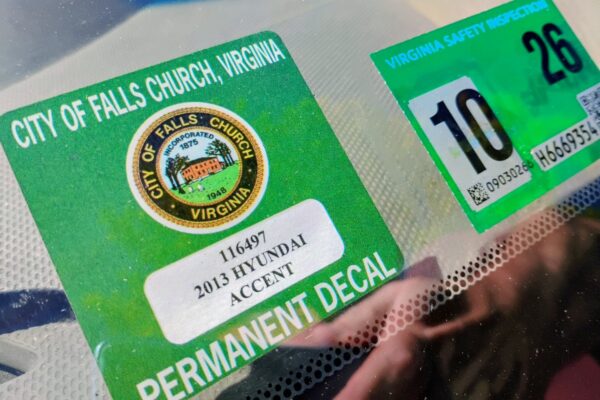
Falls Church vehicle decal (staff photo by Scott McCaffrey)
More owners of low-valued vehicles could receive a full exemption from car taxes in Falls Church.
Vehicles assessed at $1,500 or less are currently exempt from the city’s car tax of $4.80 per $100 assessed valuation. Under a proposal brought to Council members by Commissioner of Revenue Tom Clinton and city staff, the exemption level would double to $3,000.
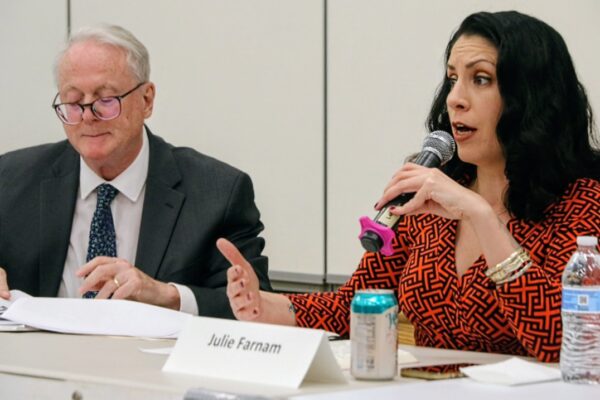
County Board challengers James DeVita and Julie Farnam (staff photo by Scott McCaffrey)
Democrats challenging incumbent Matt de Ferranti are criticizing the County Board for what they see as putting government spending ahead of tax relief.
Echoing a theme long trumpeted by Republican and independent political challengers to the county’s all-Democratic Board, candidates James DeVita and Julie Farnam each used the June 3 Arlington County Democratic Committee candidate forum to accuse the Board of excessive spending.
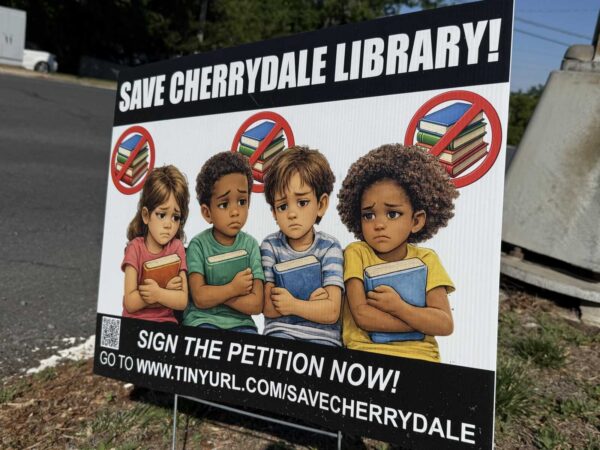
A "Save Cherrydale Library" sign at the intersection of N. Glebe Road and Old Dominion Drive (staff photo)
The response to the proposed closure of the Cherrydale library and the county’s competitive gymnastics program was swift and relentless.
Speakers lined up at County Board meetings, petitions were circulated, signs proliferated on local roadways, and local listservs and social networks lit up with calls to right what defenders saw as the injustice of cutting something beloved from the budget.
In the end, the County Board restored funding, keeping the Cherrydale library, the gymnastics program, and the Barcroft Sports & Fitness center, which was also on the chopping block. Instead, the Board balanced the budget by raising the property tax rate by two cents for commercial and residential properties in Arlington.
Neighboring Fairfax County, meanwhile, lowered the rate by $0.25 for every $100 in property value.
This is how many budget battles go in Arlington. Something people like is proposed for cuts, but then the Arlington Way kicks in, with lots of outcry about saving the thing that might be cut.
The last time Arlington‘s property tax rate was as high as it now will be — $1.053 per $100 assessed valuation — was 1980, when it was $1.12. It has fluctuated over the years since then, reaching a low of $0.765 per $100 in 1990 and 1991.
The process of cutting Arlington County‘s budget is not as easy as some might hope. You can perhaps trim administrative positions and contracts around the margins, but any low-hanging fruit was almost certainly pruned over the past few cycles, each their own “tough budget year.” (And making changes to county contracts with marginal fiscal benefits sometimes leads to undesired results.)
To really make a dent would take cutting something with a constituency, whether it’s a library, infrastructure improvements, affordable housing, nonprofit grants, and so on. And that’s not to mention core services like public safety, where costs have been increasing as recruitment challenges have led to increased pay, or Metro, investment in which continues to weigh heavily on local government budgets.
A budget is, in the end, a math equation. And if inflation continues rising above the annual increase in property values, that’s going to tend to push expenses higher than revenue. Already, county officials have been sounding warnings of another tough budget and additional tax hikes next year.
Meanwhile, the commercial property taxes on office buildings that used to prop up the county’s budget are down amid continued high office vacancy, so the burden for increased tax rates will fall on homeowners, whose property values have continued to rise, with no end in sight.
The need to make hard budgetary choices is nothing new. One of ARLnow’s early articles, from March 2010, noted the tension “between those who think taxes are high enough already and those who take an ‘increase my taxes, please’ approach.”
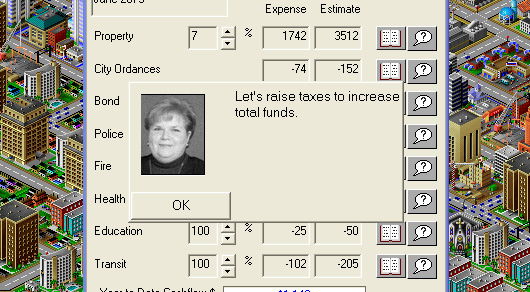
The article also included a faux graphic of former County Manager Barbara Donnellan in the classic municipal simulation game SimCity, where you often have to make unpopular decisions to balance your city’s budget — or risk disaster. You can underfund the fire department for awhile without public disapproval, but your city will eventually burn down.
SimCity photo illustration, featuring former County Manager Barbara Donnellan (by ARLnow)
Arlington County memorably took one of those budgetary shortcuts in the wake of the Great Recession. In 2009, just 25 lane miles of the county’s 974 miles of roadway were repaved. A few years and some hard winters later, county roads were littered with potholes and the public grumbling grew loud enough that the county bumped up the paving to 72 lane miles per year by 2014.
A return to crumbling streets seems unlikely, so next year’s budget will likely come down to the classic choice: you’ll have to increase taxes, cut services, or some middle-ground combination of the two.
Today we’re making it a binary choice, to see which ARLnow readers prefer. All things considered, and assuming that consequence-free cuts to administrative functions are not feasible, would you rather see the County Board cut services or raise taxes next year?