


This sponsored column is by Law Office of James Montana PLLC. All questions about it should be directed to James Montana, Esq., Janice Chen, Esq., and Victoria Khaydar, Esq., practicing attorneys at The Law Office of James Montana PLLC, an immigration-focused law firm located in Falls Church, Virginia. The legal information given here is general in nature. If you want legal advice, contact us for an appointment.
The government likes to release unpopular items on Friday afternoons, and, when the government has something really unpopular to say, the Friday afternoon before a holiday weekend is considered ideal. Last Friday, before the Memorial Day weekend, USCIS published a truly incredible policy reversal – PM 602-0199 (the “May 21 Memo”), which purports to upend the ability of most foreigners to apply for green cards from within the United States. DHS and USCIS’s respective public messaging on the memorandum is clear but wrong. The memorandum was more nuanced, but still, in our view, deeply misleading. The purpose of this advertorial is to explain what happened, why it matters, and offer some predictions about how this unforced error is going to be resolved.
First, here’s what DHS and USCIS said about their own memo.
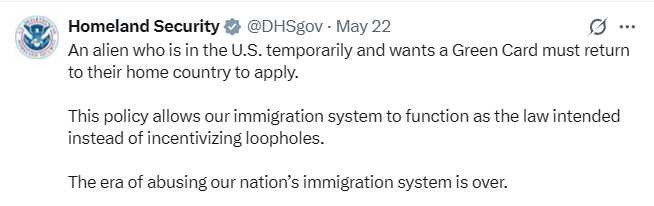
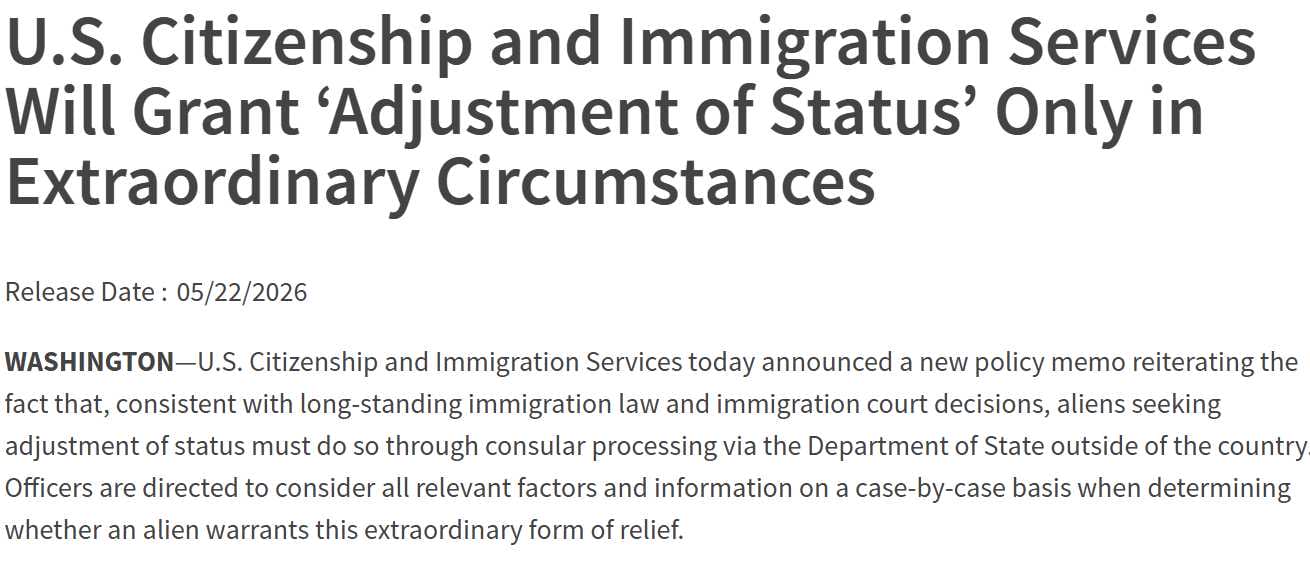
What do these press releases mean? They mean to highlight the following distinction: some people apply for a green card from inside the United States, at USCIS field offices; others apply for a green card from outside the United States, at U.S. Embassies and Consulates abroad. Per both press releases, nearly everyone who applies from inside the U.S. is ineligible to become a lawful permanent resident. Almost everyone who applies for a green card should do so via U.S. Embassies and consulates abroad.
That might seem reasonable, and, ex ante, it could be, if our laws and institutions were set up properly. There are, unfortunately, a few problems with this new policy position, both practical and legal.
As a practical matter, very large systems are difficult to change overnight, and both the U.S. consular apparatus and the U.S. domestic immigration bureaucracy are very large systems. To a first approximation, about 1 to 1.5 million people receive green cards each year, of whom ~60% receive green cards in the United States and ~40% receive their green cards abroad. So, if you shut down 90% of all green card applications inside the United States and force the applicants to apply from abroad, the burden on U.S. Embassies and consulates will double, with concomitant increases in administrative burden and wait times.
The above statistics assume that all those who apply for a green card in the United States would be equally eligible for a green card at the relevant U.S. Embassy abroad. However, as the drafters of the May 21 memo certainly know, many applicants for adjustment of status inside the United States would not be eligible if applying for visas abroad. The reason stems from a peculiarity of the Immigration and Nationality Act. If you overstay a visa (say, a visitor visa or a student visa), there are heavy penalties – for example, a ten-year bar on applying for a green card, if you overstay for longer than one year – but those penalties only become operative upon departure from the U.S. If you apply from inside the U.S. as, say, the spouse of a U.S. citizen, those penalties simply don’t apply.
The May 21 Memo therefore puts (by our estimation) hundreds of thousands of spouses of U.S. citizens in an impossible position: depart from the U.S. and be separated from your U.S. Citizen spouse for a decade, or apply from within the U.S. and face the prospect of being forcibly ordered removed. Most people would choose not to apply at all.
So, the May 21 Memo would, if applied, have immediate and catastrophic consequences; USCIS recognized this less than 24 hours later, and began backpedaling, hard:
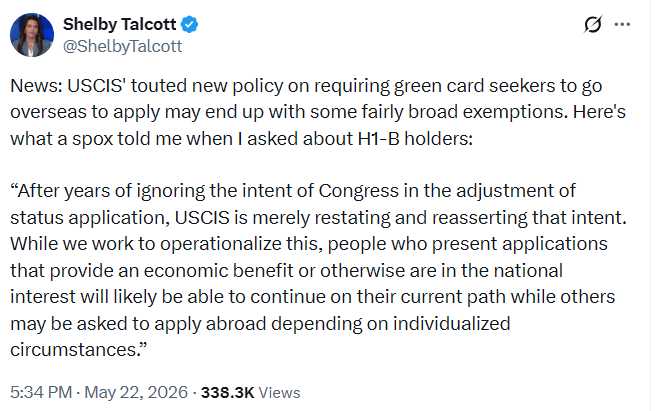
Got it? The Memo says that almost nobody should be able to apply for a green card from within the United States. “While we operationalize this” – for which, read: while USCIS figures out what the hell is going on – USCIS won’t apply the memo to people who “provide an economic benefit” or whose admission is “in the national interest.” What that means, and what it means to our immigration system, from the very top down to the individual adjudicator, is anyone’s guess.
We’ve seen immediate reports of increased questioning at green card interviews, with questions including “Why didn’t you apply at the U.S. Embassy abroad?” Applicants for adjustment of status should be prepared for surprising and strange questions at green card interviews.
Now, we’d like to offer a few predictions about how this will work out.
First, we would like to observe that, while we haven’t seen this particular movie before, we have seen other movies from the larger Trump Cinematic Universe, and the plot is pretty predictable. First, the administration makes a massive announcement (“All H-1B visas now come with a $100,000 surcharge!“). Then, the administration backpedals furiously, while confusion reigns and costs pile up. Then, the administration gets sued and fights to preserve its policy in court – sometimes successfully, more frequently not. We expect this new announcement to follow the same pattern; right now, we’re in the backpedaling, confusion, and cost stage.
Second, we expect that the forthcoming litigation against the new policy will probably succeed. INA § 245 establishes clear procedures for applying for a green card from within the United States. The cases cited within the May 21 memo only weakly support the general proposition that green card applications should primarily happen abroad, and the U.S. government has processed most green card applications from inside the United States for decades. Federal judges are going to have a great deal of (entirely reasonable!) sympathy for people who applied before the May 21 Memo was published and have their applications adjudicated using an entirely different policy scheme.
Third, we think that this is going to lead to chaos at the State Department. The State Department has no easy mechanism for ramping up staff and resources to handle twice the number of immigrant visa applications. Although the increase isn’t likely to be a full 2x, resources are already strained, and wait times will increase.
Fourth, we think that this is going to lead to more variation in adjudication at USCIS field offices. Until this policy gets properly implemented (or, more likely, enjoined and scuttled) USCIS adjudicators are going to be completely at sea when trying to apply it. The moment a new Democratic administration takes office, the policy will be reversed.
This policy memorandum will not work, and it was foolish of the Trump Administration to promulgate it in this way, rather than via ordinary legislative or regulatory processes. Ordinary USCIS employees, immigrants and their U.S. citizen relatives, and our legal system are worse off thanks to this memorandum. The only winners, in a chaotic and unpredictable legal system, are the lawyers who track matters carefully and can advise you properly on how to navigate it. That is a bug, not a feature – we wish that our immigration system were simpler, fairer, more orderly, and more stable, and that the services of the immigration bar were less valuable.
