

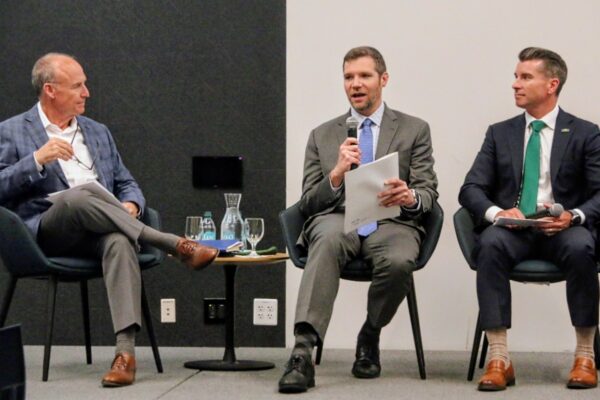
Relatively modest changes to Northern Virginia zoning requirements could be a key step to delivering on more housing stock, panelists suggested last week.
Members of a panel convened by George Mason University last Wednesday argued in favor of looser zoning policies and other changes to how localities approach the development process. The alterations don’t need to be draconian or revolutionary to have a positive effect, participants said.
“I’m not saying ‘get rid of zoning,'” said Taylor Chess, senior managing partner for development at Peterson Cos., at the forum.
Instead, local governments should focus on “deal[ing] with the plans that are in front of you faster,” Chess said.
The forum, held on Mason’s Arlington campus, was sponsored by the Schar School of Policy and Government and Center for Regional Analysis.
Its intent was “recognizing our strengths and weaknesses and laying out a path forward” in complicated economic times, said Schar School dean Mark Rozell.
Housing, transportation and quality-of-life issues dominated the discussion.
“Our #1 challenge? Very simply, we need more housing supply,” said Ryan McLaughlin, CEO of the Northern Virginia Association of Realtors.
Northern Virginia leaders need to do their part to break the housing bottleneck, he said.
“We’re going to need to be shifting our mindset — take what we learned over the past and what we’ve done over the past 30 years,” McLaughlin said. “Not just talking about it, but actual solutions.”
Chess and McLaughlin said the biggest housing issue regionally is a scarcity of new detached homes and townhouses. The Northern Virginia inventory of single-family detached homes on the market is only about 60% of the total in spring 2019 before the pandemic hit, McLaughlin said.

Affordability issues are hitting hard both regionally and nationally, he said, pointing to National Association of Realtors’ data from late 2025.
“Only 21% of home-buyers last year [across the U.S.] were first-time homeowners, an all-time low,” he said. “That’s an eye-opener.”
While the 2026 General Assembly delivered some changes to how localities must approach development of affordable housing, there needs to be a broader look focused on market-rate single-family construction, Chess said.
“To get those built, we need to relax zoning laws,” he said.
Another panelist, Jason Stanford, said improving housing and transportation in Northern Virginia too often are impacted by the same type of policy and bureaucratic roadblocks.
“When the rubber meets the road, it becomes very difficult to move those things,” said Stanford, president of the Northern Virginia Transportation Alliance.
“You get stuck in the planning process,” Stanford said. “You just see firsthand how difficult it is.”
Terry Clower, director of GMU’s Center for Regional Analysis, said those who want to build housing or locate businesses in Northern Virginia too often view political leadership and those who work under them as uncooperative.
“We have a perception problem,” he said.
Whether fair or not, “we are not considered a very easy place to do business,” Clower said.
Like Chess, McLaughlin said the answer was not having local leaders throw out the current development process.
“What we’re asking them to do is take incremental steps, think about being creative,” he said.
Chess suggested one regional leadership challenge appears to be paralysis-by-analysis. He urged local leaders not to let the perfect be the enemy of the good.
“We’re trying to do great things and [as a result] we’re not doing anything,” he said.
The June 3 forum was part of a year-long celebration of the 10th anniversary of GMU’s Schar School of Policy and Government.
Rozell said events will culminate with a “grand celebration” sometime in the fall.
