


The National Park Service is requesting more public input on a plan to build a triumphal arch on the Virginia side of Memorial Bridge.
Respondents have until Thursday, July 30 to submit feedback on President Donald Trump’s plans to build the 250-foot arch in a heavily trafficked roundabout between the Lincoln Memorial and Arlington National Cemetery.
The proposal has been steadily moving forward despite an earlier round of overwhelmingly unsupportive public feedback. The National Capital Planning Commission voted earlier this month to approve preliminary site and building plans, while a USA Today analysis of 1,696 public comments found that 99% of them were negative.
The U.S. Commission of Fine Arts, a separate federal agency, approved the design for the arch in May. The National Capital Planning Commission oversees construction on federal land in D.C. and began reviewing the arch plan in June.
Opponents of the project argue that the arch is too big for the skyline and would disrupt carefully designed views between the Lincoln Memorial and Arlington National Cemetery that were meant to symbolize the reunification of the North and the South after the Civil War.
The project is also expected to cause significant disruption for drivers, pedestrians and bicyclists, most immediately during two to three years of construction that would impact segments of Memorial Avenue, Arlington Memorial Bridge, the Boundary Channel Bridge, Arlington Blvd, and Washington Blvd.
Will Scharf, who has served as Trump’s White House staff secretary, heads the National Capital Planning Commission. He has argued that ultimately, this year’s 250th anniversary of the Declaration of Independence “is as good an opportunity as any to add something to Washington, D.C., that will hopefully stand the test of time.”
Stuart Levenbach, Trump appointee and vice chairman of the commission, said the proposed site represented “one of the few locations” in the area where such an “iconic civic monument could be appropriate,” although he added that “it’s reasonable to consider whether a significant architectural statement belongs in such a location.”
If built, the arch would function primarily as a pedestrian attraction in the middle of a roundabout that many local residents rely on for commutes to and from D.C. The National Park Service estimated in 2018 that about 62,000 vehicles crossed Memorial Bridge every day.
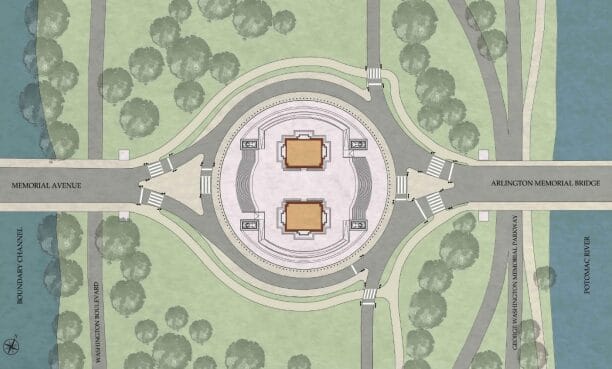
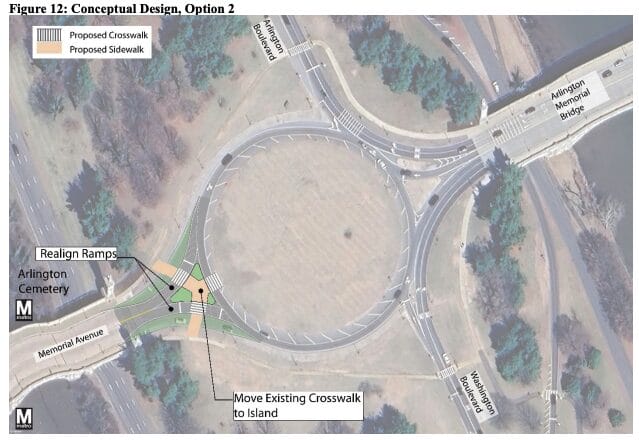
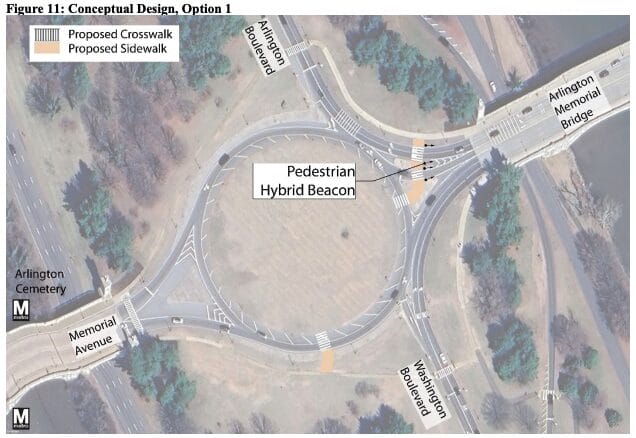
The project design currently depicts signalized crosswalks allowing pedestrians to visit the roundabout via two entry points. An environmental assessment by the National Park Service estimated that daily visitation during the peak season could range from 2,000 to more than 22,000 visitors per day.
The assessment anticipated that drivers “would encounter low to moderate delay during the busiest commuting times, but overall experience predictable movement through the area.” The most severe impact would likely be on northbound traffic turning onto Memorial Bridge during morning peak hours.
“Under assumptions of maximum pedestrian signal activation, conditions could approach the upper limit of roadway capacity, resulting in significant delay, reduced maneuverability, and limited ability to recover from disruptions,” the assessment found. “Vehicles would continue to move, but at slower speeds and under constrained conditions.”
Physical changes to the roundabout would include the following:
- Enlarged median islands on the east and west sides of Memorial Circle
- Circulating roadway narrowed to approximately 20 feet
- Conversion of the pavement-marked truck apron to a mountable concrete truck apron
- Replacement of existing Belgian block along the outer edge of the Circle with grass
- Recommended safety design features such as raised crossings, curb extensions, median refuge islands, reduced curb radii, and rumble strips
- Construction phase changes including closure of the southern half of the Circle, detouring two-way traffic to the north side, elimination of certain left turn movements, and temporary pedestrian routing with a new temporary crosswalk
The proposal also includes a designated pickup and dropoff area along Memorial Avenue, in addition to improved wayfinding signage.
The environmental assessment notes that the roundabout is already known for its confusing and sometimes hazardous conditions for drivers, cyclists and pedestrians. In addition to traffic impacts, an influx of visitors would likely create more “conflicts and close encounters” with bicyclists on the Mount Vernon Trail.
The National Park Service concluded that the arch “would not result in significant environmental impacts.”

