

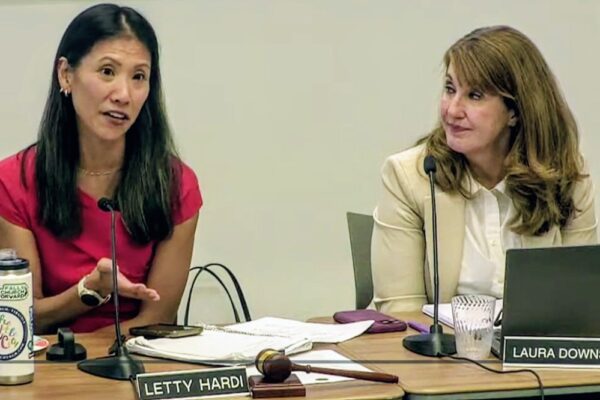
Falls Church City Council members have begun cautious discussions about a possible new tax on commercial and industrial property owners.
Under state law, the city has the ability to levy a surcharge of up to 12.5 cents per $100 assessed valuation on non-residential properties, so long as the funding supports new transportation initiatives.
At an Aug. 24 work session, staff told Council members that each penny of a new tax would generate about $113,600 in additional funding. “The common theme here is new or expansion” of transportation infrastructure, said David So, the city’s director of finance.
The discussion took place as city officials are beginning to formulate a draft fiscal year 2028 budget, which will be considered next spring. No member of the Council expressed a concrete opinion either for or against.
“I’m not sold,” Mayor Letty Hardi said.
Several Northern Virginia localities already levy the tax. Arlington imposes the full 12.5 cents on commercial property owners.
However, Hardi raised concerns about how more taxes might affect businesses.
“We should be very deliberate,” she said. “I think our residents will expect us to be a lot more disciplined on costs before we talk about [more] revenue.”
Several Council members said implementing a tax surcharge might be reasonable. They pointed to recent budget challenges that have restricted transportation improvements the city is able to make.
“Our goal is not to tax more. It’s to make sure we have the funds for transportation. We’ve already cut there way too much,” Council member Arthur Agin said.
Council member Erin Flynn said a surcharge on non-residential properties could help homeowners at a time they have seen tax bills rise at a higher rate than seen by those who own commercial properties.
Adding a surtax on commercial and industrial real estate would be an effort “trying to recalibrate that tax burden,” she said.
Council members directed staff to come back with more information, but also requested outreach to organizations such as the local Chamber of Commerce.
“It would be good to get the public feedback,” Agin said, while Council member David Snyder pressed for a future community roundtable on the topic.
Flynn said Council members could enact an ordinance providing taxing authority in the coming months.
“We need to start having this conversation sooner rather than later — this seems, to me, important enough,” she said.
“Then you can decide” whether to implement it, she added.
Over the next year, Falls Church leaders also will need to determine whether to use newly granted authority from Richmond to hold a voter referendum on adding an additional 1% to the sales-tax rate, with the funding going to education, transportation or a combination of the two.
Other Northern Virginia localities have the same option, and there have been some indications that the region’s localities might try to coordinate sales tax referendums. If approved by voters, these would all go into effect at the same time.
