

This reporting was supported by the ARLnow Press Club. Join to support in-depth local journalism — and get an exclusive early morning email with a preview of that day’s planned news coverage.
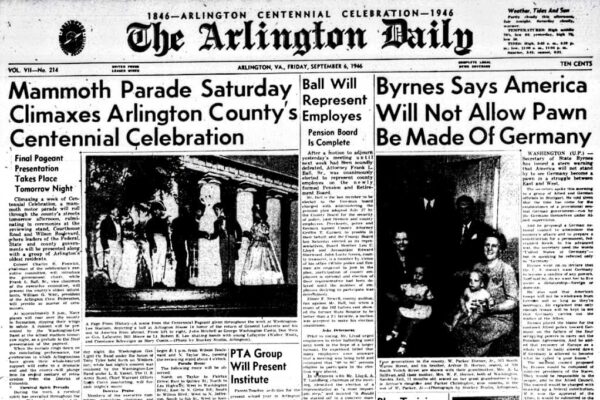
Around this time 80 years ago, Arlington residents celebrated the community’s 100th anniversary with a week’s worth of special events.
The festivities, which sought to look back at the past while also gazing into the future, were a mix of successes and failures.
They arrived at a time when the county was in the midst of a rapid growth spurt and also attempting to plan for a post-war future. As a result, the county’s 1946 centennial celebration proved a momentary diversion for residents, many of whom were new arrivals and just putting down roots.
Coverage of the details comes largely from two sources: Contemporaneous media coverage and a report delivered to County Board members in late 1946 by the event’s executive director, E.L. Kirkpatrick, which was notable for accentuating the undertaking’s triumphs while not sugarcoating the shortcomings.
What was being commemorated?
The 1946 centennial was intended to mark the 100th anniversary of “retrocession.” This was when modern-day Arlington County and Alexandria left D.C. and returned to Virginia.
The two localities had been incorporated into D.C. in 1801. An earlier ARLnow history article examined the intricacies of retrocession, which involved action by Congress and President James K. Polk as well as a vote by residents in the affected areas.
Given the chance to decide their own fate, residents of the town and county of Alexandria who were eligible to vote (white, male property owners) gave it their seal of approval on a 763-22 vote.
They were among about 10,000 residents of what was then known jointly as the Federal County of Alexandria. About 8,500 residents were in modern-day Alexandria, while the remaining 1,500 were in modern-day Arlington.
On March 13, 1847, the General Assembly accepted the locality back into the Old Dominion’s embrace, extending “all benefits, rights and privileges” on an equal basis with other Virginia residents.
Retrocession did not change conditions for those enslaved in Arlington and Alexandria. Slavery remained a fact of life in both D.C. and Virginia until the Civil War era. And while slavery had been abolished in the 1860s, rigid racial segregation continued across Virginia into the 1960s.
The idea originated with the Chamber of Commerce
In 1957, Paul Hill wrote up his reminiscences about planning for the centennial for the Arlington Historical Society’s annual magazine.
Hill held a front-row seat at the planning effort, as in 1946 he was serving as secretary-business manager of the Arlington Chamber of Commerce. The proposal to celebrate the centennial originated with the Chamber.
On Dec. 8, 1945, a proposal written by Hill and supported by the Chamber was presented to the County Board. It put out a call “to the County Board, to the business, professional, religious, veteran and civic organizations and to the citizens generally of Arlington County” that a celebration be held the succeeding year.
Elected officials took the matter under advisement, but apparently made no promises that day.
On March 22, 1946, the Chamber forwarded a letter reiterating its desire that the county host a celebration later in the year. And on April 13, County Board members designated Sept. 7, 1946 as the date of a countywide commemoration, marking 100 years to the day that President Polk certified the return to Virginia as fully in force.
County Board Chair Edmund Campbell — about to embark on a challenging and ultimately unsuccessful re-election bid — set May 13 as the date for an organizational meeting to be held at the county courthouse.
“This meeting was attended by more than two dozen persons, practically all of whom were countywide-organization executives,” Hill recalled in his 1957 retrospective.
It was at that meeting that Charles Fenwick was elected chairman of the organizing committee, with Frank Ball, Sr., vice chair, Alan Prosise as treasurer and Hill as secretary. Other committee members were Neil Foss, Lena Wolfe, Eva Miner, High McGrath and William Watt. Kirkpatrick was selected as executive director, and a host of committee chairs were selected.
The body also created an honorary advisory council, ranging from Gov. William Tuck and Sen. Harry Byrd to Circuit Court Judge Walter McCarthy, members of the County Board and legislative delegation, constitutional officers and County Manager Frank Hanrahan.
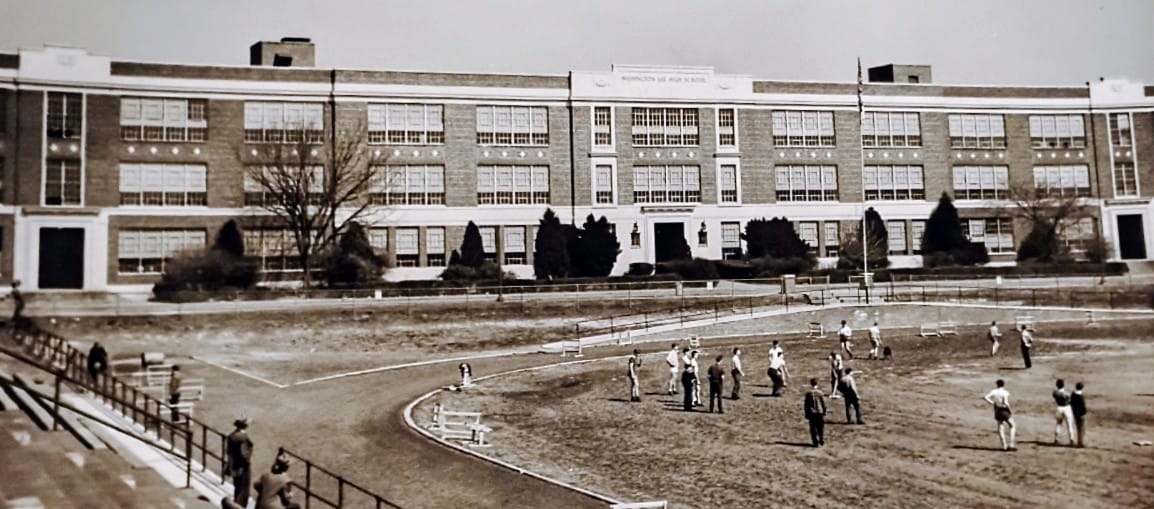
The theme selected for the celebration was “Arlington’s Cavalcade of Progress.” Fenwick proposed a five-night festival at Washington-Lee High School, as it was then known, saluting the county’s growth while embracing the future.
County Board members appropriated $5,000 to support the effort, with another $5,000 forthcoming if the local business community could raise a similar amount. In the end, the total cost of the festivities totaled just under $26,000, with some of that recouped by the sale of commemorative items and event tickets.
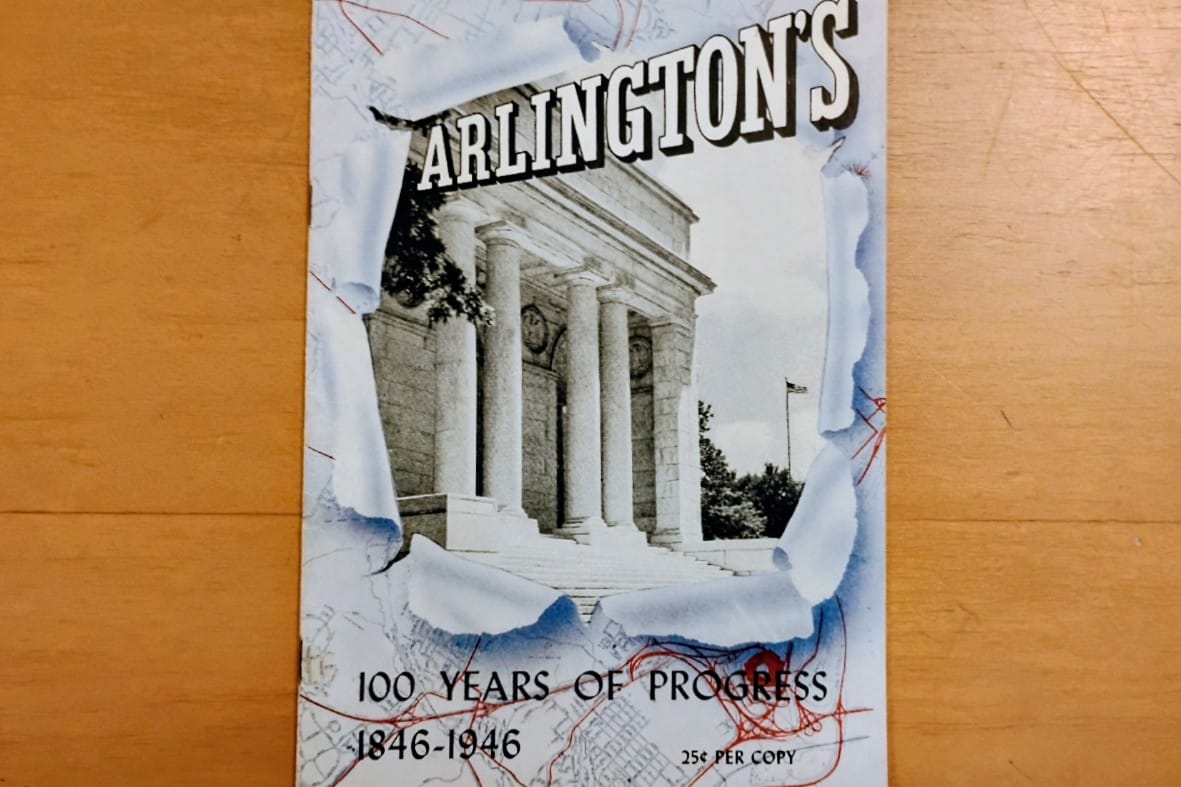
In addition to helping to create the event, the Chamber of Commerce had 1,000 copies of a special pamphlet about the celebration printed and distributed to fellow chambers of commerce nationwide.
Looking back on the 1946 event from 1957, Hill said the celebration proved “that Arlingtonians will show loyalty to a common cause, turn their faces forward and work faithfully for a better and bigger community.”
But as the months that followed creation of the organizing committee would prove, not everything went according to plan.
Trying to get businesses on board
In July 1946, several months into the effort, the organizing committee suggested local businesses sponsor storefront displays, each marking different chapters and topics in county history.
Kirkpatrick’s final report to County Board members said the proposal was initially met with “apparent lack of interest.” A backup plan to place the displays at Cherrydale Recreation Center had to be nixed when ongoing renovations at the center did not finish in time.
The displays ultimately were placed primarily at the courthouse, but some businesses did participate, including Woolworth’s, Hahn’s Shoes, Brown’s Garage and Yeatman’s Hardware.
Paul Hill, secretary of the organizing committee, was among those encouraging businesses, and others, to do their part in making the event a success.
In a letter to The Washington Post, he said a successful look back would provide a springboard to the future:
“It is sincerely hoped that our children, and their children’s children, will with courage and deep loyalty carry the torch of progress ever forward and upward, and build Arlington into a greater and better county.”
The committee contracted with George Studio, located at 1409 N. Garfield Street, to chronicle the festivities in photographs. Many can be found in the archives, while the company also sold copies to the general public.
“You’ll want several as souvenirs,” it said in an Aug. 20 ad in the Northern Virginia Sun.
Praise for the effort
Centennial organizers made a concerted effort to connect with local media, both print and radio, across the D.C. area in advance of the festivities.
Those efforts frequently paid off with positive media coverage.
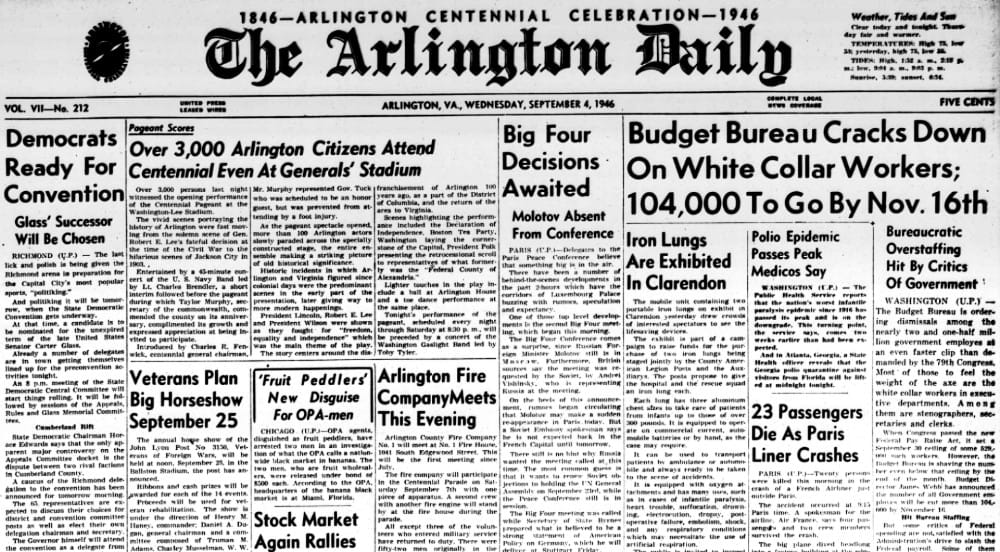
The Sept. 2, 1946, edition of the (Washington) Evening Star provided details for that evening’s opening ceremony, coinciding with Labor Day.
The Army Air Forces Band was slated to kick off events, with Maj. George Howard leading the band in Ravel’s “Bolero” and Gershwin’s “Rhapsody in Blue,” the newspaper reported.
Gov. Tuck was expected to attend the kickoff to six days of events, it added.
Over the course of the following week, county offices would hold open houses, while concerts would be presented by the Washington Gas Light Band, Army Band, Colored Choral Group and Washington-Lee High School Band, plus soloists Jody Miller of Arlington and Phyllis Jones of Alexandria.
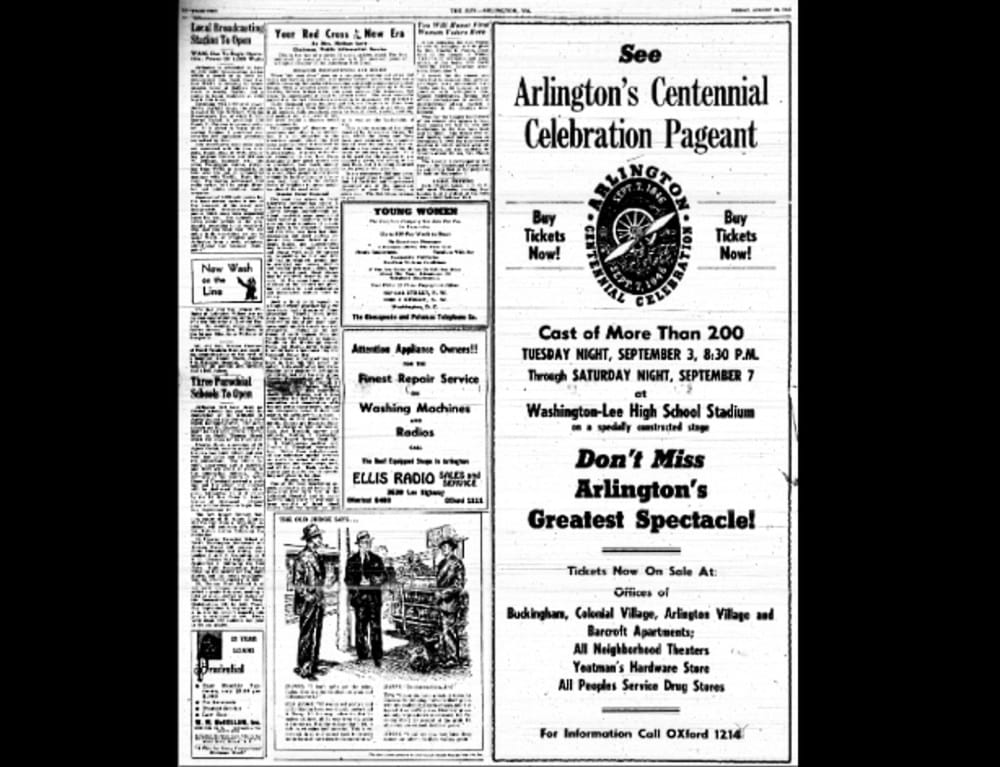
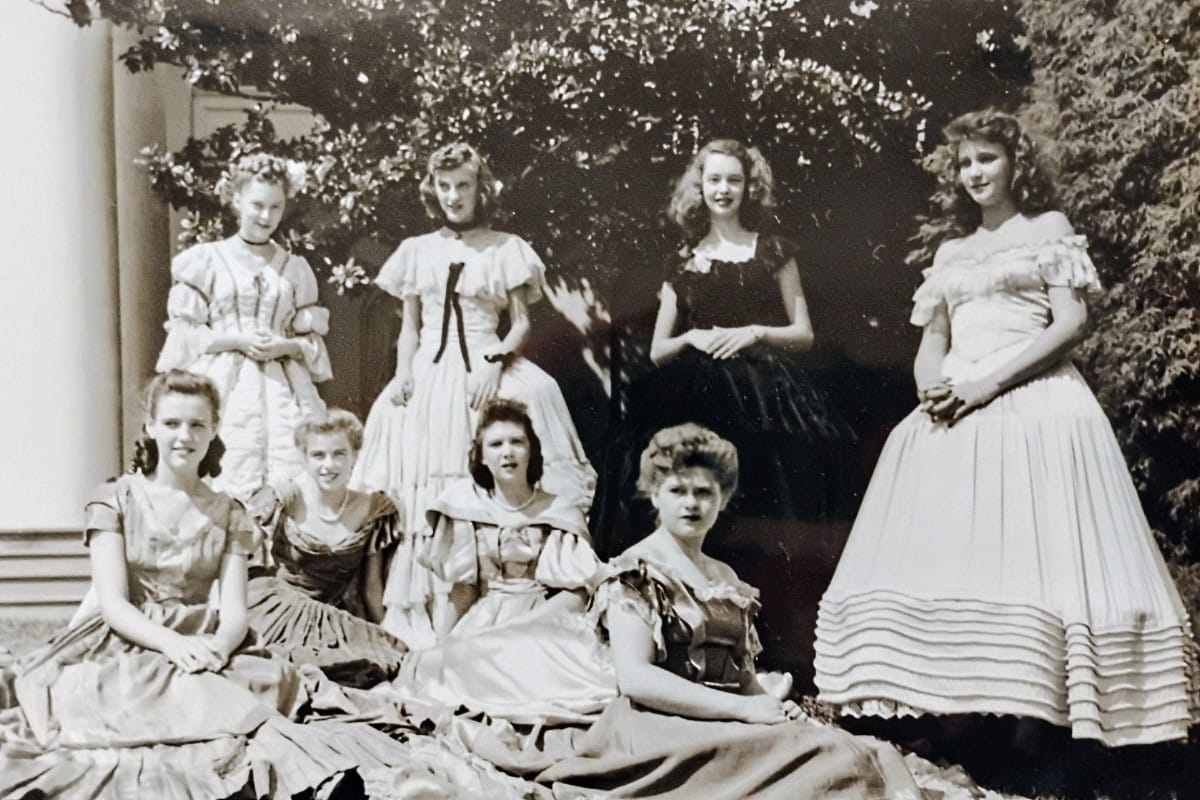
The Cavalcade of Progress, a five-night evening presentation at Washington-Lee High School running Sept. 3-7, would feature 28 scenes and a cast of 100 volunteer thespians tracing the county’s history.
The centennial parade on Sept. 7 was expected to be the largest in county history, running for three hours and featuring 100 units and floats along with Sen. Harry Byrd, Sr., on the reviewing stand.
That same day, the Star’s editorial page saluted “our neighbors across the Potomac” in Arlington for the schedule:
“The sponsors of the elaborate program, beginning this evening and continuing through Saturday, marks the beginning rather than the end of ‘Arlington’s 100 years of progress.’ This is supported by a great deal more than community pride.”
The editorial noted that in 1870 the county’s population was about 3,180. It had grown to 125,000 and “in place of the quiet, country-like county of even a few years ago there has emerged a bustling, progressive community that is a modern city in everything but name.”
Not to be outdone in terms of praise, The Washington Post on Sept. 3 editorialized in support of the celebration.
The editorial noted that Arlington was believed to be the fastest growing locality in the nation owing largely to an influx of federal workers and military personnel, adding:
“The nasal twang of the Midwest is at least as common as the soft Virginia drawl — Arlington today is an amazing conglomeration of apartment developments, superhighways and prosperous shopping centers, superimposed on the older rural setting.”
The editorial also put in a plug for Arlington becoming a city, saying the county government was “a holdover from the times of separate small communities before the present urban unit was created.”
“Such essentials as schools and municipal services suffer accordingly,” the editorial said. “A movement is now afoot to recognize what is already a fact in all but name and incorporate Arlington as a city.”
Northern Virginia Sun editor weighs in
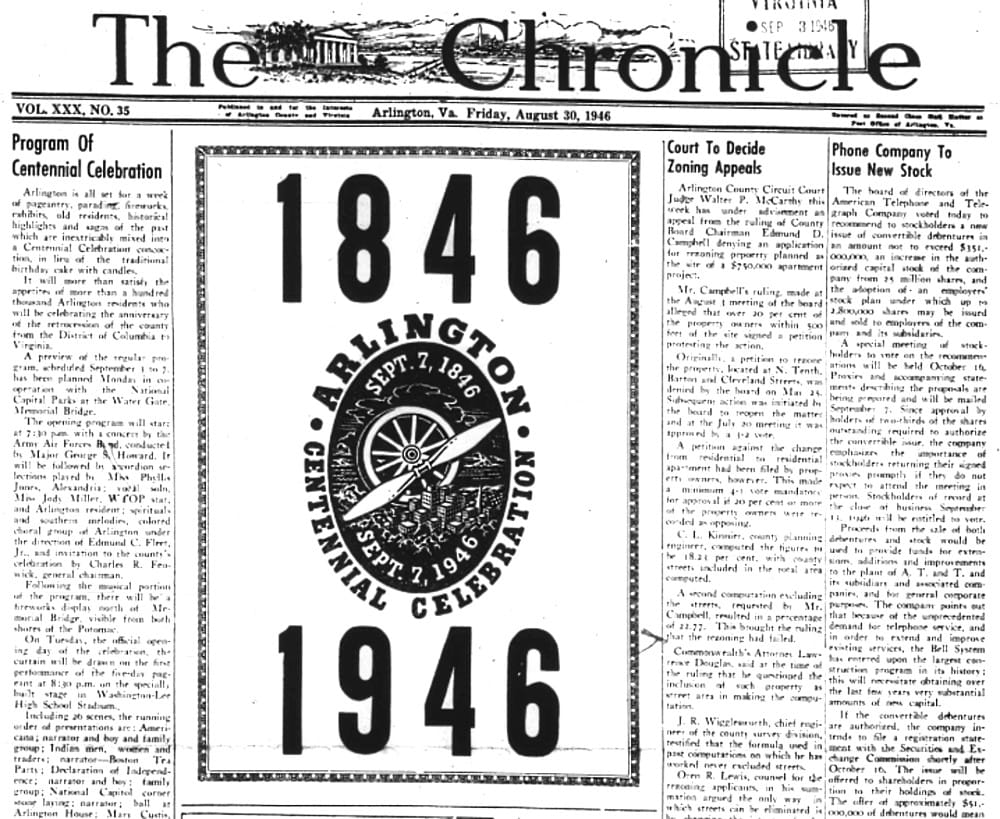
The Aug. 30, 1946, edition of the Northern Virginia Sun included a 12-page special section devoted to the centennial, with additional copies on sale at the Sun’s office for 5 cents each.
Unfortunately for researchers, the special section is not included among the online holdings of the Sun’s archives by the Library of Virginia.
But on the front page of the same issue, editor Howard Bloomer’s “Week by Week” column said the upcoming celebration “is going to be quite a party, and we hope you can take in as much of it as you can.”
“After all,” Bloomer wrote, “it’s not every day a county has a 100th birthday, and a lot of people have put in a lot of hard work to show you and tell you how Arlington has grown.”
Bloomer, who wrote the column each week from 1937 to 1951, then became a little philosophical about changes since retrocession:
“Much water has flowed down the Potomac since then (does anyone want to calculate how much?) and it is flowing today along a shortline which wouldn’t be recognizable by anyone who saw it last 30 or 40 years ago.”
Authors get in the centennial spirit
The July 12, 1946, edition of the Sun noted that Dietz Press of Richmond had just published “A History of Arlington County, Virginia,” with prose by Dorothy Ellis Lee and illustrations by Lydia Keown Felder.
“It is a good job — accurate and interesting. I have learned a good deal,” George Stetson, an authority on county history, told the Sun.
Lee was a lifelong county resident and taught at Maury Elementary School in Clarendon.
A few weeks later, the Arlington Daily recorded that a second book was on the way.
“Your Arlington and Mine — The First One Hundred Years” was being authored by Mrs. Cecil Chittendon, the newspaper noted. It was being prepared for publication later in the year.
In addition, a committee within the centennial organizing committee was working on a brochure focused on county history.
Fireworks display overcomes obstacles
Fireworks displays to celebrate important events have been around nearly as long as the nation itself. However, the centennial organizing committee hit a speed bump in its plans for a fireworks celebration to close out the first night of festivities on Sept. 2.
County ordinances prohibited fireworks being shot off anywhere in Arlington, and no way could be found to circumvent the prohibition.
But a workaround was found when the National Park Service offered its land to serve as the launch spot for the fireworks. Because that was federal property, the county’s ordinances didn’t apply.
Organizers paid the International Fireworks Co. to put on the display, which according to reports was witnessed by up to 10,000 people on the Virginia side of the Potomac River.
As the fireworks began, rain started falling across the area and, according to Kirkpatrick’s report, “shooting was sped up as the slow rain became heavier.”
Saluting longtime residents
One of the highlights of the parade was slated to be a salute to county residents who had lived in Arlington for at least 70 years.
Organizers found nine of them, ranging in age from 79 to 96: Annie Morris, Ida Marcey, Martha Hatch, John Marcey, Philip Marcey, William Marcey, George Marcey, Ella Boldin and Cora McIntosh.
When the time came to celebrate the seniors, the result was a mixed bag, according to Arlington Daily coverage of Sept. 9.
Some of them didn’t attend, the newspaper reported, noting that “a reluctance has been shown on the part of ladies to appear and admit their longevity.”
Another who skipped the event was William Marcey, who told friends he’d rather go to market than spend time at the parade.
Perhaps those skipping the event were right to do so, given the media coverage that followed. The Washington Post reported that those being honored represented “wrinkled but well-preserved” Arlingtonians.
One of those happy to give her age, but not invited as a guest of honor, was Flora Hiett of 6732 25th Street N.
Though 102 years old — older than retrocession itself — Mrs. Hiett had lived in Arlington for “only” 50 years and did not meet the criteria for selection.
“Still an energetic little lass of 102, Mrs. Hiett spends her day puttering about her East Falls Church home, somewhat hampered by an impaired nerve, which makes difficult her piano-playing and gardening,” The Washington Post wrote.
Born in 1844 in Winchester, Mrs. Hiett “has vivid memories of the Civil War,” the paper noted. She and her husband moved to Arlington in 1896.
Her husband, Capt. Joseph Hiett, served in the Confederate 12th Virginia Cavalry during the Civil War. He died in 1907, and Mrs. Hiett soldiered on in Arlington for the subsequent four decades.
“She has a clear mind, is a little deaf and has poor eyesight, but she leads her harassed housekeeper on a merry chase,” Washington Post coverage added in flourishing prose.
Also receiving mention in the press was 90-year-old Dr. H.C. Corbett, who since the death of his wife in 1937 had been living in Chevy Chase, Md., with his daughter and son-in-law.
But prior to that, Dr. Corbett had been a practicing physician in Arlington. It is believed that in the late 19th century, he was the county’s only physician, often setting off on horseback in the snow to deliver babies.
Planning gears up for 5-day pageant
The summer of 1946 was used to prepare for the five-day centennial pageant, to run Sept. 3-7 at Washington-Lee High School.
Harry Anger, formerly managing director of the Earle Theatre in D.C., was appointed pageant director. Tryouts were held July 23-27, with 44 speaking parts plus scores more serving as background performers.
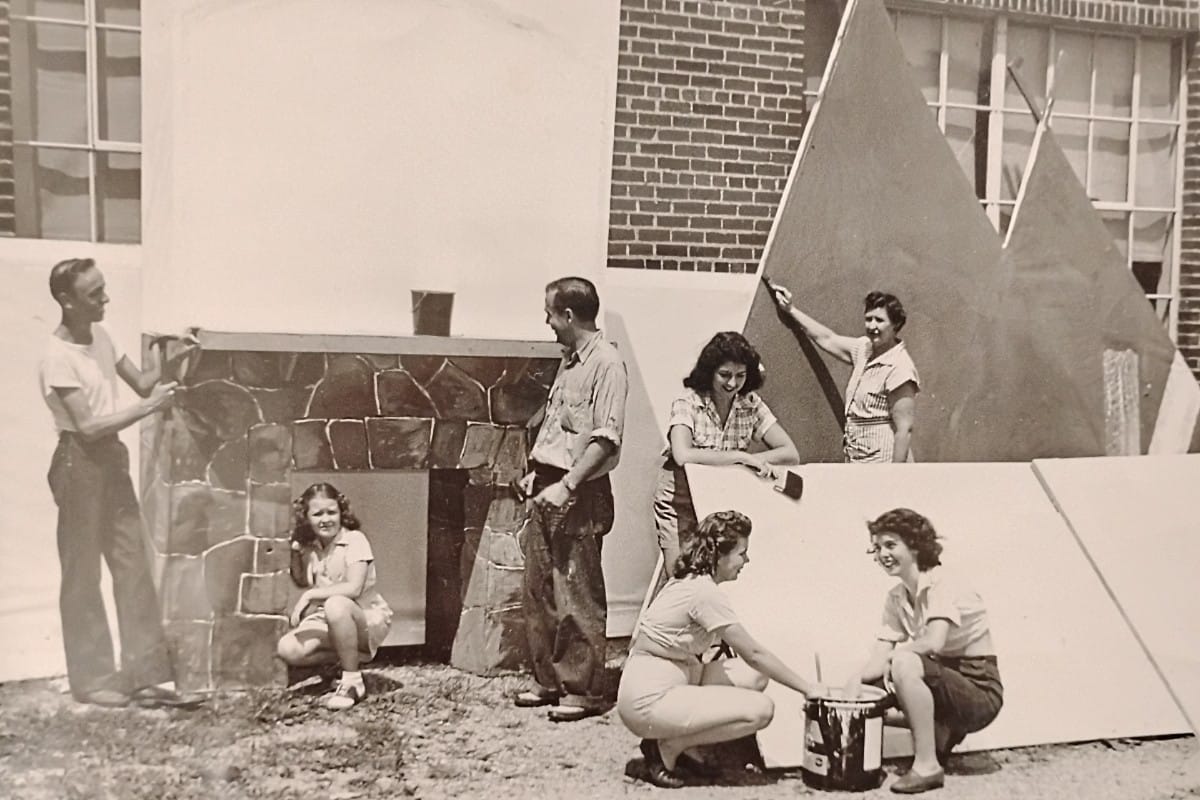
Music for the show was to be provided by the Arlington Civic Symphony and several choirs, and volunteers got to work painting scenery and creating costumes.
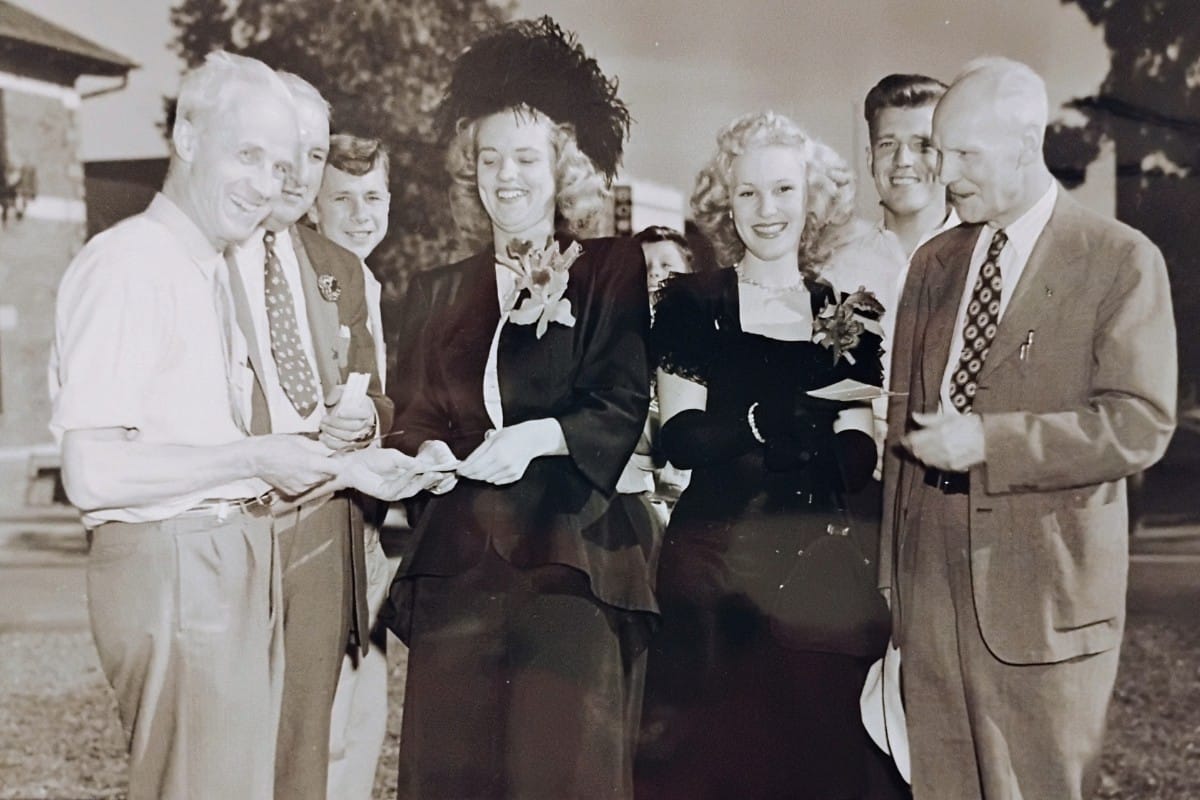
In an effort to spur sales of tickets priced at the not insubstantial rate of $1.20 for adults, or 60 cents for children, organizers enlisted the services of what The Post called, with typographical error, “two zeauties” who soon would be competing in the Miss America pageant.
They were Betty Cannon, the reigning Miss Virginia, and Jeanne Carlson, Miss Washington. According to Aug. 25 Post coverage, the duo had spent the previous day on a ticket-selling blitz, crisscrossing the county in “a luxurious 1946 Lincoln donated for the day by Burr Heishman, vice president of the Arlington Chamber of Commerce.”
The county government did its part, providing a “police escort of two motorcycles with screaming sirens” as they were ushered from location to location.
In June, Fenwick extended an invitation to President Truman to participate in one or more events connected with the centennial. When they came around several months later, the president proved unavailable.
Pageant falters after opening night
Organizers began to get nervous in late August, when tickets sales for the five nights of the centennial pageant were running behind expectations.
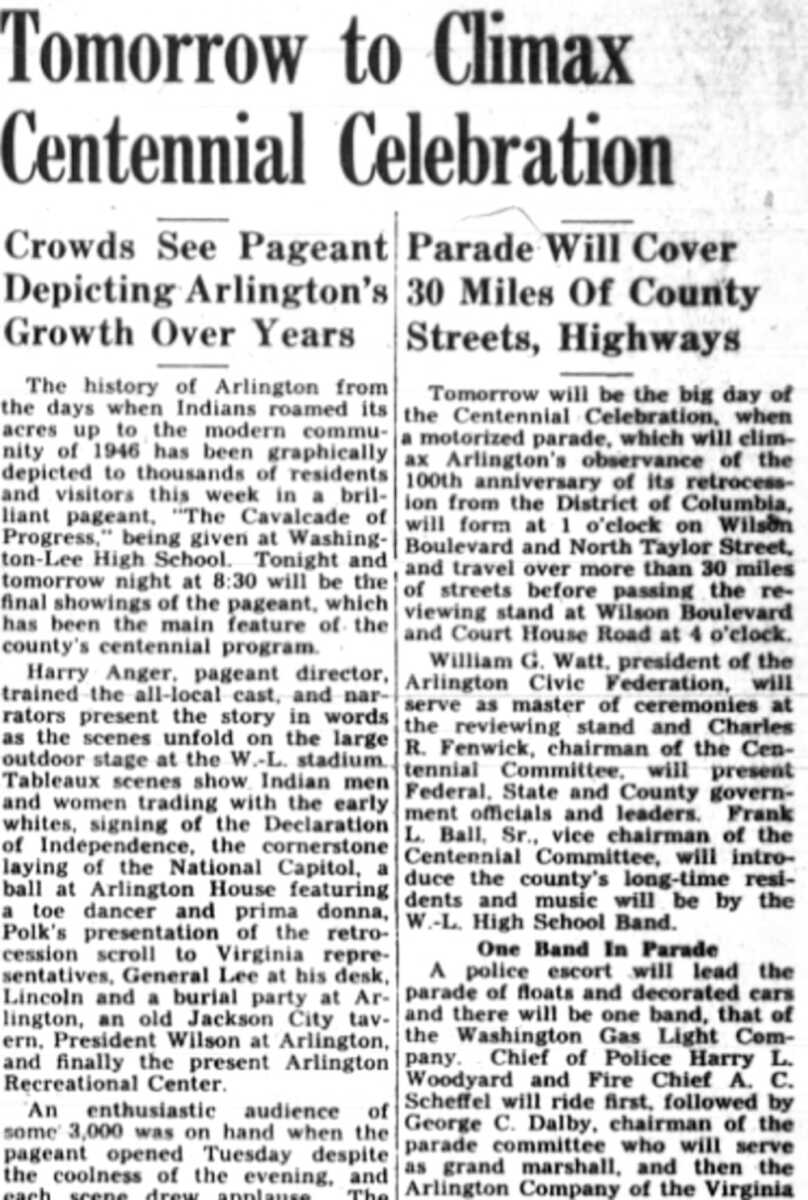
The Arlington Daily reported that 3,000 attended the opening night of the pageant on Tuesday, Sept. 6. Gov. Tuck was suffering from a foot injury and unable to attend; he was represented by Secretary of the Commonwealth Taylor Murphy.
A large number of “comps” helped to fill the house the first night. After that, attendance declined precipitously.
“The pageant seemed to get high praise from those who had seen it, yet there was no crowd on the second night — cold weather may have accounted for some of this,” Kirkpatrick wrote in his final report for the centennial committee.
Tickets sales brought in about $2,000, but “the pageant came far from paying out, financially,” Kirkpatrick wrote in his wrapup.
Recriminations continued after the pageant had concluded.
In a letter published in the Sept. 13 Northern Virginia Sun, Mr. and Mrs. Charles Planck, who had written the original script, explained why they had demanded their names be removed from the program.
Revisions made by others resulted in what was, “in our judgment, a bad piece of writing,” the authors said.
They also complained about the cost of tickets, which “left hundreds of empty seats inside.”
“The tickets which were given to schoolchildren for the last performance at the knock-down price of 20 cents should have been sold at that rate from the first,” they said.
Despite their unhappiness with the situation, the Plancks had attended one of the shows. Their complaints about the script did not ruin the evening for them entirely.
“Production, on the other hand, was well done,” they wrote. “The cast, too, deserved much credit.”
Parade draws crowds of participants, onlookers
The parade route began at Wilson Blvd and N. Taylor Street, would travel in a long loop taking in most of the county before returning to the reviewing stand presided over by Arlington County Civic Federation president William Watt.
The Arlington County Police Department provided an escort to start the parade, with the fire department concluding it. In between, there were bands, organizations and floats by organizations as diverse as the Chamber of Commerce, Women’s Christian Temperance Union, Red Cross, Negro Citizens Association and Cherrydale Hardware.
Some were taking the parade very seriously. Media coverage reported that the Daughters of the Confederacy “are keeping their entry a complete surprise.”
The parade was largely deemed a success in subsequent coverage, but was not without some tragedy.
Twelve-year-old Carolyn Janson was riding her pony as part of a parade entry when the pony slipped on gravel.
Thrown to the ground, young Carolyn was taken to Arlington hospital for treatment.
She recovered, but her equine companion was not so lucky. According to media coverage: “Her pony, Flicka, had to be shot because of a broken leg. Her father, Edward N. Janson, 2326 N. Military Road, said he would get a new one, ‘if Carolyn insists.'”
Celebrating what was accomplished
The final verdict on the centennial was mixed, but organizers opted to accentuate the positive.
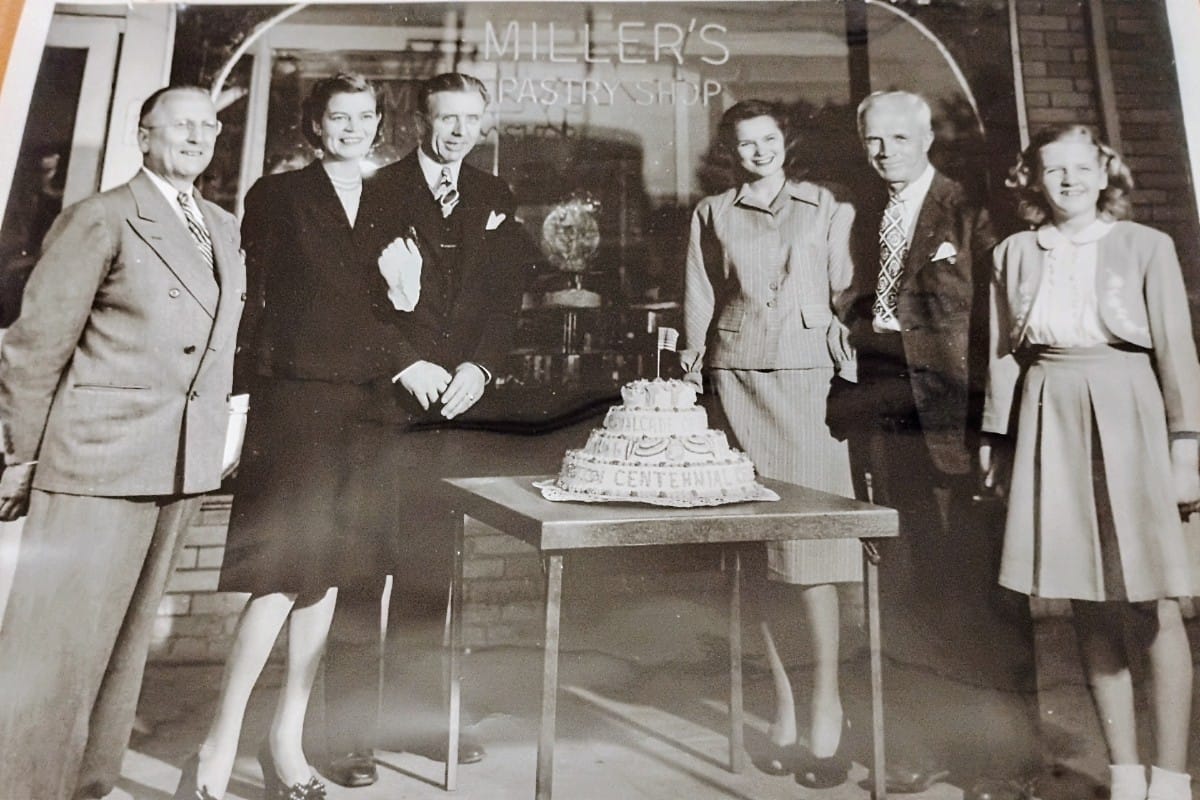
The concluding event was a party for those who participated in the effort in some capacity. It featured a 30-pound “birthday cake” donated by Miller’s Pastry, with punch made and served by the home-economics classes at Washington-Lee High School.
Little did some of the younger participants in the centennial celebration realize they’d be around when Arlington marked the county’s bicentennial.
The celebration, which took place throughout 2001, marked a different milestone. It was 200 years since the incorporation of modern-day Arlington into D.C.
Organizers based their reasoning on the fact that this defined the boundaries of today’s Arlington. Before being incorporated into D.C., the 26 square miles of what is now Arlington was merely a rural portion of Fairfax County.
Knowingly or not, organizers of the 2001 event borrowed a number of items from the 1946 celebration. There was a community parade as well as a multi-performance “tableaux” looking at the county’s past and present.
It may be too early to start planning the bicentennial of Arlington’s emergence as its own sovereign community, but the clock is ticking. Just 20 years remain until 2046 arrives.
Thanks as always to the Charlie Clark Center for Local History, Library of Virginia and D.C. Public Library (Washington Star archives) for assistance with research.
