

The following in-depth local history feature was supported by the ARLnow Press Club. Join to support local journalism and to get an exclusive version of our afternoon newsletter, plus an early look at what we’re covering each day.
Marymount University is in the midst of celebrating its 75th anniversary this year.
But were it not for a little-remembered Arlington County Board vote, the university might have been forced to depart the county a half-century ago.
Fate, and perhaps prayer, intervened. The university won the down-to-the-wire, 3-2 vote in large part due to the tenacity and diplomatic skills of the institution’s longest-serving president: Sister Majella Berg, RHSM.
The story of the 1965 zoning battle over Marymount’s future is worth retelling even if there are some gaps in the historical record. Marymount’s archives are off-limits to researchers at the moment, and efforts to track down county-government documentation of the vote were unfruitful.
But from news articles of the era, coupled with an oral history conducted with Berg two decades after the events, some pieces of the puzzle did fall into place.
Before reaching that 1965 vote, it’s necessary to step back almost two decades to the founding of Marymount by the Religious of the Sacred Heart of Mary (RSHM) order of Roman Catholic nuns.

A small start with modest growth
The Religious of the Sacred Heart of Mary is known for its work in education, having established a number of institutions with the name Marymount.
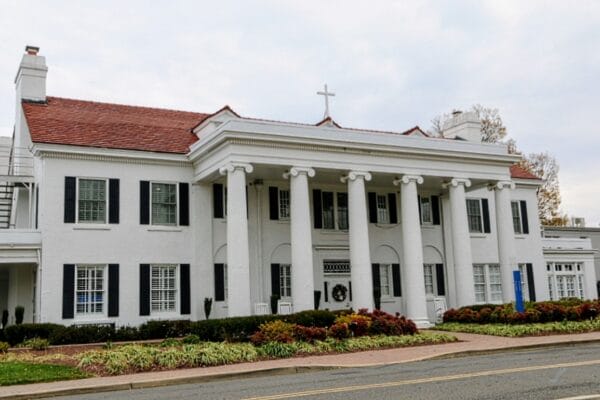
The order’s Virginia outpost began life in 1950 as Marymount College, a two-year institution for the education of women. While it has expanded to other areas, the main campus remains, located on what was once the estate of U.S. Navy Adm. Presley Rixey.
Rixey had served as the Navy’s surgeon general and as personal physician to Presidents William McKinley and Theodore Roosevelt. His large home and expansive grounds provided views east as far as the National Cathedral.
According to a history of the building, it was constructed around 1920 after Rixey’s farmhouse burned down.
After Rixey’s death at the estate in 1928, his widow continued living there. When she died a few years later, the home was sold and used as what has been described as a “tea house.”
In the late 1930s, when the main building at the adjacent Washington Golf & Country Club burned down, the club leased the former Rixey home to use as a dining room until a replacement was completed.
In searching for a location in Virginia, leaders of RSHM asked for the help of Peter Ireton, the bishop of Richmond.
Ireton’s diocese at the time encompassed all of Virginia. The Diocese of Arlington, carved out of the Diocese of Richmond to oversee the northern part of the commonwealth, was created in the 1970s.
Ireton and his staff helped facilitate the purchase of the former Rixey property in 1948. The sale included the main house, surrounding acreage, a stone guest house (today known as The Lodge) and two cottages.
In 1950, the main Rixey home was able to accommodate the entire founding class of students — 13 in all — plus faculty from the religious order.
Today, it houses the office of Marymount president Irma Becerra and several other departments, and serves as a setting for university social events.

Sister Majella arrives on the scene
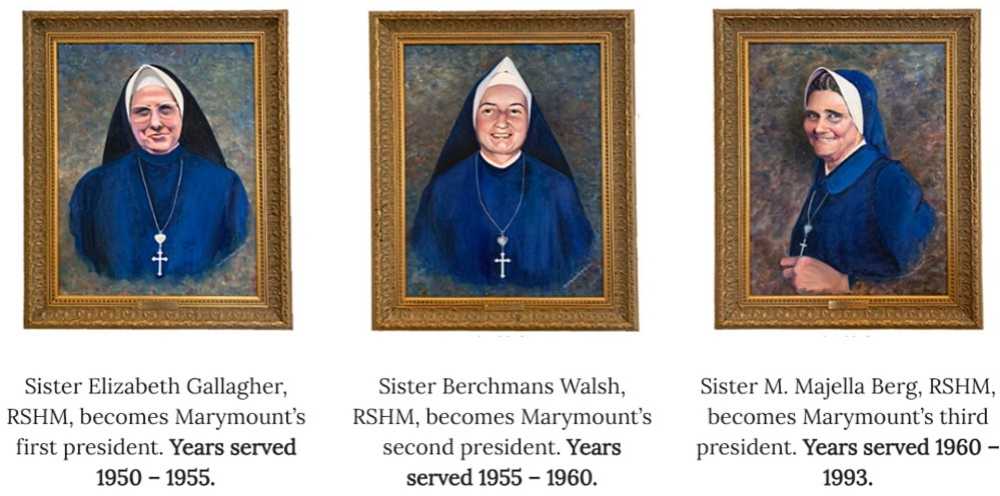
The first two presidents of Marymount each had five-year tenures: Sister Elizabeth Gallagher served from 1950-55 and Sister Berchmans Walsh from 1955-60.
So when Sister Majella Berg was dispatched to become president of the 240-student junior college, one might have expected that she, too, would have a relatively short tenure.
But “Sister Majella,” as she became known to one and all on campus, remained as president for 33 years, one of the longest tenures of any college or university president of her era.
Berg was born Mae Katherine Berg in Brooklyn in 1916. The name “Marie Majella” was bestowed when she became a nun at age 18.
Berg earned a bachelor’s degree in Latin from Marymount College in Tarrytown, N.Y., then a master’s degree in classics from Fordham University.
From 1936 until her appointment to the Arlington post in 1960, she held academic and administrative roles in various educational institutions run by her order.
New construction had taken place at Marymount before Berg’s arrival, with both Ireton Hall and Chapel Hall being completed in the late 1950s. More were in various stages of planning when she arrived, so Berg’s earliest years in Virginia involved efforts to grow the student population and facilities at the college.
Five years into her tenure, Berg put that experience to use when she faced what likely was the most challenging episode of her lengthy tenure.
In Majella Berg’s own words
The Charlie Clark Center for Local History at Arlington Central Library contains the transcript of an oral history with Berg, conducted in 1986 by Edmund Campbell.
In it, she details the close calls the college had with Arlington officials and the federal government in its quest to expand on the N. Glebe Road campus.
Though it was still a women’s junior college in the mid-1960s, Berg had plans to grow beyond its small beginnings.
In the interview, she pointed to the work of an economist of the time, who traveled the country telling higher-education leaders “you couldn’t have a good quality education unless you had 800 students — and you really should have 1,000, but 800 was the minimum,” Berg told Campbell.
At the time, Marymount had a much smaller enrollment, being capped at 500 under its existing zoning.
As for getting to 800 or 1,000? “At first I thought that was an impossibility,” Berg said, given the physical limitation of the existing, landlocked parcel.
“But we did a study of the campus and we found that we could have accommodations for 800 boarders plus some day students,” Berg said.
To finance expansion, the university sought low-interest loans from what was then the U.S. Department of Health, Education and Welfare, or HEW. University officials began filling out “all these blessed piles of papers” required, Berg said.
Expansion opportunities suddenly looked possible, even probable. But then a snag developed.
“We had everything set when, all of a sudden, we found that our neighbor didn’t want this expansion,” Berg said.
Neighbor not happy with proposal
The “neighbor” was Charles Olmstead, who owned an adjacent parcel and was known in Northern Virginia as the owner of an Oldsmobile dealership on Wilson Blvd.
At first, college officials thought an earlier rezoning of their campus meant there would be no need to return for additional approvals. But that belief turned out to be incorrect.
Under the new zoning interpretation, the front of the campus was not where the Rixey mansion faced N. Glebe Road, but instead on much lower 26th Street N. This meant that, under height restrictions connected with that zoning, the mansion itself really wasn’t supposed to be more than 6 feet tall.
Getting a variance for that issue was not likely to be a problem. The bigger challenge was that, under the existing zoning, the part of campus facing the Olmstead property would require buildings to be set back further from the property line than would be architecturally feasible.
“It was [planned for] 35 feet and [under the zoning] it was supposed to be 50,” Berg said in the oral history. “And so we had to get another variance.”
In the weeks before a public hearing on the request, the county government began putting up legal notices along Glebe Road. Their language set off alarm bells among many neighbors.
“Everyone got frightened to death that we were building some kind of skyscraper. It was really a problem,” Berg recalled.
Those fears could be allayed. The firm opposition of the Olmsteads to the proposal, however, could not. The family remained opposed to granting anything to Marymount.
“Someone would say, ‘What are you worried about Mr. Olmstead for? He’s only an automobile dealer,'” Berg recalled. “And you’d talk to someone else and they’d say [he was a] powerful guy. I didn’t know who to believe.”
All the while, the deadline for submitting paperwork for federal grant funding to support expansion was drawing ever closer.
The media starts paying attention
In the summer of 1965, the Northern Virginia Sun began to track the case. Its archives help to pin down details.
In the Sun’s issue of June 26, 1965, the newspaper carried a brief item noting that the County Board had deferred action on a requested use permit that would allow the expansion to go forward.
On Aug. 2 of that year, the Sun carried a legal ad notifying the public that on the next evening — a Tuesday — the County Board was slated to consider use permit U-1671-65-2, permitting operation of a junior college with increased enrollment of up to 800 students.
Final authorization for expansion would be subject to the county manager’s approval of a landscaping and drainage plan, and Board of Zoning Appeals’ approval of any height variances.
Nobody was sure how vote would turn out
Then as now, County Board members reserved Tuesday evenings to handle items that didn’t fit in the Saturday board meetings.
In this case, it may have been an effort by Board Chair Joseph Fisher, who supported the expansion plans, to give Marymount a few more days to rally support.
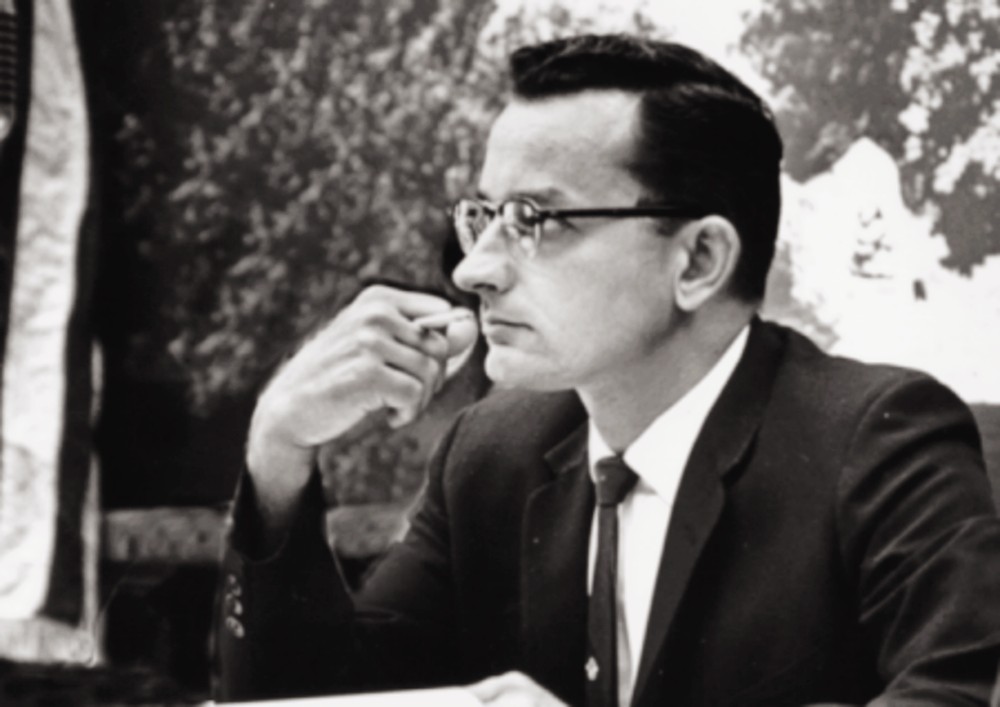
Going into the meeting, it was generally known that Fisher and colleague Harold Casto supported the expansion plan, while Roye Lowry and Leo Urbanske opposed it.
That left Thomas Richards as the swing vote.
Richards had been elected to the Board in 1960. His two four-year terms in office would include support for expanding Arlington’s parks — earning him the nickname “Nature Boy” from critics — and helping to usher in what would come to be known as “smart growth” development.
To get slightly ahead of the story, Richards (1926-2011) would return to the Board for a one-year stint in 1975, filling the remaining year of the term of Fisher, who in November 1974 had been elected to Congress by defeating Rep. Joel Broyhill (R-10).
The key vote approaches
That Tuesday-night meeting went into the wee hours of the morning, with “supporters and opponents in equal measure” turning out, the Sun reported.
Opponents largely were concerned about the height of new buildings, the Sun’s report noted.
Supporters of the proposal “came out and said we were part of the Arlington community — we had been doing a great job there and they certainly wanted us to get the facilities that we needed,” Berg recalled in the 1986 oral history.
The meeting rolled past midnight and then approached 1 a.m. Those assessing the situation anticipated the discussion would end in a 2-2 tie vote, with Richards abstaining.
A 2-2-1 split would have meant the effort failed for the moment, but could be brought back later for further consideration.
“Mrs. [Elizabeth] Weihe told me, don’t be discouraged if they continue it, because it’s not turning it down,” Berg recalled. “I said, if they continue, they can get me a coffin because I can’t stand any more of this.”
Berg said that in trying to get the elusive third vote for approval, Fisher appealed to a power slightly higher in the pecking order than the County Board.
“At a quarter to one, Dr. Fisher said, ‘Well, everyone, please say a prayer,'” she recalled.
Maybe it worked, because rather than abstaining, Richards voted yes — “reluctantly,” he noted, but yes nonetheless.
“I felt the Lord must have really wanted this, because it was a case of skin-of-the-teeth,” Berg said. “If we hadn’t gotten that, that would have been the end, because we wouldn’t have gotten the loans.”
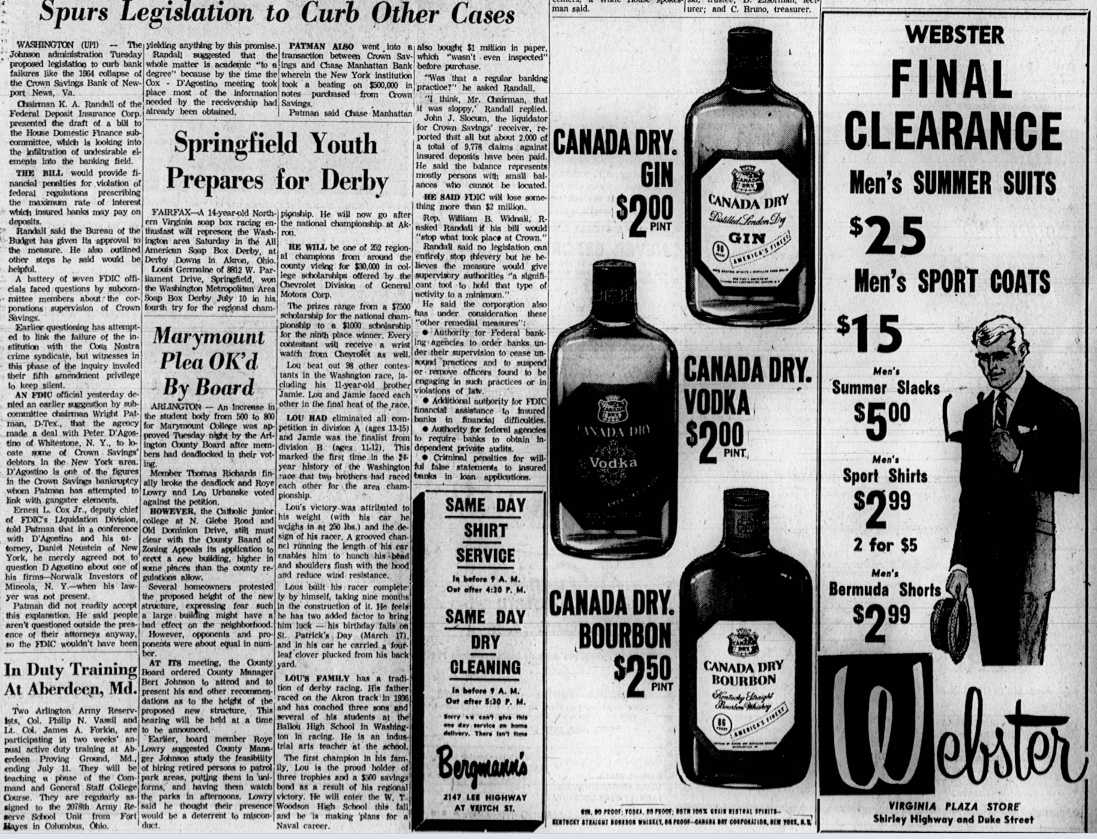
The Sun reported on the vote in that day’s edition. Perhaps because it happened so late at night, close to the newspaper’s publication deadline, coverage was relegated to a six-paragraph item on an inside page.
More bureaucracy awaits
The college had its zoning approval, but still didn’t have the federal cash in hand.
And because the federal government had imposed a moratorium on new education-construction funding at just that moment, the whole plan again seemed at risk of collapse.
“I didn’t know what to do,” Berg confessed. “So I went over to see Mr. Broyhill and asked him what to do about it.”
Broyhill not only represented Arlington in Congress at the time but was a neighbor of the college. In addition, his family had developed some of the residential neighborhoods around it.
Broyhill’s two-decade (1953-74) career in Congress seemed centered on two main passions: conservative politics and constituent service. Under the sound political theory that it is never a good idea to turn down a nun’s plea, he promised Berg to do what he could to help, urging the college to have all its paperwork ready to go.
At the time, Broyhill was coming off an unexpectedly close battle for a new term in 1964 against Democrat Augustus Johnson. He withstood and would remain in office until unseated by Fisher during the Watergate election of 1974.
Broyhill put in words of support for the university. Ultimately, the federal funding stream reopened, and Marymount got the loan to continue its expansion program.
The Northern Virginia Sun continued to cover the ongoing expansion, with several articles in October 1965 plus the news in 1966 that a $1.2 million loan for academic facilities had been approved by HEW and the U.S. Department of Housing and Urban Development (HUD).
Two years later, the paper reported that HEW and HUD had agreed to a $1.7 million, 40-year bond at 3% interest to allow the university to continue expansion plans.

Growth and evolution continue
Sister Majella Berg remained at the helm of Marymount until retiring in 1993. After the zoning battle of 1965, she oversaw the transition to a four-year institution of higher education, the introduction of graduate programs, and the process of becoming fully coeducational in 1986.
Among those with fond memories of Sister Majella is Louisa Llop. She is one of four sisters — with Rita, Elizabeth and Ann — who were raised mostly in South America as their father was in the Foreign Service. Each ended up attending Marymount in the 1960s-70s.
“I lived right down the hall from Sister Majella while I was a resident assistant in the Main House,” Louisa Llop recalled in an interview with a Marymount publication.
“Our whole family loved her,” she said. “She was at every family wedding and baptism and became close to my parents when they moved back to the States. She is one of the main reasons we enjoyed our time at Marymount so much.”
Berg in 1993 was succeeded as president by Sister Eymard Gallagher. Like Berg, Gallagher had received a new first name upon becoming a member of RSHM; her birth name was Delphine Gallagher.
Gallagher, who served until 2001, was the last RSHM member to date occupying the presidency. Her three successors — James Bundschuh, Matthew Shank and Irma Becerra — have been Catholic lay educators.
In 1993, Berg was named president emerita of the university, and remained an active public face of the institution, spending many more years on campus before eventually moving to a property in New York run by her religious order.
Berg was named to the Virginia Hall of Fame in 1992 and as a Notable Woman of Arlington. A year later, Pope John Paul II bestowed the Pro Ecclesia et Pontifice (“For Church and Pope”) medal upon her, and she later was honored as a Virginia Changemaker through the Library of Virginia’s Strong Men and Women in Virginia History initiative.
In 1998, Berg was named to the Washington Business Hall of Fame.
At Marymount, a residence hall for male students is named in her honor. Berg Hall also is home to the university’s Student Health Center, the Counseling Center and Office of Campus and Residential Services.
Each year, Marymount presents the Sister Majella Berg Service Award to a student for exceptional dedication to serving others.
Presented around commencement, the 2025 award went to Cara Craig, a criminal justice major.
A permanent memorial
At her death in 2004, the 87-year-old Berg had been a member of the Religious of the Sacred Heart of Mary for 68 years.
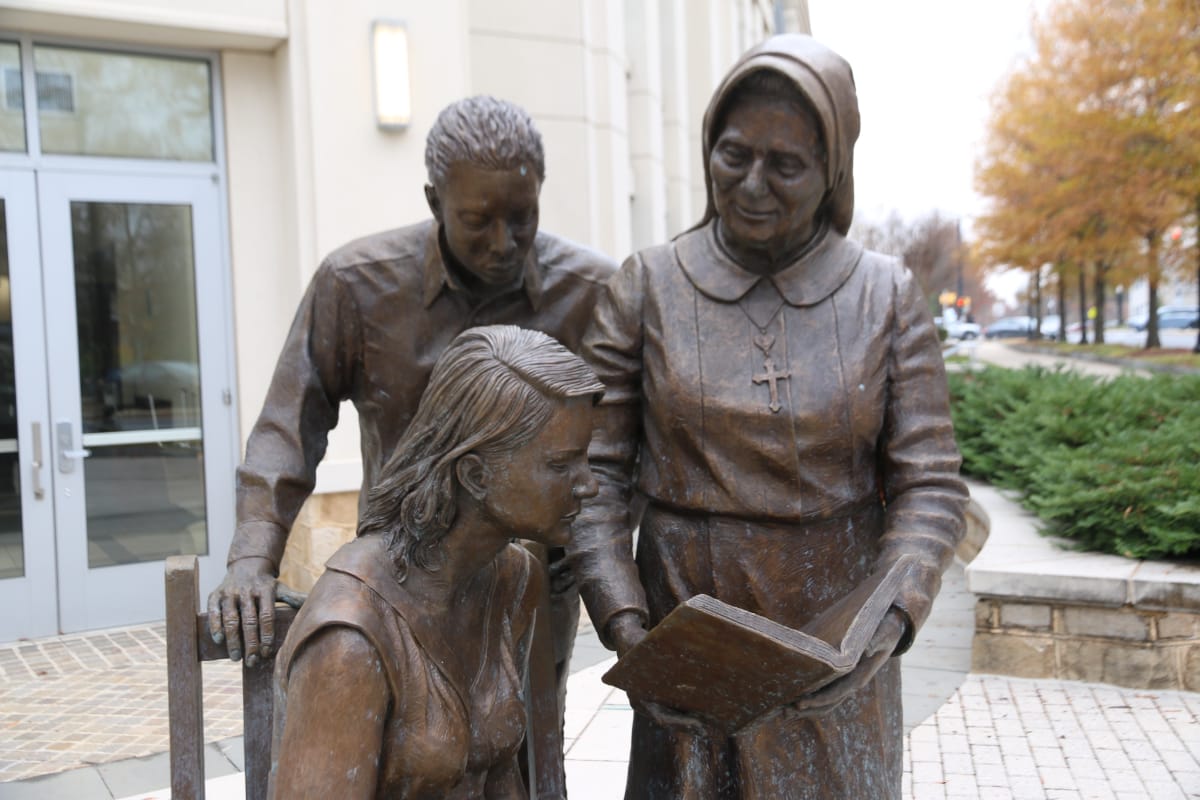
In 2011, the university unveiled a 1,500-pound bronze statue outside the new Caruthers Hall, showing Berg overseeing the studies of a male and female student.
“It really does look like her!” then-Marymount president Bundschuh exclaimed at the unveiling.
The dedication ceremony marked the first time any RHSM member had been honored with a statue.
At the 2011 unveiling, artist Kathleen Farrell said the work could withstand hundreds of years in its outdoor location, but would require proper care to avoid the greenish tint that comes with oxidation.
University officials must have taken that caution to heart. No green patina was to be found during a recent visit to the sculpture, located on the 26th Street S. side of the main campus.
At the 2011 event, Bundschuh touched the statue for good luck, inaugurating what he hoped would be a tradition. As an added incentive, he suggested to students that a quick tap on the sculpture while passing by could bring them better test scores.
Thanks to the Charlie Clark Center for Local History, Library of Virginia and Marymount University for assistance with this article.
