

This sponsored column is by Law Office of James Montana PLLC. All questions about it should be directed to James Montana, Esq., Janice Chen, Esq., and Victoria Khaydar, Esq., practicing attorneys at The Law Office of James Montana PLLC, an immigration-focused law firm located in Falls Church, Virginia. The legal information given here is general in nature. If you want legal advice, contact us for an appointment.
ArlNow readers, like the reckless scientists of Jurassic Park, need to be told, occasionally, to hold onto their butts. We told you to do so, and we were right. On January 1, USCIS Director Joe Edlow released another profoundly silly memo adding another twenty countries to the Trump Administration’s domestic immigration freeze. In this advertorial, we’ll tell you (1) what countries have been added, (2) possible reasons why, and (3) how this is affecting our clients.
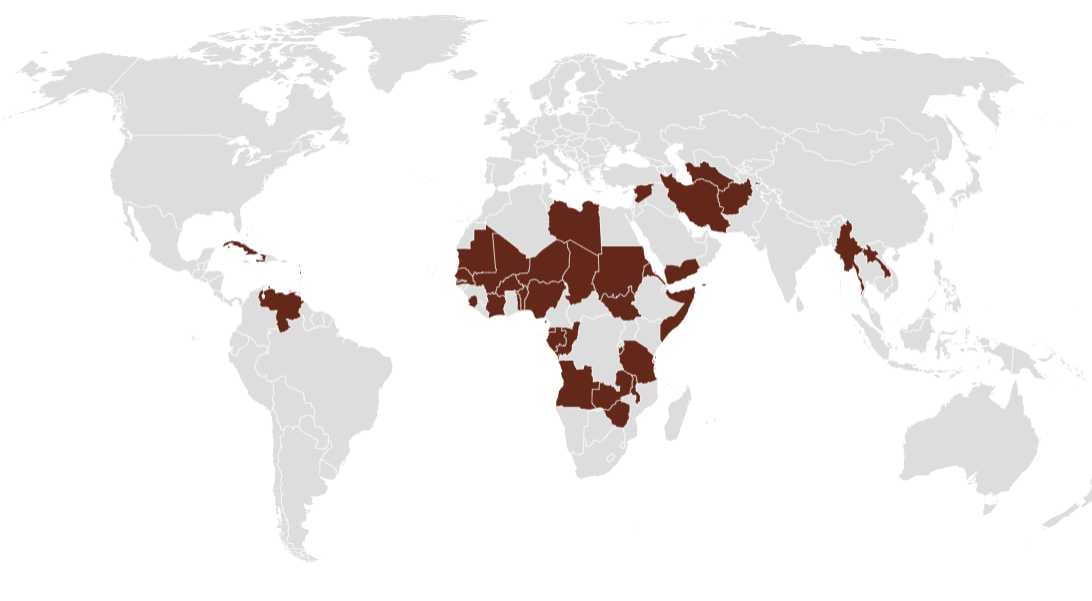
The full list now reads: Afghanistan, Angola, Antigua and Barbuda, Benin, Burkina Faso, Burundi, Chad, Congo, Cuba, Dominica, Equatorial Guinea, Eritrea, Gabon, Haiti, Iran, Ivory Coast, Laos, Libya, Malawi, Mali, Mauritania, Myanmar, Niger, Nigeria, Senegal, Sierra Leone, Somalia, South Sudan, Sudan, Syria, Tanzania, The Gambia, Togo, Tonga, Turkmenistan, Venezuela, Yemen, Zambia, and Zimbabwe.
Some of these countries are obvious window dressing; North Korea does not permit its citizens to leave, and the United States does not offer visa services to North Koreans. If you ignore the window dressing (North Korea, Iran, Cuba, Venezuela) and the fulminant civil wars (Yemen, Burma) it is obvious what gets you on the list: being a country in Subsaharan Africa, a region the President no longer even pretends to respect.
What does this mean for our clients? It has concrete and serious consequences. Here are a few people – anonymized, of course – from my casefiles.
- Ms. Z, a Laotian national, has her immigrant visa interview in a week. After working for the last two years to get her to the interview in Burma, in the midst of a civil war, Ms. Z’s visa will be denied. Her husband, a U.S. citizen, who stocks the grocery shelves at your local frou-frou emporium, won’t get to live with her for an indeterminate period.
- Ms. N, a Zambian national, has been my client since she was a little girl. She is applying to renew her DACA, and her work permit is on the chopping block. If her employer notices that USCIS failed to renew her work permit, she’ll be fired.
- Ms. B, a former Afghan civil servant (in the U.S.-backed government!) applied for and won asylum in this country. She has duly applied for a green card. Her application will be frozen forever.
It isn’t quite fair to say “forever.” USCIS Director Edlow makes clear, with insouciant bureaucratic longueur, just how and when he is prepared to thaw the freeze. This passage really is worth reading, both in full and in translation.
Per the memo, the freeze will be thawed when USCIS has finished a “a thorough review on a case-by-case basis to assess benefit eligibility including whether:
- The alien is listed in the Terrorist Screening Dataset (TSDS) as a Known or Suspected Terrorist under Tier 1 or Tier 2 classifications or is included in Tier 3 of the TSDS with significant derogatory information related to the alien.
- The alien is connected to prior, current, or planned involvement in, or association with, an activity, individual, or organization described in sections 212(a)(3)(A), (B), or (F), or 237(a)(4)(A) or (B) of the Immigration and Nationality Act (INA).
- The alien is linked to prior, current, or planned involvement in, or association with, an activity, individual, or organization that may pose a risk of serious harm or danger to the community, including criminal conduct described in INA 101(a)(43), 212(a)(1)(A)(iii), 212(a)(2), 237(a)(2), or 237(a)(4)(A)(ii).
- The alien is unable to establish their identity as outlined in PP 10949 and PP 10998.”
What does that mean, in plain English? It means that USCIS is going to review, one human being at a time, the following impossibilities:
- Whether any database shows that the immigrant has, at any time, been logged in a terrorism database that her lawyer may not see.
- Whether the immigrant was ever associated with an organization disliked by the U.S. government, or might ever associate with such an organization in the future.
- Whether the alien has ever had, or ever may have any connection, however glancing, with an activity considered to be dangerous “to the community” by the Trump Administration.
- When South Sudan will start issuing birth certificates in a way that meets Joe Edlow’s exacting standards, or those of his political masters.
The only way this will end is by litigation. Some federal judge, somewhere, will say “enough.” Until then, I suppose, the Trump Administration will have its way.
