

Arlington’s level of homelessness was largely stable from 2025 to 2026, but the number of those considered chronically homeless showed a year-over-year increase.
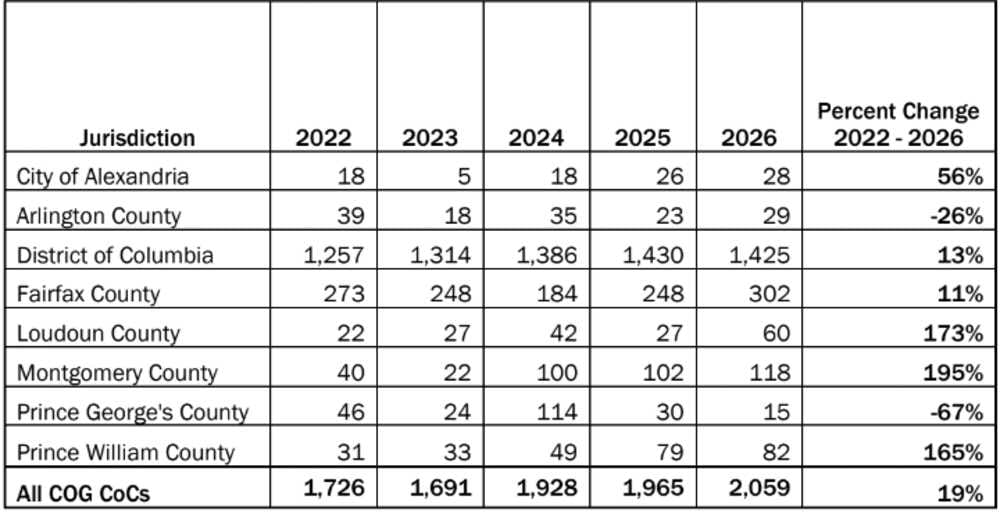
A total of 29 single adults in Arlington were counted as chronically homeless in this year’s Point-in-Time Survey, a one-night regional tally of those experiencing homelessness across the region. That’s up from 23 a year before.
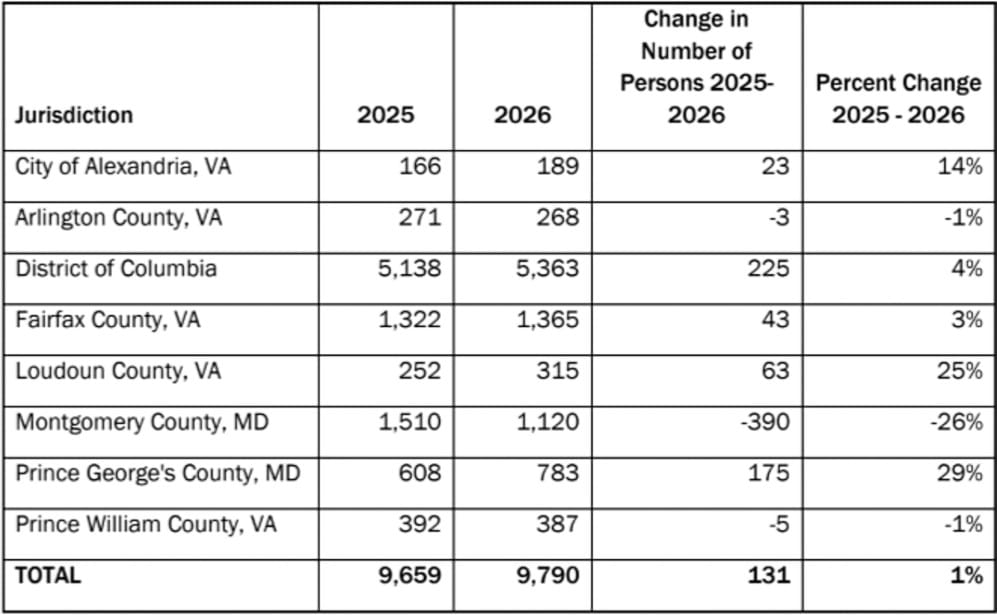
Overall, in the 2026 count, there were 268 people in Arlington experiencing homelessness — down slightly from 271 a year before and marking the first year-over-year decline since 2022.
“Chronically homeless” people have either been without permanent housing for a continuous year, or have been experiencing homelessness on multiple occasions totaling more than 12 months over the preceding three years. Some are living on the streets, while others are accommodated in shelter facilities.
Arlington’s figure has ranged between 18 and 39 individuals over the last five annual counts.
Region-wide, the number of chronically homeless individuals increased 5% year-over-year to 2,059, with most — 1,425 people — reported in D.C. Arlington follows a similar trend in nearby Fairfax County, where chronic homelessness also experienced an increase despite overall rates of homelessness being relatively stable year-over-year.
Count was delayed due to weather
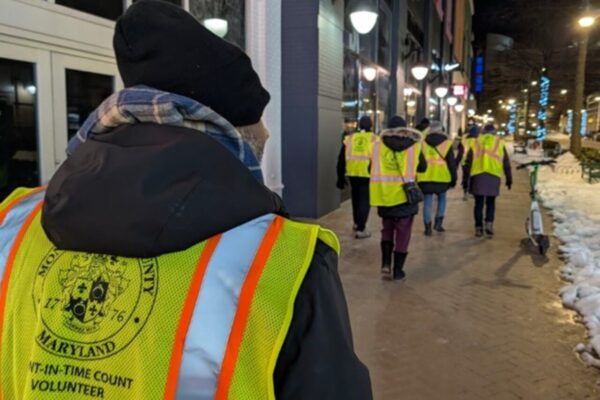
The 2026 survey was conducted overnight on Feb. 4-5. Typically held in late January, it was delayed two weeks due to inclement weather and freezing temperatures.
Coordinated by the Metropolitan Washington Council of Governments, the effort uses government staff and volunteers to tabulate those living on the streets. Local shelters provide usage information for that night, which is added into the total.
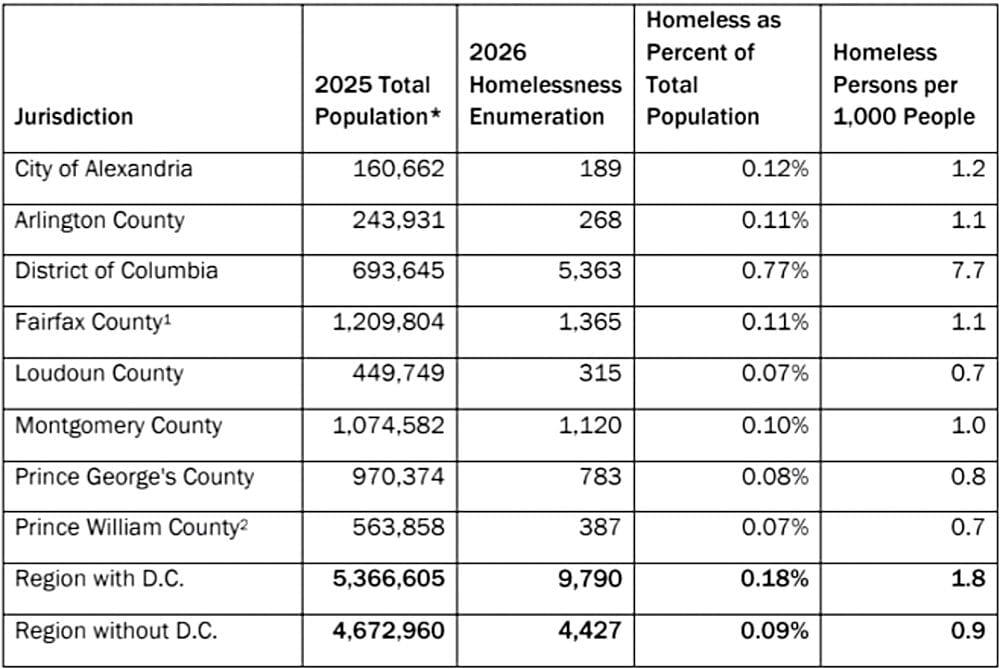
Arlington’s 2026 rate equated to 1.1 people per 1,000 total population, slightly higher than the rate of 0.9 per 1,000 recorded throughout the D.C. suburbs this year.
Of the 268 in Arlington, 25 were unsheltered — living outside — compared to 37 in 2025. County officials attributed the decline in part to the weather conditions and in part to an increase in shelter availability compared to a year before.
According to county officials:
“People experiencing unsheltered homelessness received bagged meals, a backpack of supplies, a gift card for completing a survey, and other supplies upon request. Surveyors were provided with Narcan and Fentanyl awareness training, including lifesaving and harm prevention supplies while canvassing the county.”
Among those experiencing homelessness in Arlington were 17 families, totaling 65 people, down from 33 families with 88 members last year.
Four of those experiencing homelessness in Arlington were military veterans.
Regional levels of homelessness rise slightly
Across the Washington region, the 2026 Point-in-Time count of those experiencing homelessness totaled 9,790, up 131 individuals (1%) from 2025.
The 2026 count was conducted on Feb. 4. It was postponed from late January, when counts typically occur, owing to winter weather.
Volunteers and local-government personnel fanned out across the region to count those living in unsheltered conditions, while shelters provided occupancy information included in the total numbers.
Those in shelter facilities represented 87% of those counted during the 2026 event.
Christine Hong, who chairs COG’s Homeless Services Planning and Coordinating Committee, said the report has built-in limitations but still provides valuable insights.
“Although it’s an imperfect measure, it provides an important regional snapshot,” said Hong, a human-services official with the Montgomery County, Md., government.
The data “tells us who was counted on one night,” she said, “[but] does not tell us causation, does not by itself tell us exactly why someone became homeless, why one jurisdiction increased while another decreased.”
Funding cuts, economic impacts affect totals
Addressing the COG board, Hong acknowledged “significant cuts” to supportive-housing programs implemented by the Trump administration. More may be on the horizon.
“We are still anticipating threats and continuing uncertainty,” she said.
In a narrative from county human services officials that was part of the regional analysis, Arlington officials said homelessness frequently is a symptom of larger societal issues.
“Effectiveness [in addressing homelessness] is only as strong as its surrounding economic and social environment,” county officials said. “Ending homelessness for all is dependent upon sufficient affordable housing, flexible and long-term rental assistance programs, and community-based services to assist people in sustaining stability.”
The county government partners with PathForward and other safety-net organizations to provide shelter and services to those experiencing homelessness.
Concerns raised about senior adults
One of the concerns raised at the meeting was an increasing level of homelessness experienced by the region’s seniors.
“Older adults experiencing homelessness face unique vulnerabilities due to health or mobility limitations,” the Point-in-Time survey reported.
“They may also have more significant health concerns not typically seen in homeless services systems, such as Alzheimer’s disease or cancer,” the report said.
The report noted that “the average life expectancy of a person experiencing homelessness is estimated between 42 and 52 years, compared to 78 years in the general U.S. population.”
In Arlington, 70 of the 268 counted as homeless in the survey were age 55 and older, including five who were unsheltered. Of the 70, 19 were over age 65, while three were between 80 and 90 years old.
The 70 people aged 55 and older counted during the 2026 PIT Count represent 26% of the overall count.
“In 2025, 32% of people surveyed were 55+, suggesting efforts at the local level to address that population are paying off,” county officials said.
