

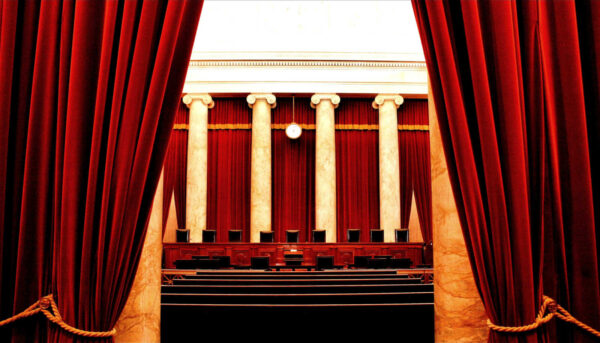
The Supreme Court tends to hand down its most controversial and political decisions at the end of June, and this year’s batch did not disappoint. In this brief advertorial, we’ll review the three most important decisions with respect to immigration law and migrants: the decision preserving birthright citizenship (Trump v. Barbara), the decision which effectively allowed the Administration to abolish TPS (Mullin v. Doe), and the decision which allowed the Administration to continue to turn away almost all asylum seekers at the U.S. border (Mullin v. Al Otro Lado).
Trump v. Barbara: Birthright Citizenship Lives On
We predicted that the Administration’s attempt to abolish birthright citizenship would fail. We were right, but only just. A bare majority of five justices (Roberts, Barrett, Sotomayor, Jackson, Kagan) found that the Trump Administration’s executive order seeking to abolish birthright citizenship by fiat was barred by the 14th Amendment’s guarantee of citizenship to “[a]ll persons born or naturalized in the United States, and subject to the jurisdiction thereof.” A sixth (Justice Kavanaugh) concurred in the judgment, but did not find that birthright citizenship was guaranteed to all by the 14th Amendment, instead holding that President Trump’s executive order simply contravened 8 U.S.C. § 1401(a), which codifies birthright citizenship as a matter of statute.
Birthright citizenship is safe for the foreseeable future, even if there are changes to the court’s composition. Congress is not going to abolish or amend 8 U.S.C. § 1401(a), and it is hard to see how a new executive order could make its way before the court before the end of the current President’s term.
Mullin v. Doe: TPS is Doomed, Doomed, Doomed
We offered no prediction on Mullin v. Doe, but, truth be told, we weren’t surprised by the outcome. When the Temporary Protected Status program was enacted, Congress specifically exempted TPS determinations from judicial review. (Yes, Congress can do that!) The statutory bar was fairly stark: “[t]here is no judicial review of any determination of the [Secretary of Homeland Security] with respect to the designation, or termination or extension of a designation, of a foreign state.” The challengers argued that this bar applied only to the substantive decision to designate a country’s designation or terminate a country’s TPS designation, so the courts could review procedural steps taken along the way toward a designation. That mattered here, because the Trump Administration is (a) very bad at following proper procedures, and (b) very bad at concealing its malignancy from the public. As Justice Kagan’s dissent points out, the President of the United States has offered the following opinions about Haitians: they eat the cats and dogs of the good people of Springfield, Ohio, they “probably have AIDS,” Haiti is a “shithole country,” which is “filthy, dirty, and disgusting.” But Justice Kagan’s dissent was cosigned by only two other Justices – Sotomayor and Jackson.
Only two countries were directly affected by the decision in Mullin v. Doe – Syria and Haiti. But every other TPS-designated country (Burma, El Salvador, Ethiopia, Honduras, Lebanon, Nepal, Nicaragua, Somalia, South Sudan, Sudan, Syria, Ukraine, Venezuela, and Yemen) is either already terminated or living on borrowed time. There is, in our judgment, no way that TPS can survive for any country if the Administration declines to extend it.
Mullin v. Al Otro Lado: The Border Is Still Closed
This case concerned a policy called “metering” through which the United States attempted to limit the number of people who could enter the United States, and then, once on American soil, seek asylum protection. Al Otro Lado, an immigrant rights’ organization, challenged this rule, arguing that physically blocking entrance into the United States did not excuse the government from its obligation, under the Refugee Act of 1980, to allow prospective entrants to apply for asylum. The Court found against Al Otro Lado and in favor of the government. If the United States wishes to bar people from making asylum claims, a physical wall will serve as a legal wall, too.
These were quite consequential decisions. The Birthright Citizenship decision, in particular, was enormously important; if the Court had abolished the jus solis rule, the fundamental character of our society, never mind our immigration laws would have been set on a quite different path. The abolition of TPS is going to push some immigrants who are eligible for adjustment of status or other relief – like asylum for instance – to apply for those benefits. (We are here to help with that, obviously.) The effects of Mullin v. Al Otro Lado will be large, but invisible – you won’t see the asylum applicants who never make it here at all. They still exist, of course. But, in the view of this Administration, they’re someone else’s problem, and that’s good enough for government work.
