

One of the goals of those seeking to revamp Arlington’s governance structure is an end to holding at least one County Board election every year.
Had it not been for a quirk of political fate, that might have happened nearly 60 years ago.
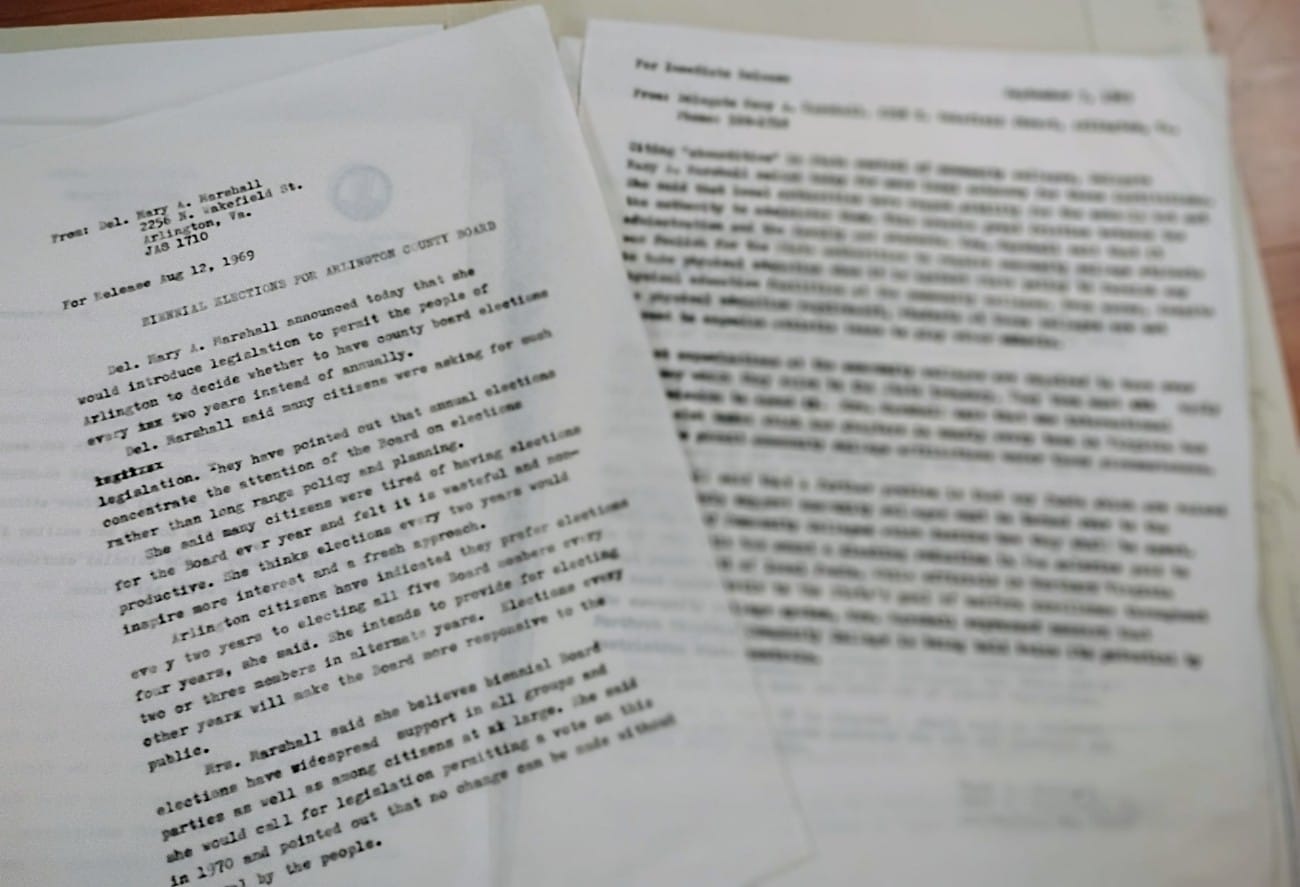
In the summer of 1969, Del. Mary Marshall announced she would introduce legislation in the subsequent General Assembly session, giving Arlington the power to move to every-other-year Board elections. Under Marshall’s plan, voters would select two Board members one year, then the remaining three two years later.
This would have brought Arlington closer to the format used in neighboring Falls Church, where three seats are elected in even-numbered years, followed by a year’s break and then elections for the four remaining seats.
In her press release of Aug. 12, 1969, Marshall said “many citizens” were asking for the change from yearly Board elections.
“They have pointed out that annual elections concentrate the attention of the Board on elections rather than long-range policy and planning,” Marshall said, calling the holding of local elections every year “wasteful and nonproductive.”
“Elections every two years would inspire more interest and a fresh approach” to governance, she predicted.
In the press release, Marshall said she would include a provision that any changes must be ratified in a voter referendum.
So what happened to derail the plan? The election of 1969.
All of Arlington was then included in a single House of Delegates district, the 9th, with four members. The 1969 Democratic ticket in the 9th House District — Marshall, Del. William Lightsey, Vivian Kallen and Arthur Walls — went down to defeat to Republicans George Mason Green Jr., Allen Harrison, Henry Lampe and George Shafran.
It was the same year in which Virginia voters, including those in Arlington, supported Linwood Holton’s bid to become state’s first Republican governor since Reconstruction.
There’s no indication that Marshall’s governance-change proposal played any role in the 1969 campaign, but the Republicans elected that year seemed disinclined to follow up on her proposal.
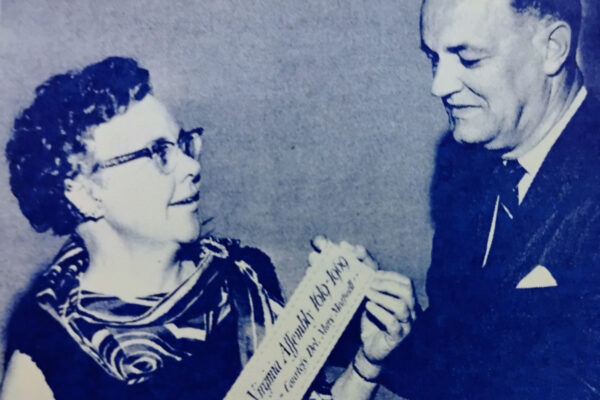
Marshall would return to the House of Delegates two years later, serving until 1992. Less than a year after her retirement, she died at age 71 following a fall at her home.
Marshall’s proposal is tucked away in her files, which are maintained by the county library system’s community archives. The mimeographed press release was uncovered during research for broader coverage of the quirky 1969 General Assembly election, which will run in coming weeks.
By the dawn of the 1970s, the yearly election of County Board members had been in place for more than three decades. But it didn’t start out that way.
In 1931, Arlington held its first County Board election, with all five seats on the ballot. The same cycle was used in 1935.
In 1939, the county switched to staggered terms, with the highest vote-getters that year receiving the longest terms.
Based on the results, Elizabeth Magruder and F. Freeland Chew were elected to four-year terms, Edmund Campbell to a three-year term, Basil DeLashmutt to a two-year term and Leo Lloyd to a one-year term.
All current Board members can trace their political lineage to the 1939 race. Current County Board Chair Matt de Ferranti, first elected in 2018 and seeking re-election this year, occupies the seat first held by Campbell.
Campbell went down to defeat to Dan Dugan in an acrimonious 1946 campaign. Dugan was followed by Leone Buchholz (elected in a 1952 special election), Leo Urbanske (1958), Ned Thomas (1966), Joseph Wholey (1970), Stephen Detwiler (1978), Mary Margaret Whipple (1982), Chris Zimmerman (1996), John Vihstadt (2014) and Matt de Ferranti (2018).
Ending every-year elections is one proposal that likely will be considered as the community moves forward with a discussion of governance changes in 2027. Others include:
- Expanding the current County Board beyond five members
- Electing a County Board chair separately from other Board members and potentially expanding the chair’s powers
- Having some or all Board members elected in districts rather than at-large
- Potentially moving from county to city status
Some of the changes would require approval from the General Assembly, and could involve community referendums.
Last December, Board members set up a timetable that aimed to set up a community task force on the subject this summer. For a number of reasons outlined in mid-June, that timeline has slipped.
Now, Board members anticipate a consultant’s report by the end of the year, with no announced plan for how the process will continue into 2027.
