

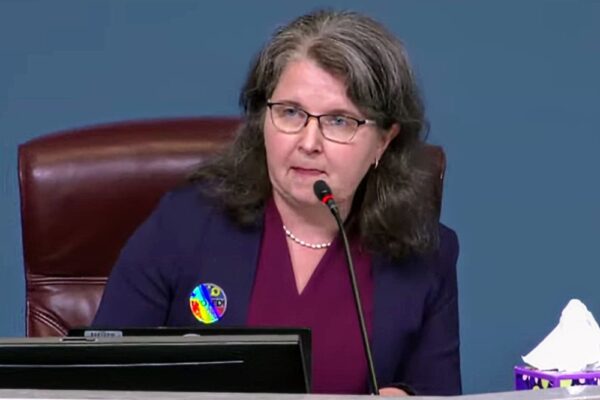
County Board members went into their two-month summer break after 15 minutes of verbal fireworks over Missing Middle housing policies currently tied up in litigation.
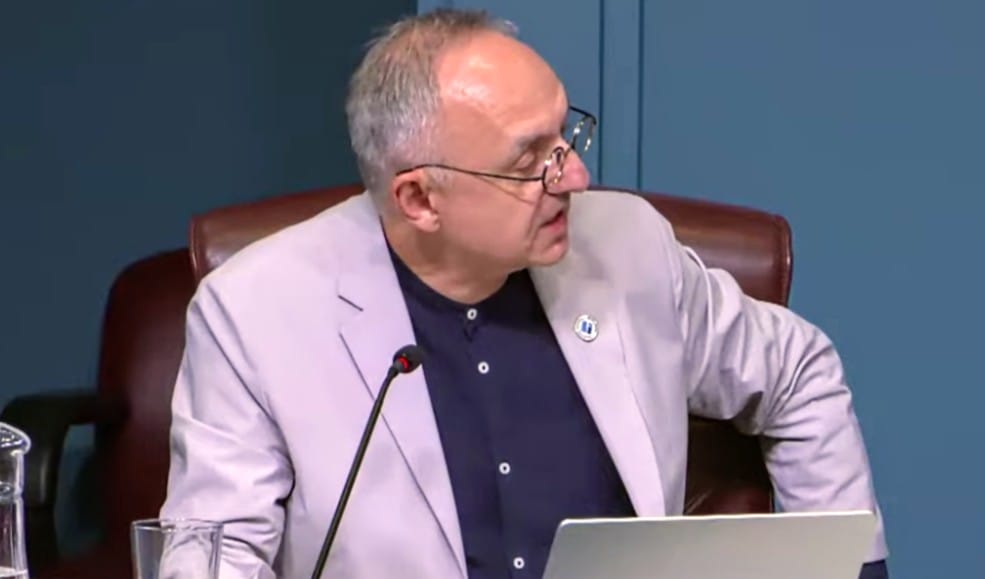
Three Board members — Maureen Coffey, Julius “JD” Spain, Sr., and Takis Karantonis — castigated colleague Susan Cunningham for a proposal made without much advance notice at the tail end of the Board’s July 21 meeting.
It was a rare public spat among Board members who typically try to keep major disagreements out of public view.
Cunningham proposed an “initiating resolution” that is required to start formal consideration of zoning changes. Her focus was on addressing expiring county caps on the number of homes that could be built under Expanded Housing Option (EHO) regulations, also known as Missing Middle.
That zoning change remains in limbo awaiting a ruling by the Virginia Supreme Court, but Cunningham said starting a process now could allow for future consideration, depending on the ruling.
“We will want to have a conversation in the next four to 12 months,” she said.
Cunningham, who as a candidate in 2023 and in office since 2024 has walked a fine line on Missing Middle, acknowledged when making the motion that she would likely not carry the day.
“I fully recognize we will probably not proceed with it today,” she said. “It’s probably not the right motion. We haven’t vetted it all the way through.”
Then the fireworks began, as Coffey, Spain and Karantonis expressed public anger rarely seen from the all-Democratic Board dais.
“This is just not respectful to us as your colleagues — just not acceptable,” said Coffey, who like Spain and Karantonis had only learned of Cunningham’s plan at the July 21 meeting.
Coffey, who largely supports Missing Middle housing policies, went on:
“There’s room for us to disagree on the [housing] policy. There’s room for us to have discussions. But frankly, this is not the way to go about it, to surprise everyone with this. It’s a disservice to the point you’re trying to make and the work you’re trying to get done. It just puts us in a horrible position now, where none of us has had the chance to think it through.”
Spain was next.
“I really feel blindsided,” he said. “We don’t like surprises. I don’t like surprises.”
Spain, who strongly supports Missing Middle housing policies, went on:
“Are we trying to get talking points on ARLnow? I’m not playing that game. This was not the time nor the place to have the conversation.”
Next up was Karantonis, another Missing Middle supporter.
“This is not acceptable, period,” he told Cunningham. “This is politics, pure politics.”
Karantonis went on:
“One logical conclusion would be that you are not interested in discussion, you are interested only in the public exposure and your own political benefit … you made yourself not viable from the point of credibility.”
Cunningham had given Board Chair Matt de Ferranti a heads-up that her proposal was coming, but de Ferranti said he understood the others’ concerns about having the matter sprung on them at the Board meeting.
“That is a point I empathize with,” he said.
Beyond the policy questions, several Board members seemed to take offense that, in framing her proposal, Cunningham brought up a recent visit she had with Dr. Alfred Taylor. The two discussed ways to bring the community together, she said.
Taylor, who is in his 90s and facing chronic illness, is a venerated figure in Arlington, having chronicled the lives of residents in Green Valley and written a number of books about the community.
Spain said it was “really bothersome” to involve Taylor in an issue that draws passions on all sides.
“That’s not right,” he said.
In response to the criticism, Cunningham said that under new rules implemented after the initial Missing Middle zoning ruling, county staff outside the county manager and county attorney can’t be involved in working on a proposal until the initiating resolution is adopted by Board members.
On that point, she was backed up by County Attorney Ryan Samuel. “That’s been the process we’ve been following,” he said.
As for the criticism she received for not keeping her Board colleagues in the loop, Cunningham thanked them for what she termed “clear and careful articulation” of their views.
“I will look forward to talking to each of you about it after summer break,” she said.
Board members historically have not held August public sessions except under extreme circumstances. Under the adopted 2026 schedule, they are slated to return on Saturday, Sept. 19.
