


This reporting was supported by the ARLnow Press Club. Get upgraded email newsletters while supporting in-depth local journalism.
The recent 100th-anniversary celebration at Washington-Liberty High School saw current-day students poring over yearbooks from the 1960s-70s.
They seemed both perplexed and excited about the lives of their predecessors a half-century before.
Imagine the reaction if students looked back another 50 years to the very start of their high school, known the first 90 years of its history as Washington-Lee. The easiest way to take a time machine to this period is to leaf through the pages — either in print or online — of the very first W-L yearbook.
This was published in the spring of 1927, at a time when the graduating senior class consisted of fewer than three dozen students. It shows a student body fully embracing the look of the Roaring ’20s with an optimism not yet tempered by ensuing decades, which would bring a depression followed by a second world war.
For those graduating seniors, most born from 1908-1910, it was a time to look forward to opportunities, not dwell on challenges. And while they are all now gone, those students are captured in time in the flower of youth, preparing to step into a world that their generation would shape until well into the 1980s and beyond.
Before delving into their lives as depicted in the yearbook, it’s worth setting the broader stage.
Arlington’s complex high-school history
Arlington’s high-school history is both complicated and clouded by gaps in the historical record.
When Washington-Lee opened in the 1920s, it wasn’t the only public high school in the county. Further south, in the Del Ray area, was George Mason High School.
Some will ask, “Isn’t Del Ray in Alexandria?” Indeed it is, but until 1929 it was part of the southernmost portion of Arlington County.
That area also included the town of Potomac, one of several towns that once existed in Arlington just as Herndon, Vienna and Clifton today can be found inside the borders of Fairfax County.
In 1929, however, leaders in Alexandria successfully annexed the southernmost portion of Arlington. With it went George Mason High School, which henceforth served Alexandria residents.
The annexation also brought the disappearance of the town of Potomac. Based on a contentious later court case, Arlington County never again would be allowed towns inside its remaining 26-square-mile confines.
Both W-L and George Mason served only white students. Until the late 1930s, Arlington paid the city of Alexandria to educate some Black high-school students at the segregated Parker-Gray School, while other Black high schoolers from Arlington attended classes in D.C.
It would not be until 1942 that Arlington’s Hoffman-Boston School, serving Black students, had its first graduating class of high-school seniors — and not until the late 1950s that integration would come to Virginia’s, and Arlington’s, public schools.
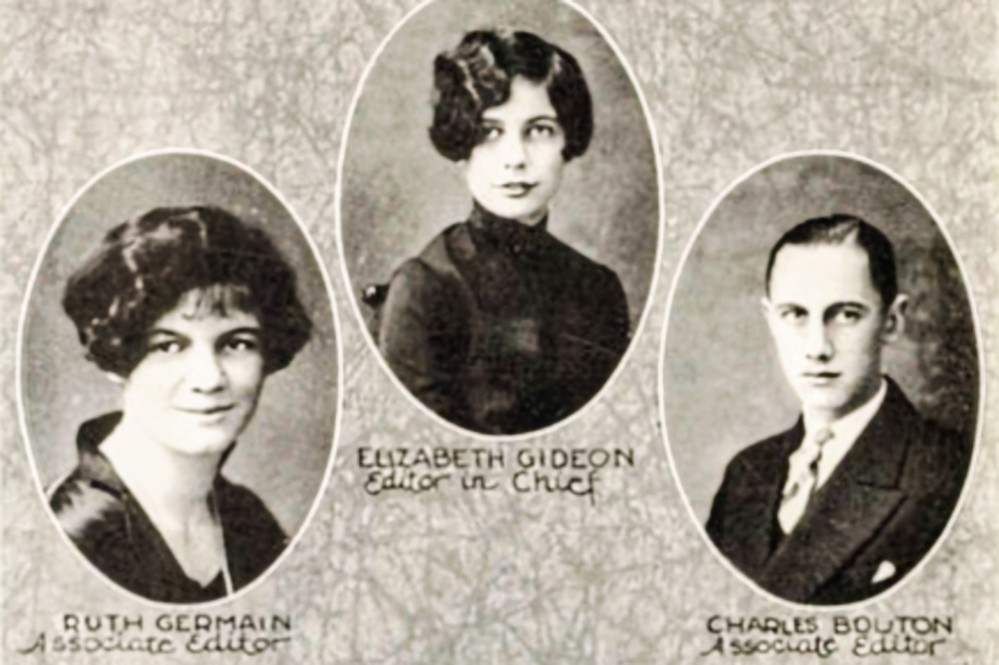
First yearbook totals 134 pages
Though Washington-Lee opened its doors in October 1925, apparently there was no yearbook for the 1925-26 school year.
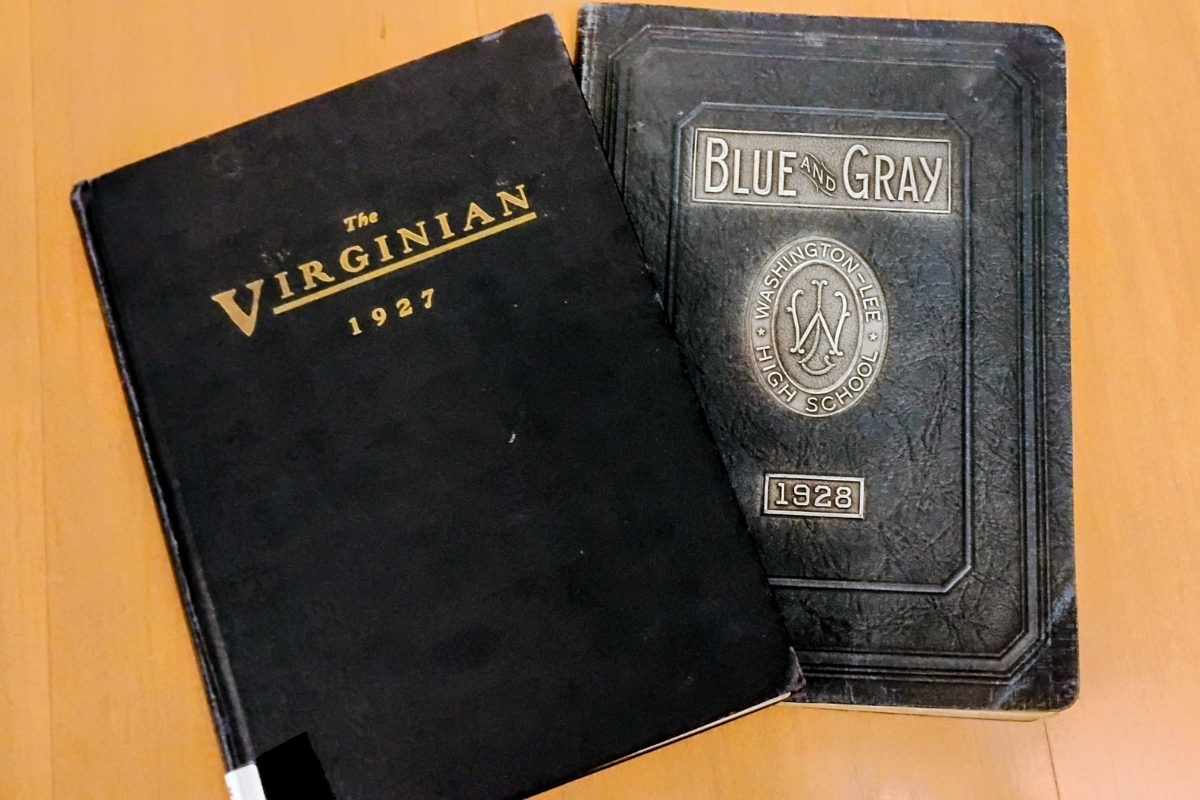
In its inaugural year of 1927, the yearbook was known as The Virginian, but that name would be short-lived. In 1928 the name switched to Blue & Gray.
The editor of the 1927 edition was Elizabeth Gideon. Ruth Germaine (spelled at times in the yearbook as “Germain”) and Charles Bouton served as associate editors.
Like her senior-year classmates, Gideon was a transplant from other schools. She had attended Western High School in D.C. as a freshman and Business High School (also in D.C.) as a sophomore and junior before landing at W-L.
Gideon was described in the yearbook as “one of the most gifted, versatile and popular girls in our class.”
“In one respect, [she is] a very serious-minded student, but with none of the mock gravity that often goes with such a trait,” the description read. “In another, a charming dancer and wonderful entertainer.”
In perhaps a sign of the times, Gideon “says her great ambition is to become the wife of a doctor,” the yearbook noted.
The 134-page 1927 edition was printed by Washington College Press of Takoma Park and composed by National Engraving Co. of D.C. Yearbook staff said they hoped it would prove “a book worthy in form and in spirit of this institution.”
The yearbook noted that members of the Class of 1927 had come from a variety of other schools to form the first W-L junior class in 1925-26. Among the superlatives among the Class of 1927, Nelson Walton and Lenore Thomas were rated “most popular,” with Spencer Sauls the “handsomest boy,” Irene King the “sweetest girl” and Sadie Boswell and Nelson Walton rated “best all-around.”
Senior class of just 33 students
The 1927 senior class was just 33 students, split among 21 girls and 12 boys. The yearbook went to print in advance of typical timing for senior prom, so there’s no indication of how that worked out (if one was held), given the gender imbalance.
Parkes Fielding served as class president, with Elizabeth Gideon as vice president, Ruth Beale as class secretary and Joseph Stalcup as treasurer. The class motto was “Not on the Heights, But Climbing.”
It is said that from small acorns grow mighty oaks. The graduating class of 33 students in 1927 was followed by a 50-student senior class in 1928. Growth in the community coupled with George Mason High School becoming part of Alexandria in 1929 led to a W-L that soon would be bursting at the seams and requiring multiple additions.
By the postwar period, Washington-Liberty had emerged as one of the largest high schools in the South. Its growth necessitated, first, the construction of middle schools to remove that student group from the W-L grounds, and later, creation of Wakefield and then Yorktown high schools.
In the early 1960s, segregation would come to an end in Virginia, and students at the all-Black Hoffman-Boston High School would be integrated into the previously all-white high schools.
The county library system holds some copies of The Aurora, as Hoffman-Boston yearbooks were known, from the 1950s and one from the 1960s before its closure as a high school.
The Hoffman-Boston building later was converted into an elementary school, keeping its name. It was the reverse of the situation at Yorktown High School, which began life as an elementary school and in the early 1960s was expanded to a high school.
But all that lay in the future. Back to 1927 we return.
Faculty helped to guide students
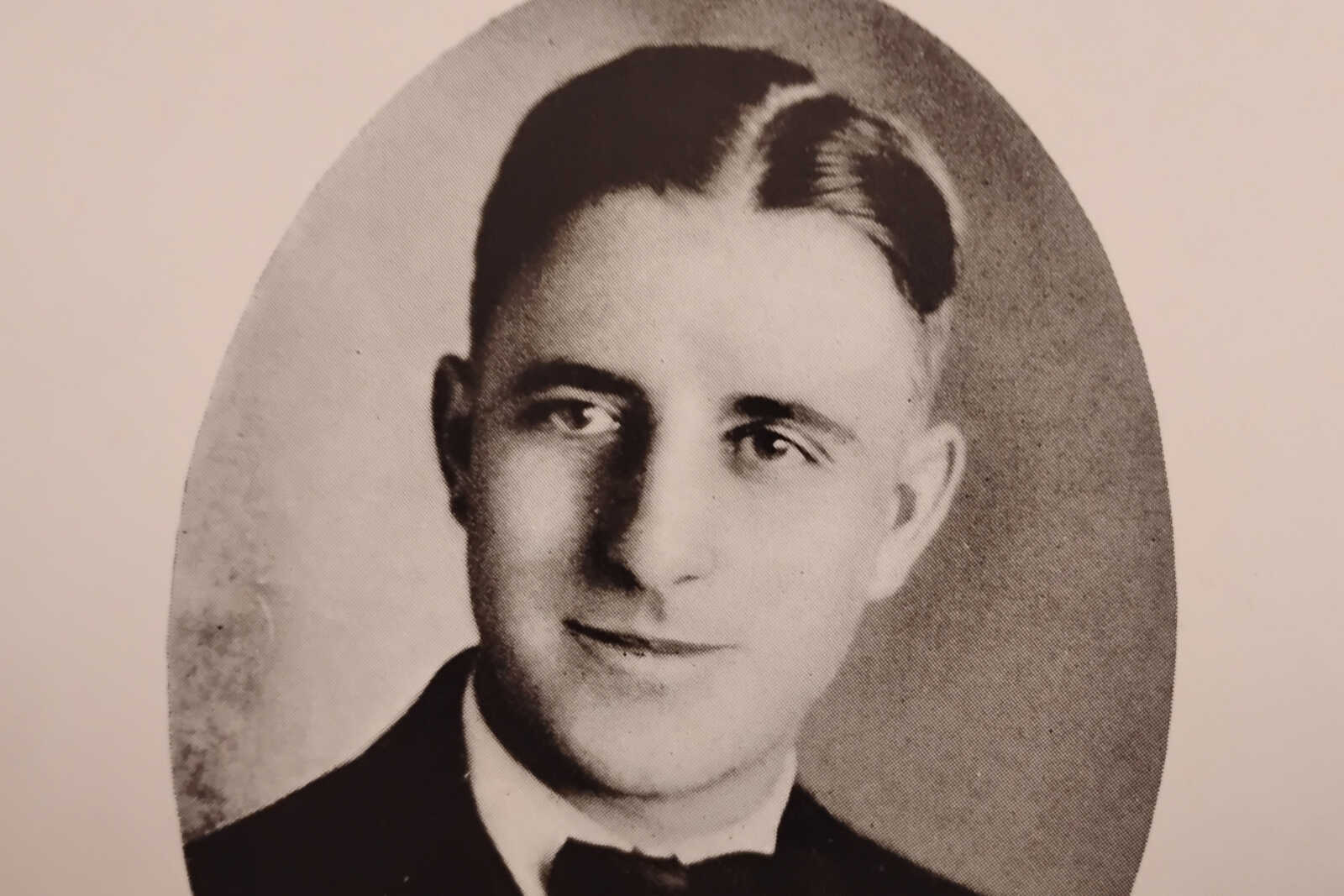
W-L’s principal in 1927 was Samuel Vanderslice Jr. and the vice principal was Geneva Thomas. When Vanderslice came to the school in 1925, his annual salary was $2,800.
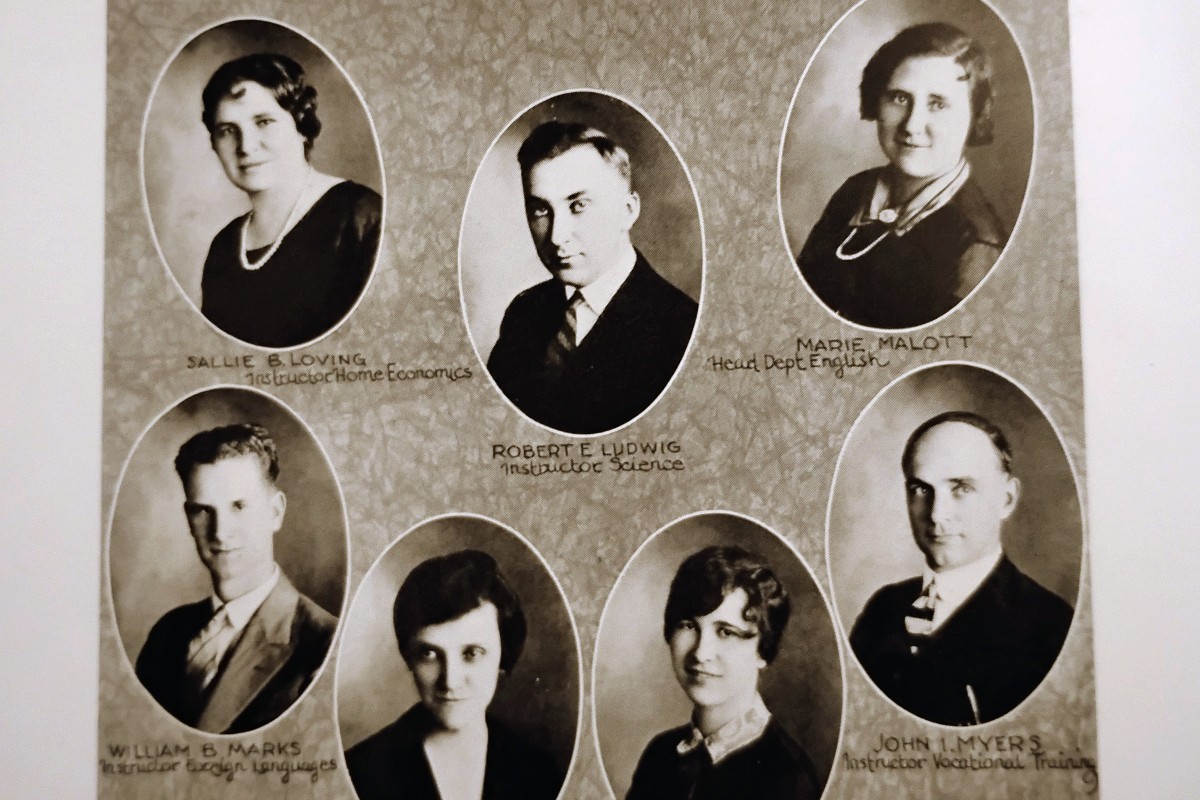
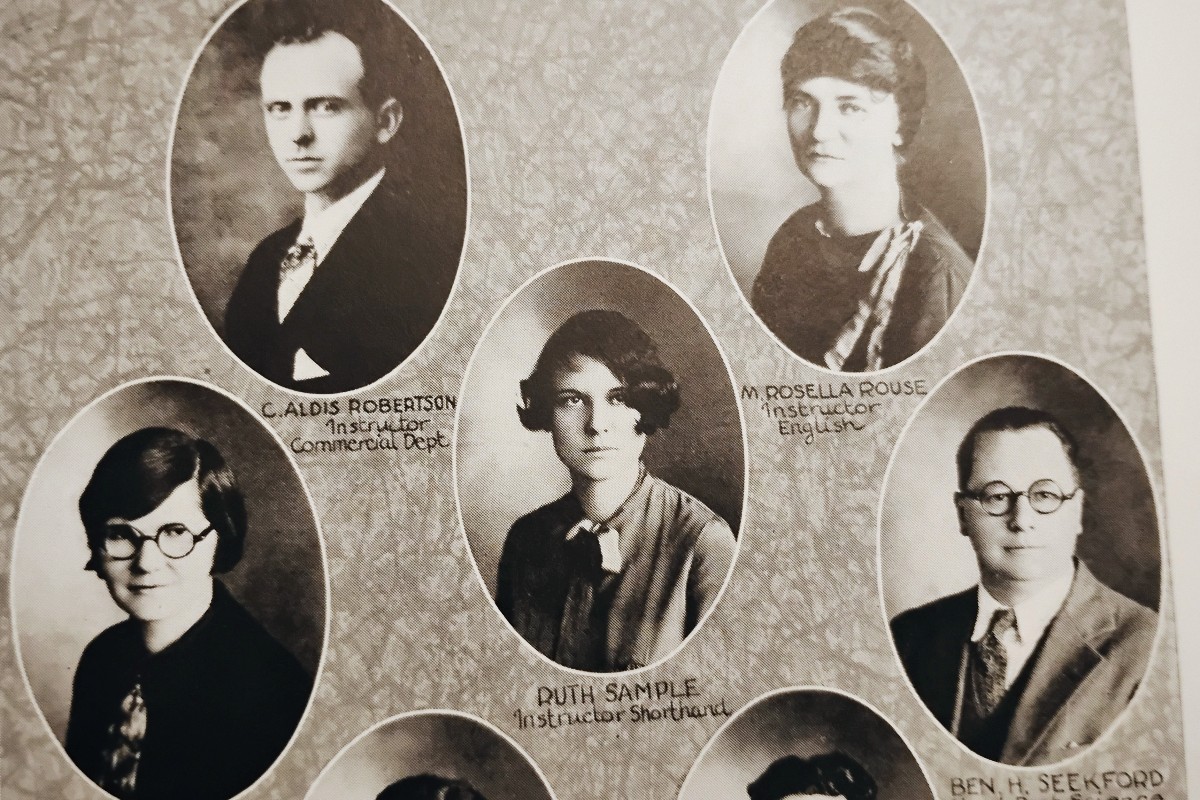
The faculty seems to have been split roughly evenly between men and women, based on those listed in the 1927 yearbook.
Sports teams had successful seasons
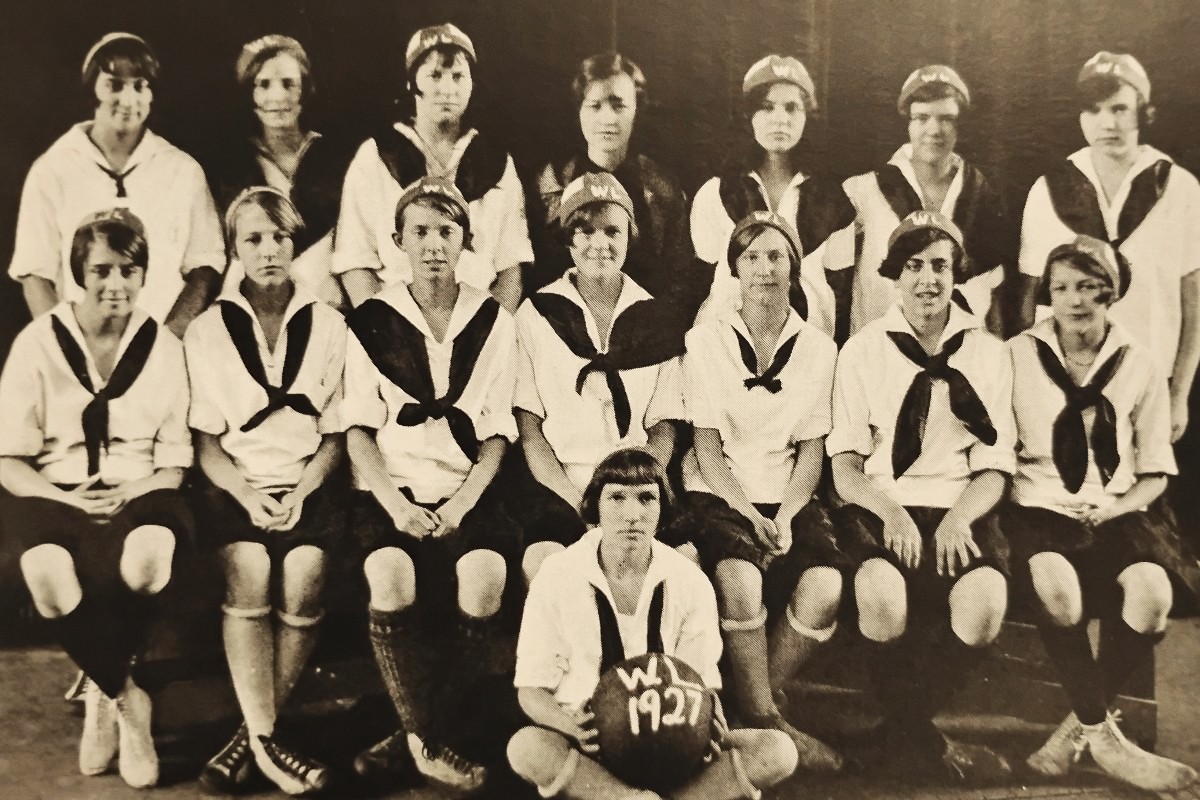
Attendees at Washington-Lee High School in the late 1920s had a limited range of varsity sports available. The 1927 yearbook provides information and photos on the football, baseball and girls and boys basketball squads.
The “fast and heavy” football squad scored shutout victories against Leesburg, George Mason, Episcopal and Warrenton high schools. Alexandria High School, however, proved a more formidable adversary, playing to a 0-0 tie in one game and trouncing W-L, 25-0, in another.
The yearbook noted that Ernest “Bum” Brust had emerged as the leader of the team over the course of two years. “His fighting spirit and his great ability as a leader inspired his teammates,” it noted.
It also paid tribute to the coaches: “‘Doc’ Simmonds prepared his men in a most skillful manner and trained them to the finest point of fitness. ‘Gloomy Gil’ Goff worked out the plays, drilled them and perfected the machinery, and by the time of the opening game it was in perfect working order.”
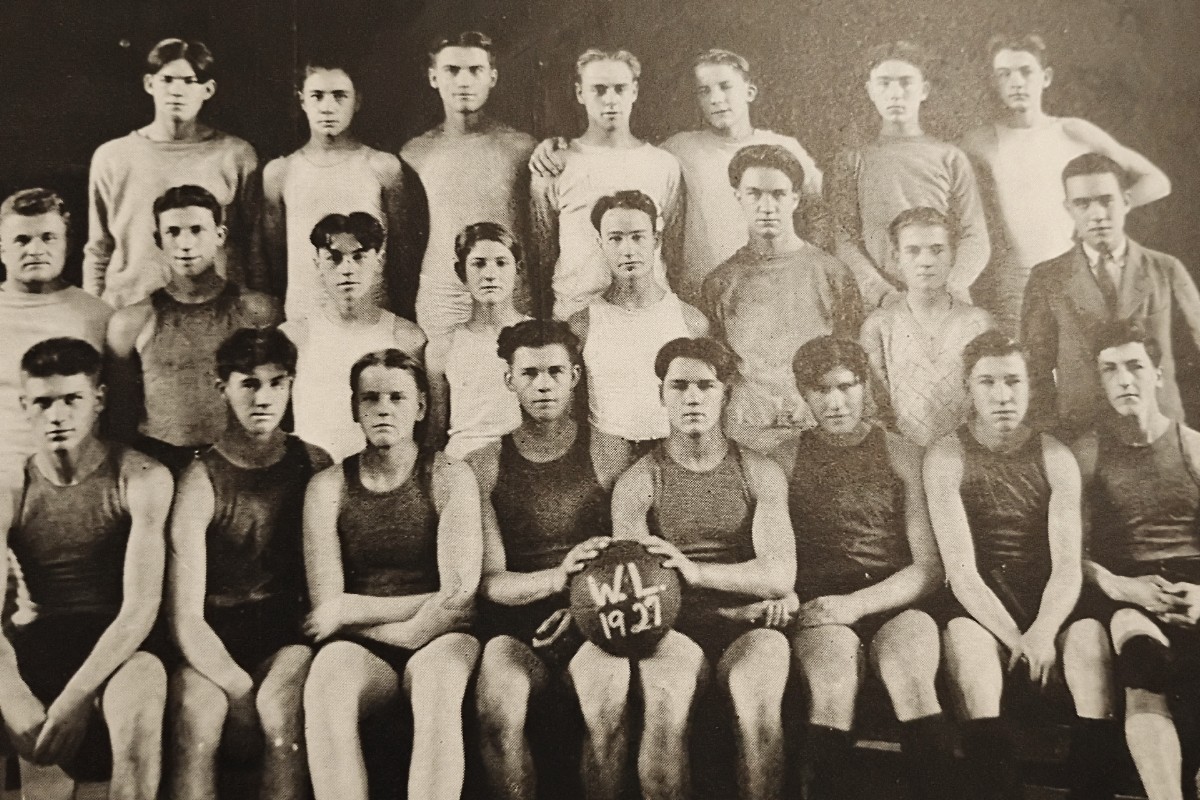
On the basketball court, the boys team exceeded expectations, the yearbook noted.
“With rather poor early season prospects for a successful basketball season, Coach L. K. Bergey created a combination of Captain Carol Croson, Ernest Brust, Denman Rucker, Elwood Clements, George McQuinn and Allen Goodwin that won eight out of the 11 games played during the season.”
One of those players, Elwood Clements, went on to serve as sheriff of Arlington from 1948-52 and again from 1964-80. Another, Denman Rucker, served as commonwealth’s attorney from 1948-52 and was the grandfather of Jason Rucker, currently chief judge of the Arlington District Court.
The story of another player, George McQuinn, will be explored below.
The W-L boys basketball team was awarded the “Championship of Arlington County” after defeating George Mason High School, 22-12, on the armory floor in Alexandria.
As with football, the W-L boys basketball team couldn’t seem to find winning ways against Alexandria High School, which emerged victorious, 52-15, in their lone meeting of the year.
The girls basketball season was still in progress as the yearbook went to press, but the squad was having a good early season.
“The passing, this year, is much better and quicker than last year,” the yearbook noted. “The girls themselves seem to be quicker and better. So far, they have lost no games but one, and that by one point. They have high hopes, though, of winning the rest of the season’s games, and there are all indications that they will, for they have defeated their worst opponents.”
The girls team was coached by Dorothy Graves and Nina Trevette. The captain was Virginia Furr.
A baseball star in the making
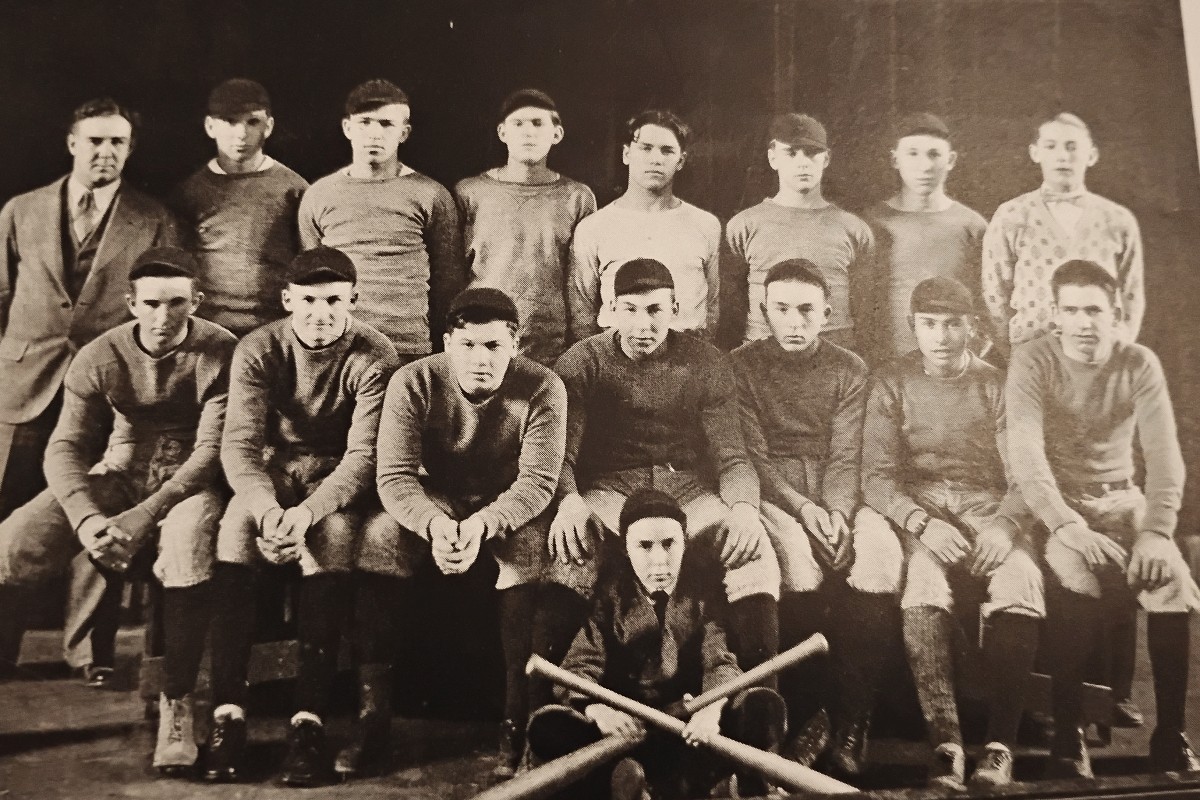
One of those on the 1927 Washington-Lee baseball team was left-handed first-baseman George McQuinn.
McQuinn (1910-78) was born in Arlington — then known as Alexandria County — spent his youth in Ballston, and died in the city of Alexandria. But in the 1930s and 1940s, he traveled the country playing, quite successfully, in the Major Leagues.
A seven-time All-Star, McQuinn played for the Cincinnati Reds, St. Louis Browns, Philadelphia Athletics and, rounding out his career in the 1947-48 seasons, the New York Yankees. In 1947, he was part of the Yankees’ World Series championship squad.
McQuinn’s lifetime Major League statistics included a batting average of .276, 135 home runs and 794 runs batted in. He had 1,558 hits spanning 1,550 games played.
After leaving the big leagues, McQuinn managed minor-league clubs for a decade and was employed as a scout. He also was the author of the training manual “A Guide to Better Baseball.”
For his achievements, McQuinn was the first inductee into the Arlington Sports Hall of Fame in 1958, and also is a member of the Washington-Lee/Washington-Liberty Hall of Fame and the Virginia Sports Hall of Fame.
Other clubs
Members of the Class of 1927 and other Washington-Lee students had a number of sanctioned clubs and activities in which to participate.
The “W-L Club” was an all-boys affair that seemed to draw its ranks primarily from athletes. Each of the students got a nickname; they included “Bum,” “Stogie,” “Hefty,” “Chuggy” and a few that might be seen as politically incorrect in the 21st century.
The Glee Club was an all-girls organization, with about 90 members in 1926-27.
Student thespians presented “The Charm School” to audiences with productions on Feb. 19, Feb. 22 and March 26, 1927, at the school.
The production of what was termed a “clever comedy” was directed by Gordon Johnson.
Gearing up for military service
Washington-Lee was the first public high school in Northern Virginia to organize a Junior Reserve Officers Training Corps (JROTC).
Science teacher Robert Ludwig was the first faculty sponsor. He was assisted by Army 1st Lt. G.B. Hudson of the 3rd U.S. Cavalry at Fort Myer (now Joint Base Myer-Henderson Hall).
Lt. Hudson appears to have just missed out on being under the command of George S. Patton, who held several leadership posts with the 3rd U.S. Cavalry in the 1920s-30s but in 1927 was posted to Hawaii.
The W-L corps of cadets of 1926-27 consisted of more than 100 male students spanning several grade levels.
Advertising pays the bills
Few yearbooks can survive without advertising helping to pay the bills. In the 1927 edition, some of those taking out ads in the back included Strayer College, Arlington County Dairy, Arlington Motors, W.R. Boyer Pharmacy, Peoples State Bank, Ballston Pharmacy and J.F. Gantry, a store that promised students candy, ice cream, soft drinks and sandwiches within walking distance of the school.
While the 1927 yearbook had just three pages of advertisements, the 1928 one (the first to be named Blue & Gray) had expanded to four times that amount.
‘Will and testament’
As part of the 1927 yearbook, members of the Class of 1927 were asked to bequeath a “will and testament” of character traits to students who would soon be seniors of the Class of 1928.
While some are inside jokes indecipherable to those not in on the humor, they remain a good way to remember those who, a century ago, were populating the halls of a high school that continues to serve students today:
We, the Senior class of Washington-Lee High School, being aware that our life as a unit of this school is nearing its close and being desirous to settle our scholarly affairs, do therefore, make and publish this, our last will and testament, in manner and form following, that is to say:
We do in good faith, and with the hope that it shall be well received and well dealt with, bequeath our dignity and proper ostentatious bearings, our standing in the affections of the faculty, our scholastic ability, our affectionate feeling toward Junior Classes, and our royally appointed section room, to that group of ambitious adolescents who strive under the appellation of “Junior Class.”
Hence:
I, Eleanor Beck, do bequeath my dramatic talent to Anna Tucker.
I, Charles Bouton, do bequeath certain traits of mine termed by some “Ricardo Cortez Atmosphere” to Bruce Hise, who is rather on the Harold Lloyd idea.
I, Ruth Ashton, do bequeath my sense of humor, which so enables me to see through each passing wisecrack, to Anna Mendel.
I, Nellie Rogers, do bequeath my dignity, which is a rare gift, to Jean Kelly.
I, Mildred Nisewander, do bequeath my skill in racing, that is, racing on a typewriter, to Elizabeth Mason.
I, Marie Yowell, do bequeath my rightfully pessimistic view of French lessons to Josephine Stirling.
I, Ruth Germaine, do bequeath my lack of dignity to Ella Rollins.
I, Lenore Thomas, do bequeath my oratorical powers to all members of the Oratory and Debate Club.
I, Ernest Brust, do bequeath my good nature and disposition to Edwin Hay.
I, Ethel Donaldson, do bequeath my height to Catherine Robberts.
I, Olivita Thomas, do bequeath my knowledge of home economics to all those flappers who cannot tell one kind of meat from another.
I, Marshall Cooke, do bequeath my musical talent to Lewis Shepherd.
I, Sadie Boswell, do bequeath my companionship to Edith Simpson.
I, Nelson Walton, do bequeath my poise to Taylor Jenkins.
I, Parkes Fielding, do bequeath my popularity with the students of Washington-Lee to Marion Moreland.
I, Nellie Spencer, do bequeath my serene personality to Donald Moore.
I, Velma Turner, do bequeath my ability to converse wisely to Martha Sanderson.
I, John West, do bequeath my peculiarly wide and all-embracing grin to Virginia Mikesell.
I, Elizabeth Gideon, do bequeath my ability as a leader to John Bell.
I, Walter Carlisle, do bequeath my recipe for henna to Ralph Forney.
I, Bernice West, do bequeath my frequent smile to all those who desire a cure for the blues.
I, Edwin Sherwood, do bequeath my swagger to Bun Sasher.
I, Charlotte Hagan, do bequeath my excessive spareness, which is a quality much in demand these days, to Elizabeth Brewer.
I, Price Kinsolver, do bequeath my bored expression and well-known strut to Jimmie Scott.
I, Virginia Furr, do bequeath my athletic prowess to Anne Croson.
I, Joseph Stalcup, do bequeath my invisible cloak on oral theme day to Mary Smoot.
I, Ruth Beale, do bequeath my favor with the faculty to Alvin Kloss.
I, Spencer Sauls, do bequeath my husky physique to Eugene Sims.
I, Wallis Schutt, do bequeath my ability to wear a collegiate outfit and still appear collegiate to Fred Taylor.
I, Louise Ballard, do bequeath my tendency to blush, which does away with the necessity for rouge, to Evelyn Bailey.
Thanks as always to the Charlie Clark Center for Local History and the Library of Virginia for assistance in coverage.
