


Suspensions were down at the start of the school year in Arlington, but some significant disparities remain across different student demographics.
First-quarter suspension totals “continue to show some overrepresentation” of certain groups, including Black students and students with disabilities, Superintendent Francisco Durán told School Board members on Nov. 13.
“That needs to be addressed,” he said.
There were a total of 191 suspensions during the first quarter of the 2025-26 school year, down nearly one-third from 283 during the same period a year before, according to data reported at the meeting.
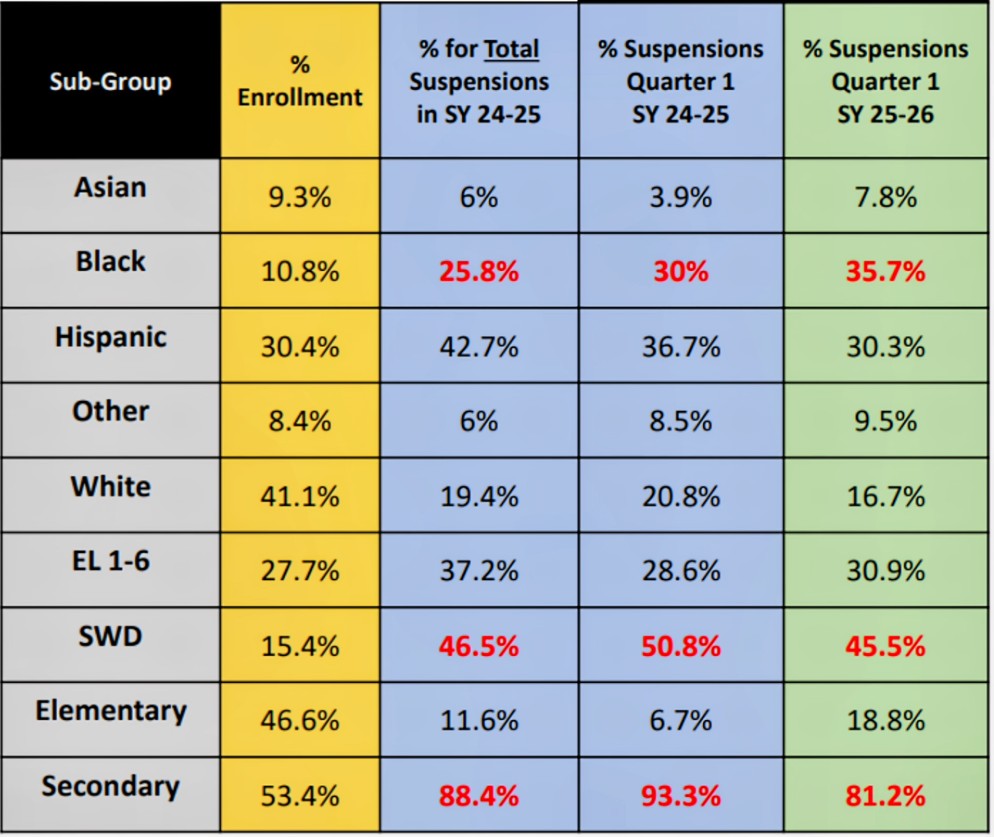
But the rates do not always correlate with the mix of students in the school system, according to school-system figures:
- Asian students: Represent 9.3% of the student body and had 7.8% of suspensions for the first quarter
- Black students: 10.8% of the student body, 35.7% of suspensions
- Hispanic students: 30.4% of the student body, 30.3% of suspensions
- Multiracial or “other” students: 6% of the student body, 9.5% of suspensions
- White students: 41.4% of the student body, 16.7% of suspensions
Students with disabilities across all demographic groups represent 15.4% of the school system’s 27,000 students, but accounted for 45.5% of all suspensions during the quarter, Durán reported at the meeting.
The disparity in suspension rates is not new in Arlington Public Schools. In recent years, it has drawn criticism from some in the community.
About half the suspensions in the first quarter were given out to students who had been suspended before, school officials said. Durán said those repeat suspensions would be a key focus in coming months.
“It’s not just the numbers. We have to look deeper,” he said. “Who are those students? If they are receiving several [suspensions], we need to provide additional supports.”
Going forward, school administrators will receive monthly reports on trends at their schools and countywide.
School board members did not directly address the suspension issue at the Nov. 13 meeting. But Board member Zuraya Tapia-Hadley said having updated figures was helpful.
“Everyone here is very data-driven, and it’s something the community has asked for,” she said.
Durán also reported on instances of bullying in schools. Data from the 2023-24 and 2024-25 school years showed a reduction in reported bullying incidents (from eight to six) at the high school level but a “significant increase” (from 21 to 34) in middle schools.
“We’re going to continue to monitor our bullying trends closely — what those incidents are, how they’re investigated,” Durán said.
Under Virginia law, bullying consists of:
“Any aggressive and unwanted behavior that is intended to harm, intimidate or humiliate the victim; involves a real or perceived power imbalance between the aggressor or aggressors and victim; and is repeated over time or causes severe emotional trauma. ‘Bullying’ includes cyber bullying. ‘Bullying’ does not include ordinary teasing, horseplay, argument or peer conflict.”
School leaders rolled out a new anti-bullying curriculum in October.
