

Arlington Public Schools leaders hope to return to a lower, pre-Covid level of student absenteeism by 2030.
“That last year before the pandemic, 2018-19, we were around [an] 8% rate. We have been using that number as a goal, our star, for the last couple of years,” said Darrell Simpson, executive director for student services, during a Nov. 13 briefing of School Board members.
The current rate of what is known as chronic absenteeism was 12.4% for the 2024-25 school year, a decline from 13.2% the preceding year.
Rates declined in nearly all schools and across all demographic groups those two years. But disparities remain, with absenteeism rates ranging from 7% of the white student body to nearly 19.7% of Hispanic students.
A student falls under the “chronic absentee” category for missing 10% of school days, or about 18 per year, whether for excused or unexcused reasons.
That amount of learning loss “has some pretty impactful consequences,” Sampson said during his presentation.
The goal for 2030 is not simply to reduce the overall rate to 8%, but to cut chronic absenteeism among all socioeconomic groups so no rate is more than 5 percentage points higher than the group’s percentage of the overall student body.
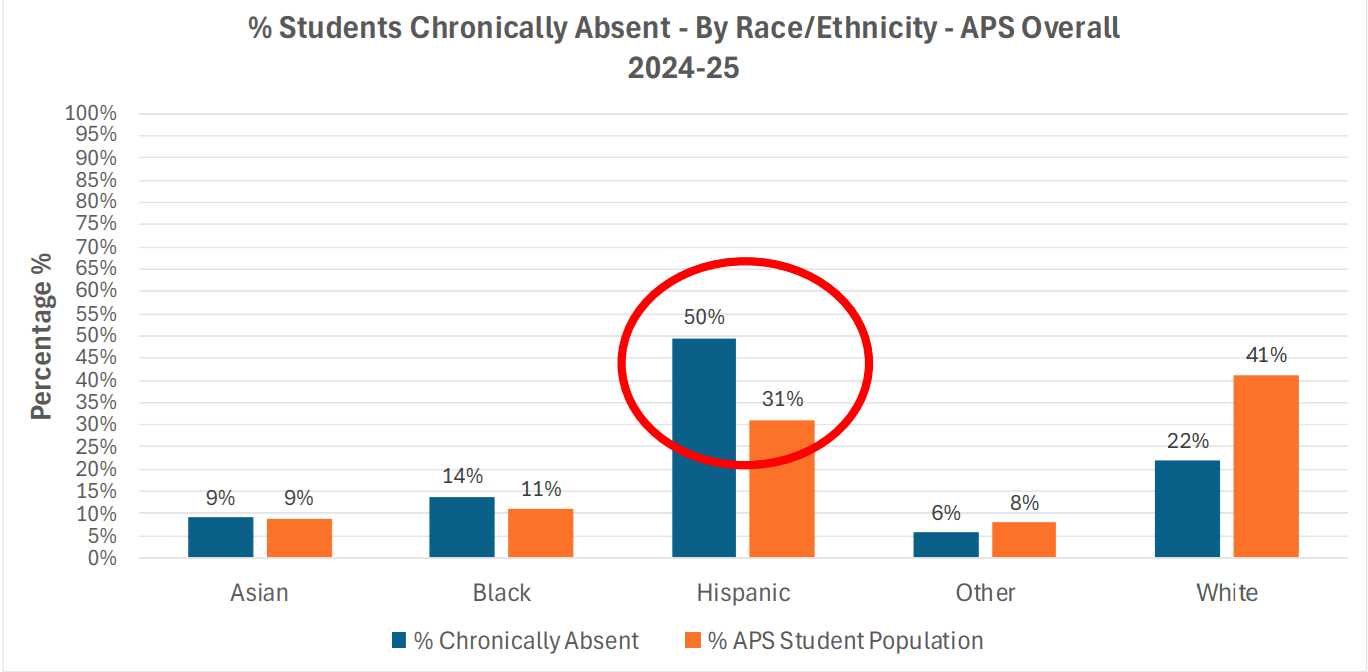
The most challenging group for meeting goals will be Hispanic students, who currently represent 31% of the overall student body but 50% of chronic absentees — a discrepancy of 19 percentage points.
This school year, the school system plans to target its efforts on schools where chronic absenteeism is approaching or exceeding the 15% mark. Those to receive special attention area:
- Elementary schools: Abingdon, Barcroft, Barrett, Carlin Springs, Dr. Charles Drew, Innovation, Randolph
- Middle schools: Gunston, Thomas Jefferson, Kenmore
- High schools and specialty programs: Washington-Liberty, Wakefield, H-B Woodlawn (high-school level), Arlington Career Center, Arlington Community High School and Langston
Asked by School Board member Zuraya Tapia-Hadley why the rate was so high among Hispanic students, school staff said the reasons varied.
“It does vary by school community,” said Faiza Jackson, the school system’s supervisor of student services for social work.
She said more work was being done to pinpoint specific causes, pointing to a partnership with the Edu-Futuro organization. That group works with students, many of them Hispanic, to provide support services.
“Our partnership with Edu-Futuro has really strengthened our ability to understand” the root causes, Jackson said. “They come back to the school and talk to us.”
During the 2024-25 school year, Edu-Futuro worked with 127 secondary-school and 18 elementary-school students countywide to mitigate absenteeism.
This school year, its efforts will be focused at Randolph and Dr. Charles Drew elementary schools; Thomas Jefferson Middle School; and Arlington Community, Washington-Liberty and Wakefield high schools.
School Board member Kathleen Clark said finding ways to get at-risk students more connected with and excited about school was key to promoting regular attendance.
Efforts need to be promoted to “give kids that hope, connection and future vision of themselves,” she said.
