

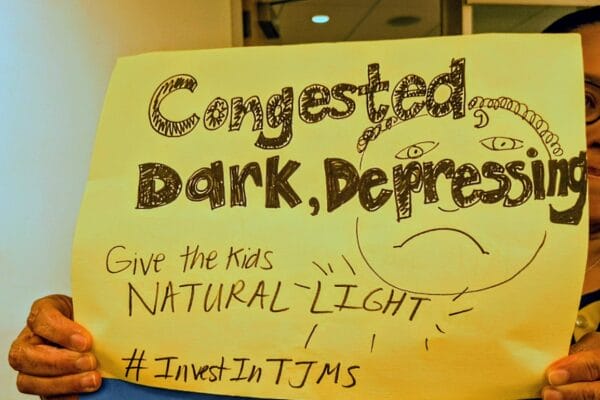
Numerous community members are pressing the Arlington School Board for a firm commitment to either renovating or replacing Thomas Jefferson Middle School.
Teachers, parents and students all pointed to the challenges of the half-century-old building’s narrow halls and limited natural light, which result in what one seventh grader called “a somewhat depressing environment.”
“I often say we have the worst building but the best people,” said Amelia Rosegrant, a library assistant at the middle school, at a meeting last Thursday.
A renovated or new facility is something “our students and staff deserve,” she told School Board members.
Rosegrant was one of more than a dozen Thomas Jefferson-connected speakers at the Board’s public-comment period. Student after student turned up to state the case for improvements.
“There are many changes that need to be made,” said Emma, a sixth-grader. “The walls are very thin. In some classrooms, you can tell the ceiling has leaked. You can hear the other classes — it is very distracting.”
Between class periods, students in hallways are “squished like connected Lego blocks,” said Rayyan, a sixth grader.
Kameron Lineback, a special-education teacher at the 1,000-student school, said his desk is at the back of his classroom because there are not enough electrical and technology outlets at the front — not surprising, he said, in a school that predates personal computers and similar technology.
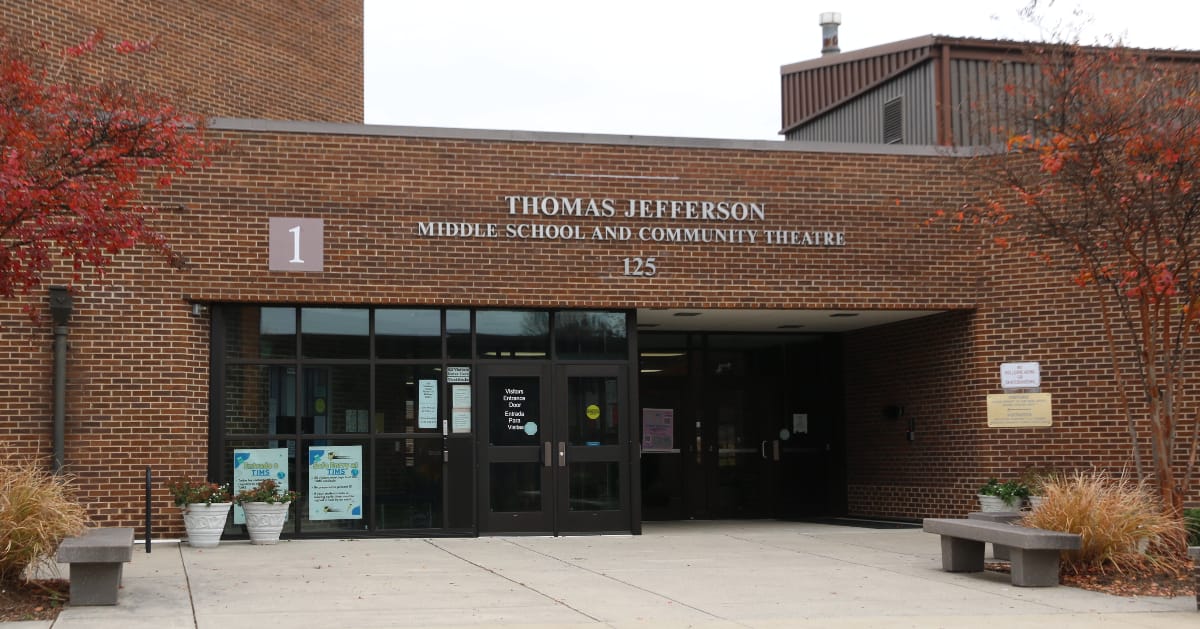
Genesis, a student at the school, said that she felt bad for her teachers and that plans to renovate or replace the school have been put off long enough.
“We cannot afford to wait until the structure collapses before deciding to invest,” she said.
Another student, sixth-grade Cameryn, arrived at Thomas Jefferson after attending the adjacent, and much newer, Alice West Fleet Elementary School.
“Coming to TJ was a downgrade, building-wise,” she told Board members. “We deserve better.”
School Board members do not typically offer a specific response to public comments made at meetings. After the students concluded their remarks, Board chair Bethany Zecher Sutton said those comments, and written ones from their classmates, all would become part of the decision-making process.
“We have an entire binder of letters, which we very much appreciate,” Zecher Sutton said.
Thomas Jefferson was constructed with an open floor plan, a design considered forward-looking when the school opened in 1972. Class instruction took place in three large spaces, with the number of exterior windows limited to minimize distractions.
Like many innovations of the 1970s, the open-design concept fell out of fashion, and in the early 1990s, modular wall panels and glass partitions were installed to create enclosed classrooms. Students and teachers say those partitions don’t do much to mitigate noise from traveling between classrooms, however.
The middle school underwent renovations in the 1990s and again in 2009 in an attempt to provide more modern learning environments. The upgrades included new exterior windows intended to bring additional natural light into the building.
The comments from students, staff and parents came as leaders of the county school system begin developing an updated capital improvement program, set for consideration and School Board adoption next spring.
A consultant released a 146-page feasibility study earlier this year on options for bringing Thomas Jefferson out of the 1970s and into the 2020s and beyond. It was the fourth plan issued in the past 20 years, with others completed in 2005, 2011 and 2014.
The 2025 consulting team offered four scenarios for moving forward:
- Renovating the existing school
- Renovation plus a minimal addition
- A more significant renovation and addition
- A new school that retains portions of the existing building
Cost estimates, in 2025 dollars, ranged from $126 million to $231 million. The consultants’ recommendation was to build a new structure on another portion of the existing campus, separating school operations from the county-run community center and theater that share the site.
Building from scratch would be the most expensive alternative, and may not fit within the school system’s capital-projects budget. But it would solve the greatest number of problems associated with the current school, the consulting team said.
Leadership of the Thomas Jefferson PTSA has voiced concern that the school system could allocate only $150 million to support renovation of both that school and Swanson Middle School. That total would be far less than both schools need, they said.
“Half-measures and Band-Aids will not solve the problem,” Melinda Wuellner, vice president of advocacy for the PTSA group, told ARLnow.
“The PTSA is in favor of whatever funding is needed to provide Jefferson students and staff with a safe and accessible building that meets APS’s own standards,” Wuellner said.
In their report, consultants noted it could be a logistical challenge to conduct a major renovation of existing facilities while students continue classwork at the site.
That could be one reason for concerns that School Board members might renege on a promise to move students at Montessori Public School of Arlington into the Arlington Career Center building, when Career Center students move to the Grace Hopper Center upon its completion next year.
Keeping the Montessori school in its current location or moving students elsewhere might allow the current Career Center building to be used as “swing space” to accommodate students displaced by construction projects elsewhere.
Decisions on capital projects made next spring would go in the queue for funding, with the next school-bond referendum likely to be held in November 2026.
