

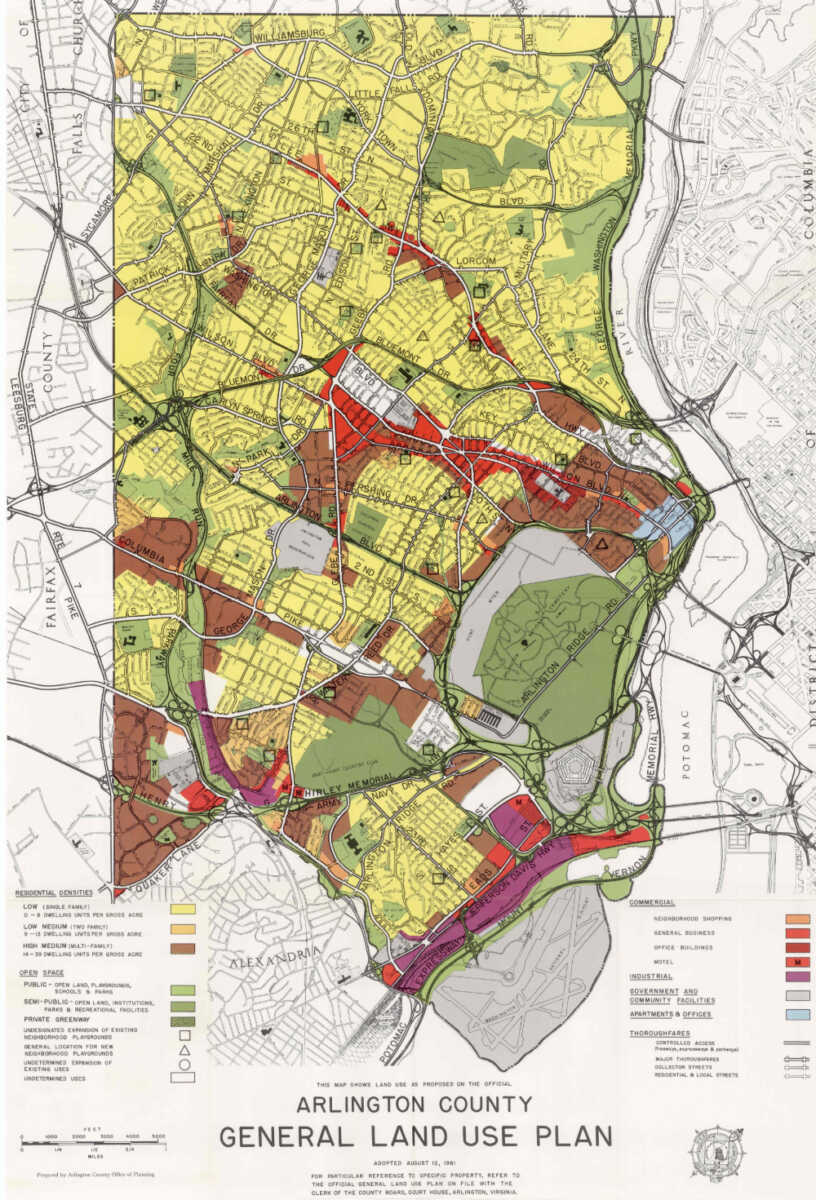
Arlington would be a very different place today if all the road plans of the county’s first General Land Use Plan (GLUP) — enacted in 1961 — had been constructed.
A massive arterial named Bluemont Drive would have cut east to southwest across the county. S. Four Mile Run Drive would have been much larger than its current configuration. A freeway in the Donaldson Run area would have connected to the George Washington Memorial Parkway.
Old Glebe Road would have linked up to a new Potomac River bridge and D.C.’s Arizona Avenue, N.W., on the river’s eastern bank. Columbia Pike would have incorporated a bypass to allow a portion of the roadway to retain a historic “main street” feel.
And the Three Sisters Bridge — a transportation project even more controversial than the Columbia Pike streetcar plan of decades later — would have become reality rather than a footnote in local planning history.
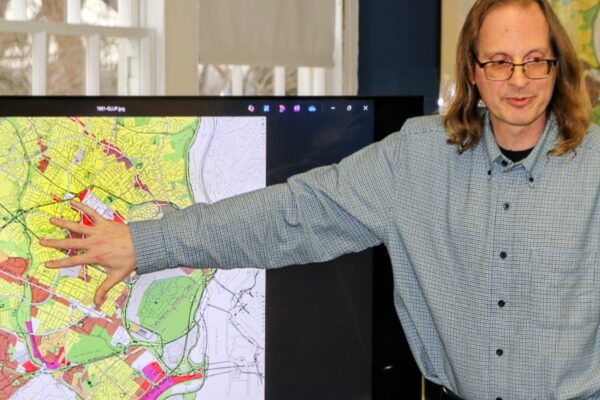
What got built, what didn’t, and why or why not, was the topic of a Jan. 18 Arlington Historical Society presentation by the organization’s former president, David Pearson.
Pointing to a screenshot of the transportation plan enshrined in the 1961 GLUP, he asked the standing-room-only crowd to consider the ramifications.
“Imagine if all these dotted lines [on the plans] had gotten built out,” Pearson said.
The 1961 document was not the first transportation plan adopted by Arlington leaders. A “thoroughfare plan” had been approved two decades earlier, and there were others.
But the 1961 plan was designed to serve as a statement of the county’s aspirations for the subsequent two decades, Pearson said.
It was developed at a time when the personal automobile remained undisputed king of transportation, and it occurred as Arlington leaders were trying to find ways to move traffic from the outer suburbs — beginning to explode with new residents — to and from D.C. jobs without clogging the county’s neighborhood streets.
By that time in Arlington, “the postwar building boom had kind of calmed down,” Pearson said.
“The explosive growth is not happening in Arlington but it is happening” in the rest of Northern Virginia, he said.
County Board members of the era were adamant about preserving Arlington’s single-family neighborhoods at all costs, while allowing for redevelopment in areas that later would become known as the Metro corridors, Pearson said.
The first wave of redevelopment in the 1960s-70s brought intense levels of commercial and residential development to Rosslyn, Ballston and Crystal City.
Particularly in Rosslyn, “it happened really quickly,” Pearson said, noting 19 new high-rise buildings were constructed in the five-year period beginning in 1962.
By the mid-1960s, though, concerns were being raised locally and nationally about the impact of unrestrained highway construction.
“People were no longer thinking, ‘We’re going to build it at any cost,'” Pearson said.
At the same time, federal transportation funding began to be diverted, at least in urban areas, from highway construction to transit projects.
Regional leaders by the late 1960s had committed to the proposed Metro system, and as a result, “there’s a move away from building out all the highways,” Pearson said.
Among those who probably let out a sigh of relief were those living near the intersection of Arlington Blvd (Route 50) and Carlin Springs Road.
Where today there is a relatively modest intersection, the plan enshrined in the 1961 GLUP would have provided for a massive cloverleaf to handle traffic on the two roads, which would have been wider than they are today in an effort to funnel commuter traffic east-west and north-south.
Also nixed was the proposed Bluemont Drive. Although its easternmost portion was constructed as Interstate 66, the portion planned to gouge its way through neighborhoods in the western part of the county never materialized.
Nor did the Three Sisters Bridge, nor a plan to push Shirley Memorial Highway — now I-395 — more aggressively into the District of Columbia rather than diverting through traffic onto the Capital Beltway.
The 1961 General Land Use Plan has been amended nearly two dozen times in the 65 years since it was first adopted. Today, it is one of 12 elements of the county’s Comprehensive Plan, which since 2024 has been in the process of being updated.
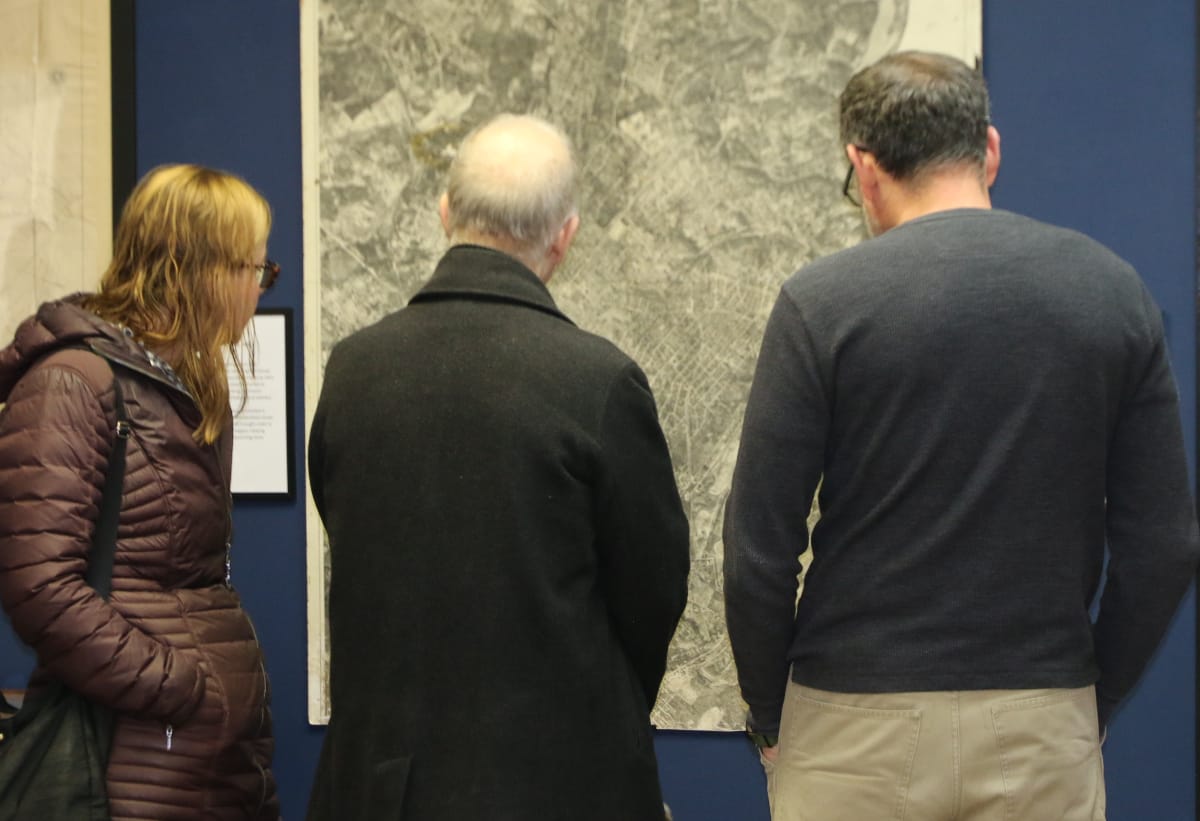
Pearson’s presentation was inspired by a recent exhibit of classic county maps, including the 1961 GLUP plan, that had been on display at the Arlington Historical Museum.
His remarks were part of a relatively new series of more informal presentations on local history conducted at the museum, located on S. Arlington Ridge Road.
“We’re always looking for people to do these — take a smaller part of Arlington history and put a spotlight on it,” museum director Bethany Baker said.
