

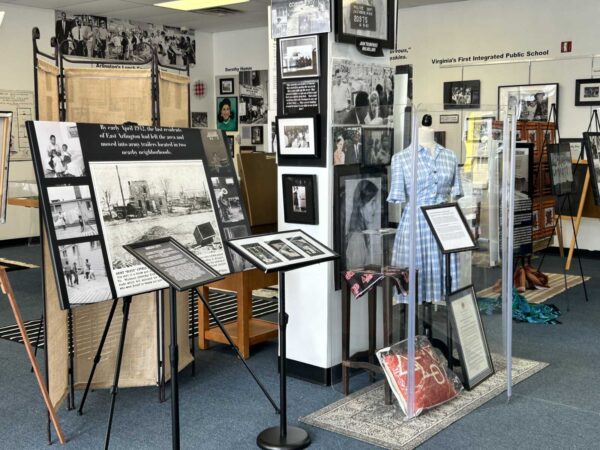
The Black Heritage Museum of Arlington honors a history spotlighted by iconic figures like Frederick Douglass and Sojourner Truth but clouded with decades of discrimination and ongoing displacement.
Tracing Black Arlington communities’ roots back to the construction of Arlington House in the early 1800s, following them up through the establishment of vibrant communities in the aftermath of the Civil War, and tracking residents’ ongoing contributions and struggles with affordability, the museum at 3045 Columbia Pike offers a portal into an often overlooked history.
“You come there, and you’re going to learn about some very, very brave people that risked their lives, their livelihoods, their families, and all in efforts to make our lives easier today,” Scott Taylor, the museum’s president, told ARLnow in a recent podcast episode.
Through museum exhibits and conversations with visitors, Taylor seeks to pull back the curtain on eras like Reconstruction, when about 75-80% of Arlington’s population was Black and historic figures like Douglass and Truth spent time in what was then Freedman’s Village.
“People would come from all over to learn how to read, write, to live the American dream,” Taylor said.
The museum at 3045 Columbia Pike also walks visitors through the severe difficulties that Black residents faced in the first half of the 20th century — when Jim Crow laws placed restrictions on their rights even as developers were buying up their properties. It follows the exodus from Freedman’s Village into the modern-day neighborhoods of Arlington View, Green Valley and Hall’s Hill.
The museum also follows some of the historic roles that Black Arlingtonians played in ending segregation — becoming some of the first to integrate public schools in Virginia, and continuing to combat invisible divides during the Civil Rights era and beyond.
“A lot of people coming up here now, Brown and Black people, have to realize that a lot of us were the ones who spearheaded a lot of … freedoms they have now,” Taylor said.
Taylor also looks at the struggles that Arlington’s long-established Black communities continue to face today, grappling with gentrification in a region that has become less and less affordable.
“As much as I love Arlington, I will tell people, if you can’t afford to live here, don’t come here. It’s very, very expensive, and it’s not getting any cheaper,” he said.
ARLnow’s interview with Scott Taylor is available in its entirety as a podcast episode. Taylor is also frequently present at the Black Heritage Museum of Arlington when it is open on Thursday and Saturday afternoons until 6 p.m.
He hopes his work can deepen Arlington residents’ connections with the county’s past, as well as their understanding of its present challenges.
“I’ve got to be out there on the ground and getting people interested, and just knowing, because knowledge is power,” Taylor said.
