

Virginia’s two U.S. senators say they will try again to reduce air traffic and take other steps to address safety concerns at Reagan National Airport.
Sens. Mark Warner and Tim Kaine are throwing their support behind the National Transportation Safety Board’s (NTSB) final report into the January 2025 midair collision near the airport
“The NTSB report underscores the risk unsustainable traffic levels at DCA pose — as we have warned for many years,” the Democrats said in a joint statement last week. “In the coming months, we will be working on legislation to reduce slots at DCA and meet the NTSB’s other safety recommendations.”
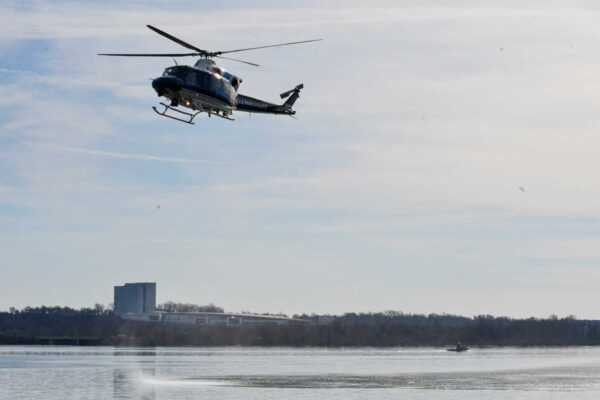
All 67 people aboard both aircraft died when a U.S. Army Sikorsky UH-60L Black Hawk helicopter collided with an American Airlines CRJ700 regional jet on final approach to Reagan National.
The NTSB’s final report on the crash — issued Jan. 28, 2026 — said “systemic failures” rather than a single cause were responsible for the collision, occurring over the Potomac River.
The NTSB issued 50 individual safety recommendations calling for changes to helicopter route design, air-traffic-control procedures, safety-management systems, data sharing and collision-avoidance technology. The recommendations do not carry the weight of law, being dependent on Congress and the executive branch deciding whether and how to implement them.
“We thank the NTSB for its thorough investigation of last year’s horrific crash near DCA that took the lives of 67 people, and for its recommendations on how to make the airspace around DCA safer,” Warner and Kaine wrote. “We owe it to the families who lost loved ones on January 29, 2025, and all Americans to implement the NTSB’s recommendations to prevent another tragedy.”
Some action is already underway, with the Federal Aviation Administration (FAA) in January making permanent some restrictions for helicopters operating in the area of the airport.
“We’re continuing to work with the NTSB to ensure an accident like this never happens again,” FAA Administrator Bryan Bedford said in announcing the permanent restrictions.
In another response, the U.S. Senate on Dec. 17 unanimously passed the Rotorcraft Operations Transparency and Oversight Reform (ROTOR) Act.
The legislation, set for consideration in the House of Representatives in coming days, would beef up minimum standards for military helicopters operating in mixed (civilian/military) airspace.
The measure is sponsored by Sens. Jerry Moran (R-Kan.) and Ted Cruz (R-Texas). It was introduced in response to concerns that new safety standards encompassed in the FY2026 National Defense Authorization Act were not enough to prevent similar aircraft collisions in congested airspace.
Kaine and Warner expressed support for the ROTOR Act, as it addresses some of the issues leading to the crash. But, they added, “that alone won’t be enough.”
Their statement did not give specifics on what might be included in future legislation, or a timeline for its introduction.
In a Feb. 20 statement, Rep. Don Beyer (D-8) said he was supportive of legislative efforts to address safety concerns:
“The collision above the Potomac which claimed 67 lives last year was preventable, and we as elected leaders owe it to those we lost and to their families to do all we can to stop this tragedy from ever happening again. This means taking comprehensive and expedient legislative action to improve aviation safety.”
If not acted upon by December, any legislation would automatically die and would need to be reintroduced when Congress reconvenes in January 2027.
Any attempt to restrict flight operations at Reagan National would likely be met with opposition from those members of Congress whose states are served by the flights. Similar efforts in the past largely have failed.
Each year, there are about 300,000 aircraft movements at Reagan National, which opened in 1941. Efforts by some in the George W. Bush administration to close the airport after the 9/11 terrorist attacks were successfully fended off by the local congressional delegation.
In an informal ARLnow poll last September, nearly 75% of respondents supported a reduction in flights.
