

Higher fees for property owners pair with rising real estate assessments in the Falls Church budget proposal unveiled by City Manager Wyatt Shields Monday night.
Falls Church homeowners would pay an average $611 more — an increase of 5% — in real estate taxes under the $134.3 million fiscal year 2027 budget.
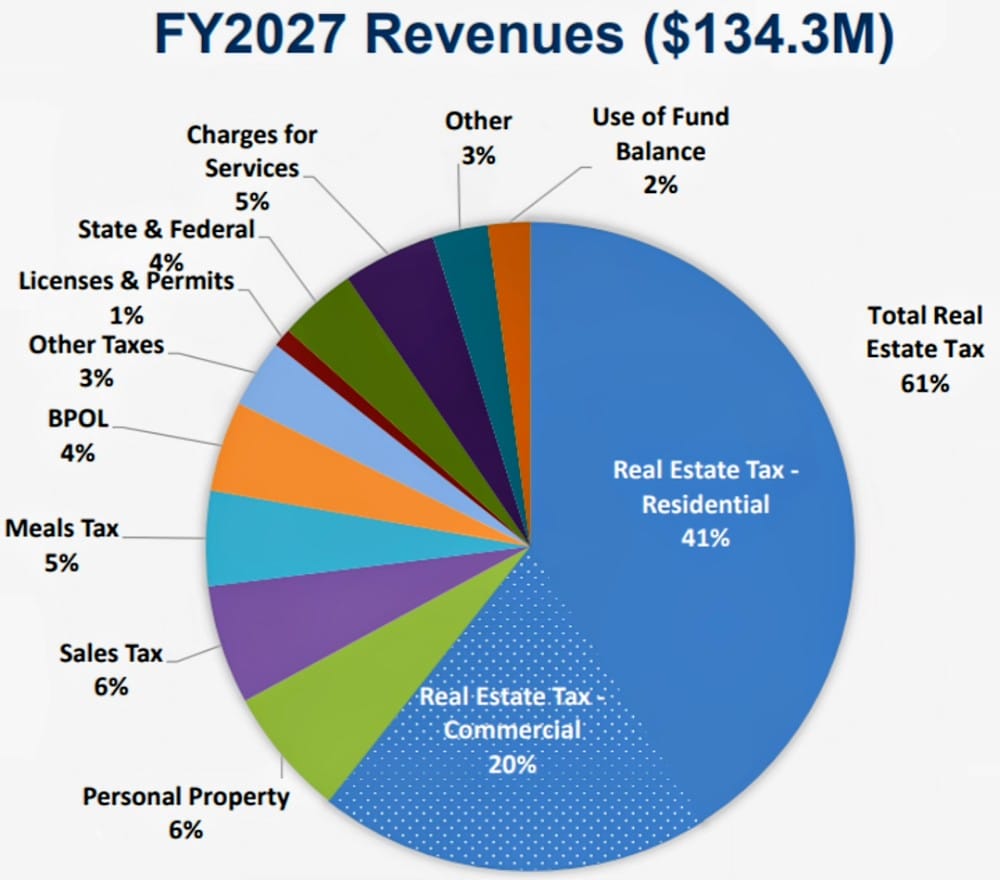
The increase would not result from a higher tax rate, which Shields proposes maintaining at $1.185 per $100 assessed value. Instead, it would come from higher home-value assessments that city officials rely on for more than 40% of all tax revenue.
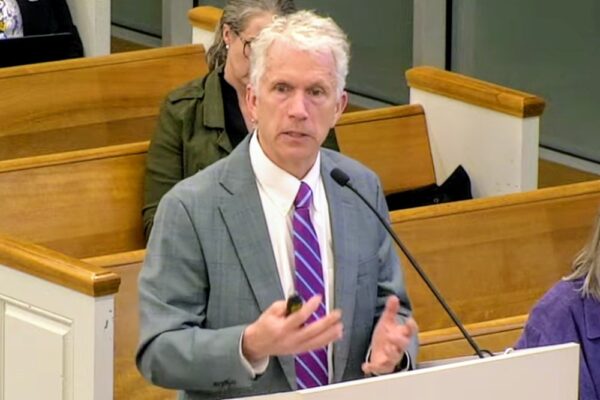
“The regional economy is facing significant headwinds,” Shields said in a budget presentation to City Council members. He called fiscal 2026 “a time of caution … focusing on core services.”
The 361-page fiscal year 2027 budget proposal is an increase of 0.8% from the adopted fiscal year 2026 budget, which runs through June 1. The package calls for a $57.8 million transfer to the city’s school system, up 4.1% from the current year.
Property owners would not simply see higher real estate tax bills. A trio of major fees also are slated to rise:
- The budget calls for sewer rates to increase by 5% from $11.15 to $11.71 per 1,000 gallons, with an average increase of $27 per household, to cover operating and capital costs
- Shields is seeking to increase stormwater fees from $21.83 to $23.36 per 200 square feet of a property’s impervious area, equaling an average increase of $23 for homeowners
- The city manager also is seeking an increase of 4% in trash/recycling fees for single-family and townhouse residents, rising to $245 for those using 35-gallon containers and $348 for those using 65-gallon receptacles
While the budget is bigger, Shields told Council members it has little to no fat.
“All of our departments were given very strict guidance. Through these efforts, we identified about $700,000 of operational efficiencies,” he said.
While still among the highest in the region, Falls Church’s real-estate tax rate has declined 17 cents per $100 over the past seven years, Shields said, as an influx of commercial property has helped to expand the overall tax base.
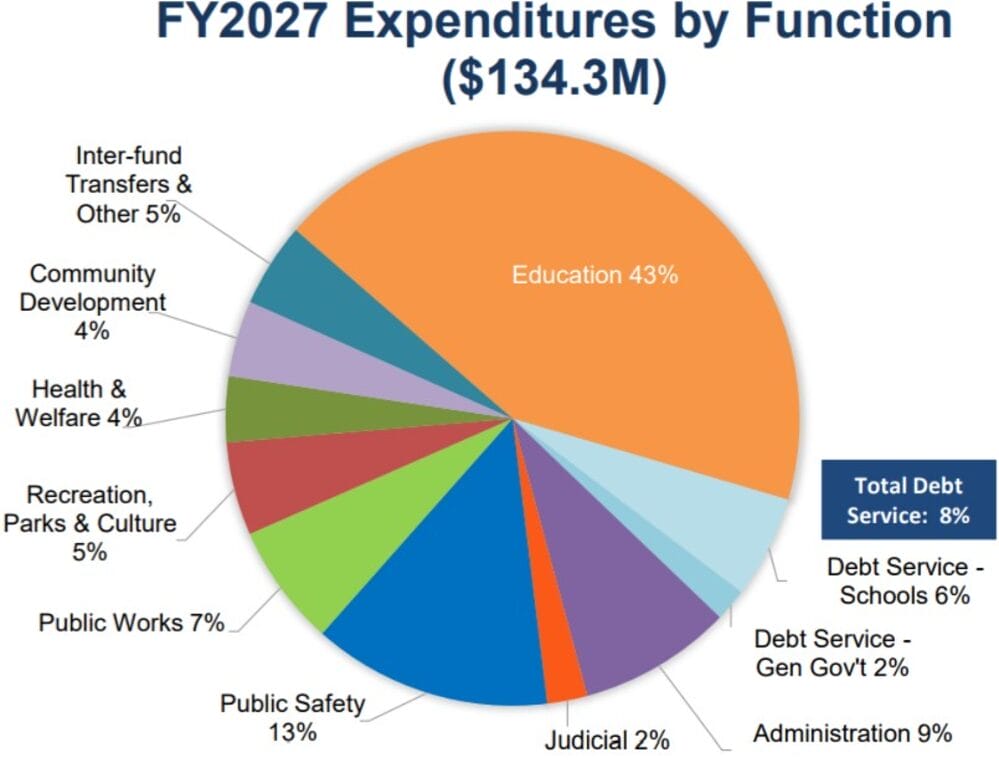
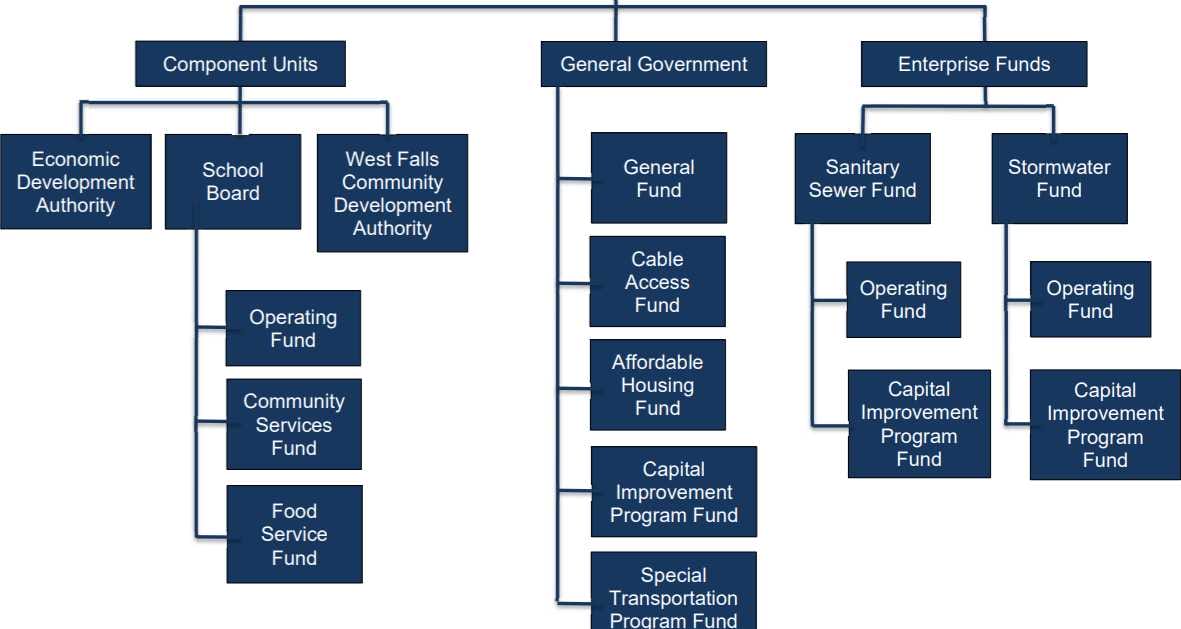
The operating budget for general government would increase 3.2% to $59.5 million, while Shields is calling for a reduction in the transfer of reserve funding to support capital projects.
With no new additional capital-projects debt anticipated in the coming fiscal year, the city’s costs to service overall debt are expected to decline 1%.
The budget includes a 4% merit-based increase for civilian employees and a whopping 14% increase in starting pay for police officers, “to preserve market competitiveness for our uniformed officers in response to recent increases by regional police agencies,” city officials said in the budget presentation.
Seven currently unfilled positions will be eliminated across various departments. Among the cuts will be one school-resource officer and a facilities-maintenance position within the Department of Public Works.
Real estate taxes account for more than 60% of the city’s overall tax revenue, split between residential (41% in the proposed budget) and commercial (20%) properties.
Council member Erin Flynn called the overall budget “sobering” and reflective of an uncertain economic environment.
Flynn was one who expressed support for higher police salaries, which will cost $400,000 to implement as Falls Church attempts to keep up with increases proposed in Arlington and other localities.
“I’m happy to see the public-safety investment,” she said.
Falls Church traditionally is one of the last jurisdictions in the region where staff rolls out budget proposals each year. Shields’ proposal to keep the tax rate unchanged is mirrored by budget proposals in Alexandria and Fairfax County. Arlington officials have advertised a 2-cent increase in that county’s tax rate.
A budget town hall will be held tomorrow (Thursday) at noon at City Hall, and also will be streamed online.
City Council members will start discussing the package in-depth during an April 6 work session. The budget will be discussed at the April 13 Council meeting, and is slated for adoption on May 11.
“We’re at the beginning of the process, with six weeks to go,” Mayor Letty Hardi said at the March 23 presentation.
At the meeting, both Hardi and Flynn expressed concern about the budget’s impact on homeowners who are facing large year-over-year growth in assessments.
“There is at least a subset of the homeowner population that has seen double-digit increases — even over 15%,” Flynn said.
Those residents have not been shy about voicing their discontent, Hardi said.
“I’ve certainly gotten a larger volume of concerns from residents,” said the mayor, who expected the number of assessment appeals to increase this year.
Public hearings on budget issues will be held on April 27 and May 11. The new budget will go into effect July 1.
As part of his budget package, Shields has proposed an updated six-year capital improvement program totaling $162.5 million.
A majority of the funding — just over $100 million — will be for transportation. Other funding will support public safety, parks, sewer and stormwater projects.
Nearly $95 million of the six-year capital plan is expected to be funded through federal, state and regional grants, including 90% of the transportation projects.
