

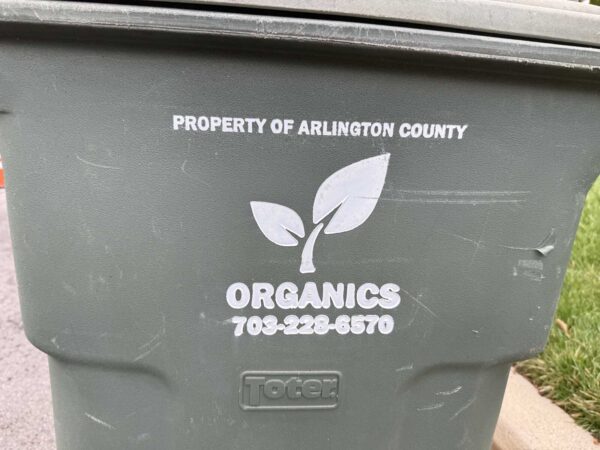
Can “compostable” products like forks and plates go in Arlington’s green organics bin? As with local recycling do’s and don’ts, the answer is a bit complicated.
Compostable paper food containers can go in, officials tell us. Compostable plastic ones cannot — even when they’re labeled “compostable” and carry a certification.
The distinction comes down to what a container is actually made of, according to the county’s Department of Environmental Services. The question came up after a reader asked ARLnow whether commercially compostable to-go boxes, cups and utensils belong in the curbside bin alongside food scraps.
Paper-based products — uncoated plates, napkins, cardboard food containers — behave much like food scraps and yard waste and break down readily, the Solid Waste Bureau told ARLnow, in a response provided by DES spokesman Peter Golkin. Even paper with a thin compostable lining is generally fine.
Compostable plastics are another matter. Items like PLA-lined cups, molded fiber containers and bioplastic utensils can take up to 84 days to decompose in a commercial setting (or 180 days in home composting setups). This is true even when they meet standards such as ASTM D6400 or carry a mark from groups like the Biodegradable Products Institute or the Compost Manufacturing Alliance.
The problem is timing. The Convertus facility in Manassas that processes Arlington’s organics typically runs a roughly 60- to 75-day cycle, according to the bureau, so sturdier compostable plastics may not break down before processing ends. They can also be tough to tell apart from regular plastic, which means they often get pulled out as contamination.
“Certification does not necessarily mean compatibility with every composting program,” the agency’s statement said.
Then there’s the wrinkle that prompted the question in the first place. The county’s own food scraps guidance tells residents to collect their scraps in certified compostable bags — which are themselves a compostable plastic product.
Those bags get a pass, we’re told, because they’re thin, break down relatively quickly and cut down on odor and mess, which keeps more people using the program. Rigid items like bioplastic forks and clamshell containers don’t offer the same tradeoff.
“The County’s recommendation to use certified compostable bags for food scraps adds an understandable layer of confusion,” the Solid Waste Bureau admitted.
Beyond mentions of compostable bags, the county’s food scraps page says nothing about compostable food service items, noted the reader who contacted ARLnow. Muddying things further: George Mason University‘s sustainability program says certified compostable containers, cups and cutlery can be composted — and its material goes to the same Convertus facility Arlington uses, the reader pointed out.
The difference is control, Arlington officials said. An institution like GMU can dictate exactly which certified products it buys, down to wood-based utensils, and can run its own sorting and drop-off system. That makes accepting certified items more workable than in a countywide residential program, even when everything ends up at the same facility.
Arlington started collecting food scraps in 2021, in the same green bin used for yard waste. Accepted items include food scraps, food-soiled napkins and paper towels, coffee grounds and filters, and cooking oil. Also accepted: pizza boxes — despite some confusion earlier this year with the county’s soon-to-be former waste collection contractor.
