


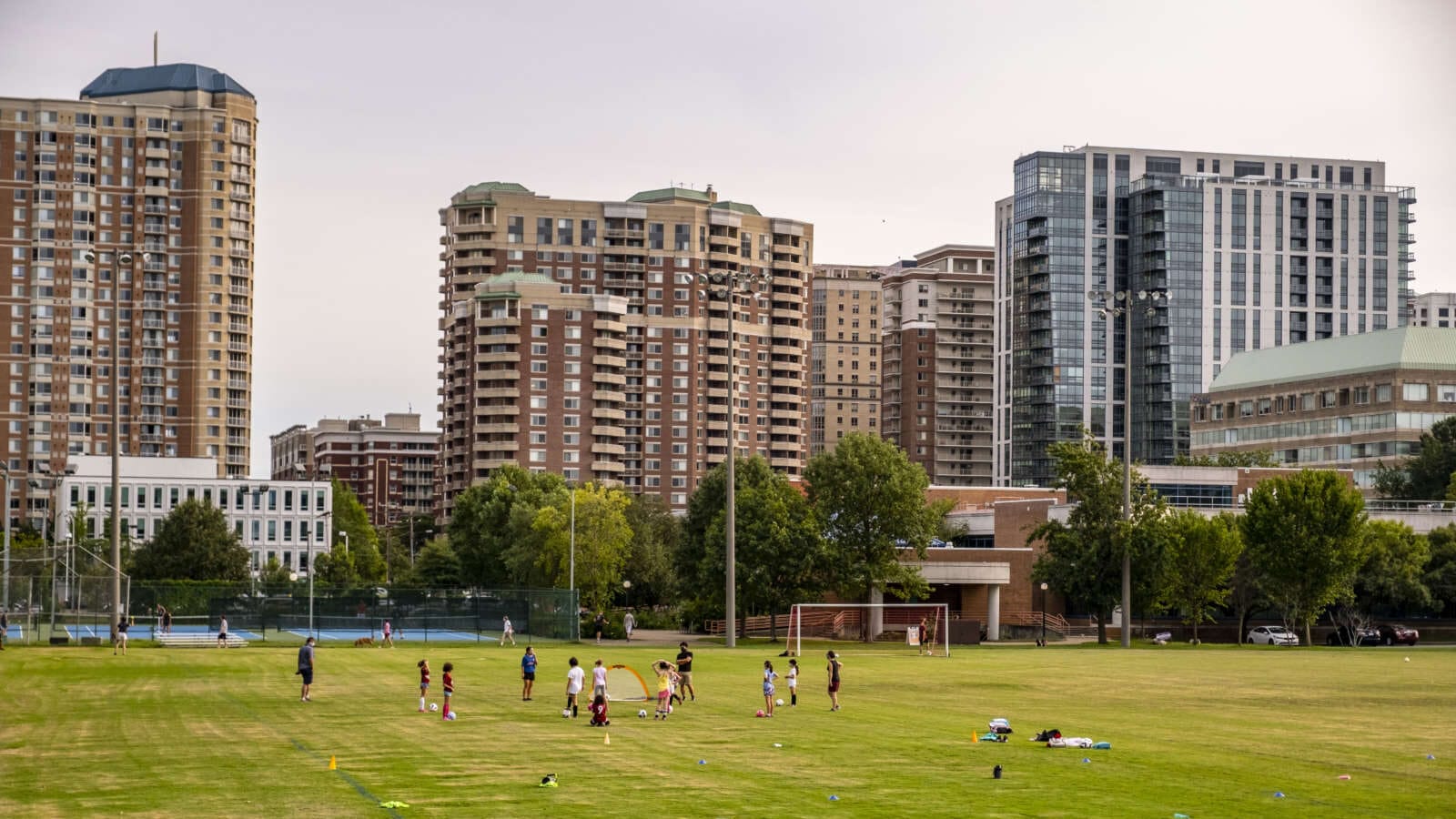
County Board members are wrestling with the timing and potential scope of future changes to Central Library and adjacent Quincy Park.
At a July 14 capital-spending work session, Board members tried to find common ground on how to approach what could become one of the county’s most contentious planning efforts of the 2030s.
“I don’t want to overpromise,” Board Chair Matt de Ferranti said during the session.
As part of his proposed 10-year, $4.3 billion capital improvement plan, County Manager Mark Schwartz has recommended including planning funding for repurposing Quincy Park during the fiscal year beginning in mid-2029. His proposal, however, has no funding for addressing the 1960s-era Central Library building and garage.
The parcels occupy prime, Metro-accessible sites in Virginia Square. Future redevelopment of the Central Library parcel is likely to include mixes beyond a new library, and various interest groups are likely to push for inclusion of an arts center, community center, affordable housing or other uses.
Board member Susan Cunningham used the July 14 meeting to press for more coordination between the two projects, including allocating funding for planning efforts a year earlier than proposed by Schwartz.
The library is housed in “a really tired building” that has faced multiple rounds of patchwork efforts to keep it running, Cunningham said. She pressed her colleagues to focus on “stopping the bleeding on the existing building and using that site more intensely.”
“We need to start with that planning work,” she said. “You’re going to be spending money one way or another.”
“Conceptually, I’m with you,” Board member Maureen Coffey said in response to the plea. But Coffey, other Board members and staff raised concerns about raising expectations about what might be feasible in an era of constrained government budgets.
“This type of process will be really complex,” said Michelle Cowan, a deputy county manager. “I don’t want us to let our community down.”
Board member Julius “JD” Spain, Sr., agreed. He said the Board needed to “set realistic expectations” on the site’s future.
“I’m not really there on accelerating this process,” he said.
Board members have until Tuesday, July 21, to determine how to move forward. That’s when they are slated to adopt the updated FY2027-36 capital plan.
Both de Ferranti and Cunningham said they expected some consensus would be reached.
“We can work it a little bit,” Cunningham said of her proposal.
There was talk of finding a development partner to offset government costs of any redevelopment, but as Coffey put it, “we have a chicken-and-egg problem.” Without determining exactly what uses on the site are desired, it would be hard to entice any partners.
Cowan expressed the same view.
“You can’t just reach out to partners without giving them some vision,” she said. “We have to give them some scope. And they’ll want something in return.”
Schwartz also seemed iffy on moving too far, too fast.
Identifying recreation needs for the park portion “is the first step,” he said, acknowledging “there are plenty of other pieces” to the development puzzle. One complicating factor: A portion of the site is owned by Arlington Public Schools.
Cunningham said bringing forward park-planning dollars by a year and adding extra money to start considering the library’s future is the best way to move forward.
“They are interrelated,” Cunningham said. “We need to have that conversation.”
