

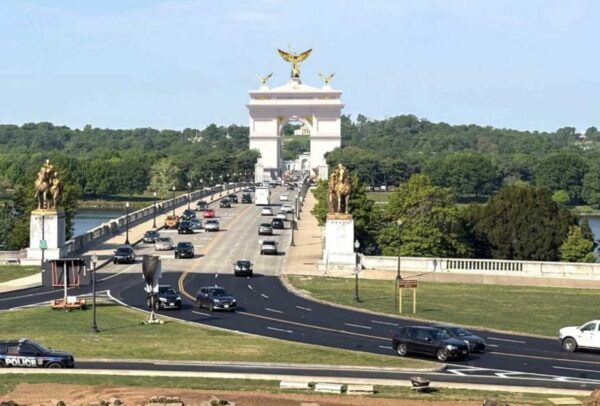
A recent project review by Arlington County planning staff flagged numerous practical concerns about plans to build a triumphal arch near Arlington National Cemetery.
Noting incomplete and sometimes inconsistent information in an environmental assessment by the National Park Service, county staff questioned likely impacts on roads, pedestrians, historic views and air traffic if the Trump administration builds a 250-foot arch in the middle of the Memorial Circle roundabout.
Writing at the end of a seven-day review period provided by the National Capital Planning Commission — significantly shorter than the usual 60-day window for projects impacting Arlington County — Planning Director Anthony Fusarelli warned of serious infrastructure and safety issues. He argued, for instance, that the sidewalks are too narrow for anticipated pedestrian crowding near the busy traffic circle, where visitors would have to cross multiple travel lanes in order to reach the monument.
“The proposed action introduces a significant trip generator in the center of a complex, high-volume traffic circle and introduces high crossing volumes of pedestrian and bicycle traffic and associated conflicts that do not exist today,” Fusarelli wrote on June 17.
Fusarelli also argued that the environmental assessment is insufficient in its consideration of transportation impacts. While the assessment presents a patchy analysis of how the arch would delay thousands of commuters who pass through the roundabout every day, he said it fails to consider downstream effects on the network of highways that the roundabout serves to connect.
“The study focuses on the circle and does not consider the larger context of potential impacts to the connected network, such as George Washington Memorial Parkway and Richmond Highway (Virginia State Route 110) for vehicles and the Mount Vernon Trail and Washington Boulevard Trail for pedestrians and bicyclists,” he wrote. “The study needs to expand the analysis area to understand larger circulation patterns, desire lines, and impacts between these contributors and the project area.”
Fusarelli also said that building a structure over 200 feet high might disrupt flight patterns over the roundabout, potentially affecting operations at Reagan National Airport and land use planning in Arlington.
The Division of Transportation provided a list of 32 comments on the plans they received. Further feedback focused on “inadequate” information on how to address expected levels of foot traffic; inconsistent information on how crosswalks would be signalized; limited amounts of shade and vegetation in the plans; lack of plans for how to prevent parked and idling vehicles from impeding traffic; and open questions about pickup and dropoff points for visitors.
Other staff concerns focused on historic preservation.
Echoing criticisms raised repeatedly in public comments and in numerous media outlets since plans for the arch were first announced, Arlington County Historic Preservation Principal Planner Mical Durak said that a structure of this size would disrupt the “feeling, setting and design” of historic resources in the area of Arlington National Cemetery.
“The scale and mass of the arch is inappropriate in the context of its historic setting and would negatively impact the physical and symbolic unity conveyed via the Arlington Memorial Bridge and Memorial Avenue between the Lincoln Memorial and Arlington house, as proposed in the McMillan Plan,” Durak wrote in a letter to the National Park Service.
She called for the proposal to “be scaled more appropriately with its surroundings,” including Arlington Memorial Bridge.
Memorial Circle is located on federal land within the borders of D.C., but Arlington’s proximity to the site makes the county “a key consulting party,” the county government said in a statement on Thursday.
“Staff encouraged the federal government to follow the 1902 McMillan Plan that guides the design and layout of Washington, D.C. and to fully consider the negative impact the arch would have on that plan,” the county wrote.
The National Park Service is collecting feedback on the arch proposal through Thursday, July 30.
The National Capital Planning Commission voted earlier this month to approve preliminary site and building plans, and the U.S. Commission of Fine Arts, a separate federal agency, approved the design for the arch in May.
Will Scharf, who has served as Trump’s White House staff secretary, heads the National Capital Planning Commission. He has argued that this year’s 250th anniversary of the Declaration of Independence “is as good an opportunity as any to add something to Washington, D.C., that will hopefully stand the test of time.”
The Associated Press contributed to this article.
