

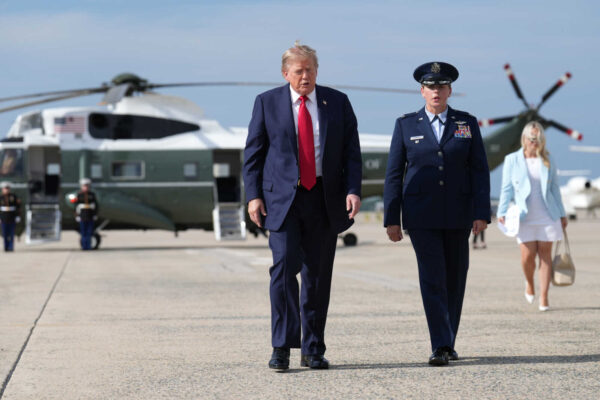
Air traffic controllers and the pilots of President Donald Trump’s helicopter met to discuss radio problems one week before a jet was allowed to take off from Reagan National Airport just as Marine One lifted off from the White House.
Controllers had reported not receiving the standard three-minute warning call ahead of Marine One flights, and both sides agreed to an alternative in those instances — but that plan, to relay the radio call through someone else, was also unsuccessful on the day of the Aug. 4 incident, the National Transportation Safety Board’s preliminary report shows. The report was released Thursday.
Having both the jet and helicopter in the air at the same time seemed to violate safety procedures put in place after last year’s midair collision near the airport that killed 67 people, but officials stressed that the president was never in danger. The FAA opened an investigation the next day.
Construction at the White House may have contributed. Work on a new ballroom forced officials to temporarily move Marine One’s takeoff spot from the South Lawn to the Ellipse, the park south of the White House, and the new location proved worse for reaching the tower by radio, according to the New York Times.
Technicians determined there was “not adequate line-of-sight to ensure communications” between the Ellipse and the tower while construction was underway, the report says. There had been no known problems with the radio frequency before that.
The Supreme Court last week temporarily allowed the 90,000-square-foot ballroom project to move ahead while it considers whether the work can be completed. The White House did not address questions about whether the construction played a role in the incident, the Times reported.
The Pentagon has a longstanding agreement with the Federal Aviation Administration to provide controllers with a three-minute warning before the president’s helicopter takes off, an arrangement that predates last year’s crash.
The NTSB said recordings from the tower showed that the controllers never heard the calls from Marine One’s pilot that day warning that the helicopter was getting ready to take off, but separate recordings posted by ATC.com show the helicopter did make those calls. The helicopter pilots tried to relay their three-minute call through the helicopter facility at Joint Base Anacostia-Bolling, but that was also unsuccessful.
Preliminary estimates show the helicopter and plane were just over 0.8 mile apart laterally and about 700 feet apart vertically at their closest, the NTSB said. The crew of the Envoy Air flight, bound for Pensacola, Florida, told investigators they received a traffic warning from their collision avoidance system right after they took off, but they never saw the helicopter.
The FAA has acknowledged that the helicopter and airliner briefly got too close before the two aircraft started to move away from each other. The airplane quickly climbed above the helicopter after Marine One’s pilots saw the plane and paused until it safely left the area.
The Marine Corps said at the time that there were no “close calls” during the flight and that the tower did not ask the crew to hold or alter its route.
The official FAA recordings from the tower at Reagan did not include the warnings that Marine One was getting ready to head to Andrews Air Force Base with the president aboard that day.
A recording posted by ATC.com showed the Marine One pilot telling the tower that the helicopter was “three minutes to lift” just like the 2013 agreement between the FAA and the military calls for. But the controller seemed surprised a few minutes later when the helicopter took off.
“Uh, Marine One, you said, uh, you’re proceeding as briefed?” the controller asked before giving the helicopter directions and commenting, “OK, no three minutes, roger, proceed as briefed.”
After the controller warned the helicopter about the plane taking off, the Marine One pilot said he saw the traffic and declared, “We’ll be doing a momentary delay.”
The FAA decided after an airliner collided with an Army Black Hawk helicopter on Jan. 29, 2025 that all takeoffs and landings at the airport would be halted anytime a helicopter passes by on a conflicting route. The airspace near the White House and Reagan is heavily congested with military and commercial aircraft.
Those changes have reshaped the skies over Arlington. New FAA charts published last fall pulled the helicopter zone back to west of Glebe Road, narrowing where helicopters can fly over the county, and the agency made the post-crash rules permanent in January.
After last year’s midair collision, it became clear that poor communication between air traffic controllers and the military had been a longstanding issue. During a congressional hearing, it came out that a hotline connecting the Pentagon to the tower at Reagan hadn’t been working for more than three years, and the FAA hadn’t even realized it. The NTSB and area elected officials later objected to a safety exception for military flights around the airport.
The NTSB said that after this incident involving Marine One, FAA technicians determined that there wasn’t adequate line of sight between the radio receiver at the airport and the location where the helicopter takes off at the White House. So those radios were moved from the neighborhood where they had been located to the top of the tower at Reagan. Subsequent tests showed the radios working well after that change.
FAA Administrator Bryan Bedford told reporters earlier this week that the agency had changed its communication procedures and relocated an air traffic antenna, the Times reported.
Families of the victims of last year’s crash have lobbied for laws requiring aircraft to carry technology that would let pilots track real-time location signals from other aircraft, rather than depending on controllers to flag collision risks. An NTSB report into the crash found that such equipment would have given the pilots almost a minute of warning that they were on a collision course.
Those efforts have been gridlocked for months as House and Senate lawmakers spar over two competing approaches, which differ over which planes would have to carry the technology and how strictly the military would be barred from switching off its location-broadcasting equipment in restricted airspace. A revised House bill won NTSB backing in March, but victims’ families said its deadlines were too soft.
The NTSB’s findings are preliminary and its investigation is ongoing.

