

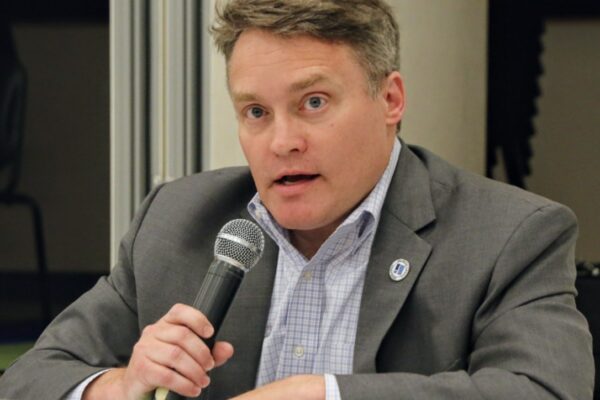
The chair of the Arlington County Board wants the General Assembly to keep out of the county’s change-of-government discussion in 2027.
“Del. [Patrick] Hope could file a bill again — I’m hoping he does not do that,” Matt de Ferranti said at a Sept. 9 governance-change forum sponsored by Advance Arlington.
De Ferranti, who will serve as chair through Dec. 31, said the local community needs to have time to determine what, if any, options it wants considered.
“Change is best considered with grassroots energy,” de Ferranti said at the forum.
Previous County Board members went to Republican Gov. Glenn Youngkin to scuttle Hope’s earlier efforts at governance-change legislation. De Ferranti said the current County Board might be willing to form a similar alliance with Democratic Gov. Abigail Spanberger in 2027.
Spanberger “pays attention to local government” and “will have serious questions” if legislation passes over County Board opposition, said de Ferranti, who is currently seeking re-election.
The County Board chair was joined in the Advance Arlington panel discussion by Alexandria Vice Mayor Sarah Bagley and Fairfax County Board of Supervisors Chair Jeff McKay. The discussion looked at the pluses and minuses of the different government structures in all three jurisdictions.
“There is no perfect model,” McKay said. “There are nuances to every one of these structures.”
Fairfax has a 10-member Board of Supervisors, with a chair elected countywide and nine supervisors elected in districts with an average population of 120,000.
“There is absolutely no doubt that district supervisors parochially care about their own residents,” McKay said, but added that “we usually coalesce around things.”
“But it takes work,” he said.
De Ferranti has floated the idea of a seven-member County Board, with three members elected in districts, three at-large seats and a directly elected chair. He acknowledges he’s just one vote, and that might not be where the county decides to go.
“We should talk about all of the options,” he said. “I want the full conversation.”
In Alexandria, there is a smaller but similar governance-change discussion taking place, with School Board members asking that their posts be moved to staggered terms.
That would require General Assembly action to amend the city’s charter, and Bagley said it had been a “chicken-and-egg thing” to decide whether to seek permission from Richmond first, or make decisions locally and then ask the legislature to ratify them.
“I’m not suggesting one way is necessarily better,” she said. “It’s tricky.”
Faced with the two options, Alexandria officials are seeking to gain local consensus before any legislative action.
Arlington leaders appear to have discounted the option of seeking conversion to city status, since there currently is a statewide moratorium on that running through 2032. Even without the ban in place, moving to city status would involve major costs at the local level, particularly related to transportation.
Concern about additional costs of maintaining roadways was the major reason Fairfax officials abandoned consideration of seeking city status, McKay said.
By Fairfax’s analysis, the conversion would add 8 cents per $100 assessed value to the tax rate, merely to control local roads.
“That’s not a good deal,” he said, advising Arlington that all impacts “have to be very carefully considered” before embarking on changes.
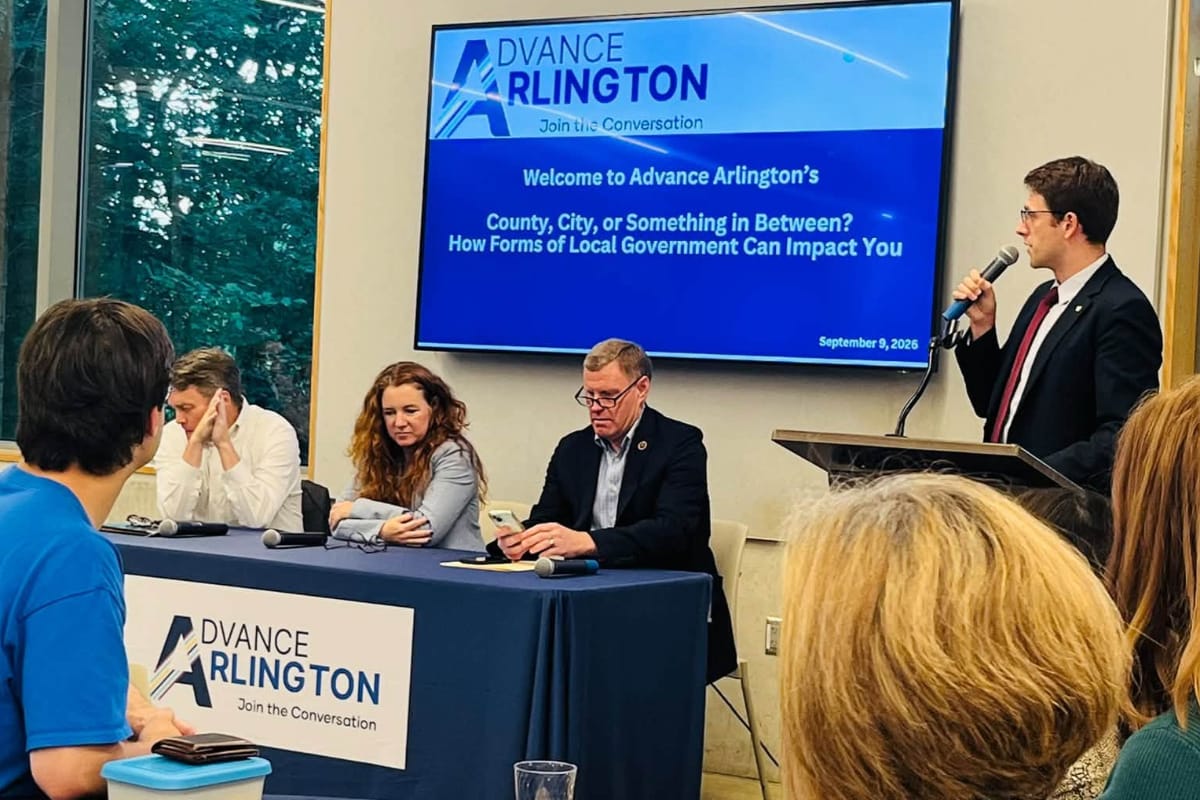
In his remarks, de Ferranti said one topic that needs to be discussed is the relationship between the elected Board and the appointed county manager.
“The balance between the manager and the Board is not right,” he said. “Sometimes he tells us what to do too much, and that has to change.”
Board members twice have delayed consideration of how to move forward on the governance change issue, punting it from December 2025 to the summer of 2026, and from there to December 2026. In the interim, the county attorney has studied the legal issues involved, and a consultant is working on a report detailing other matters for future consideration.
The next step could be the appointment of a community task force in 2027, although there may not be unanimous County Board support for that idea.
Pat Carroll, who for years was the county government’s legislative liaison on General Assembly affairs, said any possible changes need to be checked and double-checked for the possibility of unforeseen consequences.
“There’s a lot of things to balance to make this all work,” she said.
