

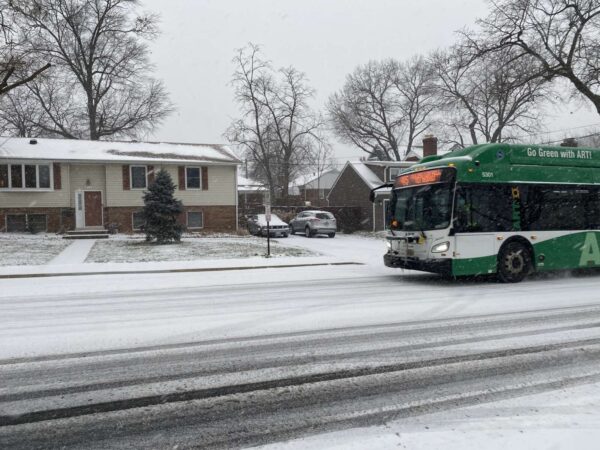
County officials now have real-world data on how Arlington Transit’s electric buses operate in winter’s chill.
Frigid temperatures in late January created unique challenges for the county’s fleet, draining batteries more quickly than normal and sometimes requiring a midday recharge, said Ryan Jones, a transportation planner who briefed the county’s Transit Advisory Committee on March 10.
Energy consumption on Jan. 29 and 30 averaged 4.3 kilowatt hours of energy per mile traveled by the electric buses, up from 2.5 to 2.7 in typical springtime conditions.
Viewed differently, buses expected to travel 219 miles and retain 20% battery life on a typical day can only run an estimated 129 miles, with the same 20% reserve, in temperatures of less than 30 degrees.
Excessive summer heat also causes battery drain, cutting performance to around 180 miles with a 20% battery reserve remaining.
On the busiest route in the system — ART 41 — buses made runs totaling 104 miles during the coldest part of late January and “we still had 35% of the battery left,” Jones said.
“Operations staff can monitor that information throughout the day,” Jones said. “If a bus is consuming energy faster than expected due to weather or route conditions, dispatch can adjust assignments to ensure the vehicle completes its service while maintaining a safe reserve.”
County officials last year introduced four battery-electric vehicles to the fleet, with the expectation that electric buses ultimately could replace all buses running on compressed natural gas. Since their introduction, the four electric buses have traveled a combined total of 74,000 miles.
Their service life is approximately 12 years. Battery efficiency declines over time and could drop as much as 20% over that period.
The accumulation of data in various weather and service conditions will “replace theoretical modeling with real operational data,” Jones said.
“As the data set grows, this information will allow us to better understand how temperature, route characteristics and operating conditions affect energy use and range,” he said.
Committee members and staff also discussed battery disposal and plans for upgrading charging capacities for the ART fleet.
At the meeting, committee member Sohail Husain sought reassurances that an increasing number of electric buses would not cause reliability issues.
“I want to make sure there’s not going to be any impact on buses’ frequency,” he said.
The American-made battery-electric buses by Gillig were chosen after testing and operations by ART staff on a variety of Arlington routes2. They were incorporated into the fleet in 2025.
Purchases were made using a mix of state and local funding.
