
This regularly scheduled sponsored column is written by Eli Tucker, Arlington-based Realtor and Arlington resident. If you would like to work with Eli and his team in Northern Virginia and the greater D.C. Metro area, you can reach him directly at [email protected].

If you enjoy reading my columns, I would appreciate your vote for top real estate agent in Arlington Magazine’s “Best Of Arlington 2026” poll. Use this link to vote, and don’t forget to include your other favorite local businesses and service providers. These recognitions mean a lot to local businesses.

Question: How has buyer agent compensation changed since the laws changed last year?

Laws Changed One Year Ago

You probably recall hearing all about the class-action lawsuits and settlements last year that made it illegal for sellers and brokers to offer buyer agent compensation through the MLS. In fact, many argue that the law makes it illegal for sellers and brokers to offer a set buyer agent compensation at all. I wrote about the changes here, if you want a refresher.

The laws went into effect one year ago, in August 2024. They were a huge deal within the industry and captured months of news headlines.

The Mechanics Changed, The Market Has Not

In October, I wrote an article clarifying some misunderstandings and shared my observations that little had changed in the market, with most transactions including seller-paid buyer agent compensation.

After a full year, including a spring market (albeit less competitive than usual), the results of the settlement have caused little change for consumers and in the industry.

  • The Mechanics Changed: Prior to August 2024, in nearly all transactions, the seller agreed to a set compensation for the agent representing them and an agent representing the buyer. The buyer agent compensation was entered into the MLS listing and became enforceable. Now, any seller-paid buyer agent compensation is enforced through the sales contract and must be agreed to during buyer-seller negotiations. If it’s not in the contract, it’s not payable.
  • The Market Has Not: Prior to the new laws, nearly all transactions included seller-paid buyer agent compensation and in 2022 the average buyer agent comp in Arlington was 2.54% with over 80% of transactions including 2.5 seller-paid buyer agent comp. Based on our team’s experience, brokerage data, and regional/national surveys the market is still operating in a very similar manner, with sellers covering buyer agent compensation in the vast majority of transactions and the average hovering around 2.5%.

In May 2025, Redfin published some great data on this (charts below), showing that the average buyer agent compensation had dropped from 2.51% in Q1 2023 to 2.4% in Q1 2025. Much less of a drop than many expected. Their data does show that the average commission percentage is about one-third percent less for homes sold for $1M+ than those sold for under $500k.

Their data does not indicate what percentage of these transactions/fees were paid by the seller, but their sub-header in the same article states “most sellers are still paying buyer agent commissions” which is exactly what I’ve seen over the past 12 months, what our brokerage of ~450 agents in the DC Metro has found surveying every transactions, and what I’ve heard from numerous lenders, title attorneys, and appraisers who have insight into thousands of regional transactions.

A graph of sales AI-generated content may be incorrect.

A graph of sales AI-generated content may be incorrect.

We Have a Data Transparency Problem

One of the trade-offs made with these new laws was losing transparency and reporting on seller-paid buyer agent commissions. Prior to 2024, when this information was entered into the MLS, all agents, brokers, appraisers, etc could easily pull buyer agent commission data for individual transactions or for an entire market (like I used to do for Arlington).

Without transparency into how much seller-paid buyer agent commission was included in a transaction, we run into challenges with property valuations aka “comparables.” While studies and experience suggest that a given sale most likely included 2.5% seller-paid commission, that’s probably true for about 2/3 of transactions these days and the others vary from less to more to none. So, the housing marketplace lost valuable insight into market values when we removed buyer agent comp from the MLS because sale prices will vary if the seller is paying 2.5-3% to a buyer agent vs nothing.

Note: other MLS’s may track this but Bright MLS (second largest in the country, covers most of the Mid-Atlantic) does not have a good method for doing so.

Frankly, I’m shocked the banks haven’t had more to say about this because their appraisers are missing information that contributes to a 0-3% shift in valuations that they use to make lending decisions.

My understanding of why they don’t want to collect this data is they don’t want individual buyer-seller decisions to be influenced by what the rest of the market is doing. I sympathize with that position, but there are plenty of other ways to access and understand what the rest of the market is doing, so consumers and agents who want the data will get it anyway. It’s also important for consumers/agents to know what competing listings are offering and what decisions past sellers have made that lead to success in their market. The loss of data transparency/reporting is a significant loss for the market.

If you’d like to discuss buying, selling, investing, or renting, don’t hesitate to reach out to me at [email protected].

Eli and his team believe that your real estate needs should be managed by advisors, not salespeople. Their mission is to guide, educate, and advocate for their clients through real advice, hands-on support, and personalized service.



This regularly scheduled sponsored column is written by Eli Tucker, Arlington-based Realtor and Arlington resident. If you would like to work with Eli and his team in Northern Virginia and the greater D.C. Metro area, you can reach him directly at [email protected].

Question: How has the rental market performed so far in 2025?

If you enjoy reading my columns, I would appreciate your vote for top real estate agent in Arlington Magazine’s “Best Of Arlington 2026” poll. Use this link to vote and don’t forget to include your other favorite local businesses and service providers. These recognitions mean a lot for local businesses.

Rental Prices Across Arlington Continue Higher

Local job uncertainty and economic headwinds were no match for rental prices in Arlington so far in 2025, with the average price of renting an apartment (condo), townhouse/duplex, and detached home all up and competition high across all three property types.

Over the past five years, the average rent price in Arlington is up 27.3% across all property types and 25.2% on a price per square foot basis. So far in 2025, the average price of all rentals is up 1.2%, but the average price per square foot is up 6.9%, which is likely a better reflection of actual rental price increases in 2025.

You can see my mid-year analysis on the for sale market for detached homes and condos, here and here.

Highlights and Data Table

Here are some highlights from the data table (keep in mind that 2021-2024 includes 12 months of data, but 2025 is just 7 months of data):

  • The average rent for an apartment (condo) is up 5.9% compared to last year and up 29.6% over the past five years
  • The average rent for a detached home is up 2.1% compared to last year and up 23.4% over the past five years
  • The average rent for a townhouse/duplex is up 2% compared to last year and up 22.8% over the past five years
  • The five year increase in average rent for apartments (condos) and detached homes is much higher than the increase in average price to purchase a condo (6%) and detached home (15.5%) over the past five years
  • While the average price of renting in North Arlington is about 16% higher than is South Arlington, the rate of annual rent growth is similar across both regions of the county
  • Renting a detached home or townhouse/duplex was moderately more competitive than renting an apartment (condo), with nearly 50% of detached and townhouse/duplex properties renting within ten days on market, compared to just over one third of apartments

A table with numbers and percentages AI-generated content may be incorrect.

About the Data

The data above is rental data from the MLS in Arlington over the last five years. Note that very few commercial apartment buildings list in the MLS so this data is limited to non-commercially owned rentals (for apartments, that is mostly individually owned condos).

Further, it’s difficult to say what percentage of non-commercially owned properties go through the MLS for rent but I would guess that it’s about half of rented apartments (condos), but likely a majority if detached and townhouse properties. Despite the limited data set, we still have more than enough information available through the MLS to generate outputs that represent the true rental market.

Upcoming (pre-market) ERG Listings, Details and Additional Listings Available by Request

  • Falls Church – 5BR/3BA/2,170 sqft – Detached Single Family (1950) – Bolling Rd Falls Church VA 22042
  • Falls Church City – 4BR/4.5BA/3,000+ sqft – End-unit townhouse (1995) – Rees Pl Falls Church VA 22046
  • Arlington Ridge/Aurora Hills – 3BR/2.5BA/2,450sqft – Detached Single Family (1961) – S Grove St Arlington VA 22202
  • Yorktown – 6BR/6.5BA/6,000+ sqft – Detached Single Family (2026) – N Greencastle St Arlington VA 22207
  • Rosslyn – 2BR+den/2.5BA/2,000+ sqft – Condo (2021) – 1781 N Pierce St Arlington VA 22209

Eli and his team believe that your real estate needs should be managed by advisors, not salespeople. Their mission is to guide, educate, and advocate for their clients through real advice, hands-on support, and personalized service.


This regularly scheduled sponsored column is written by Eli Tucker, Arlington-based Realtor and Arlington resident. If you would like to work with Eli and his team in Northern Virginia and the greater D.C. Metro area, you can reach him directly at [email protected].

TL;DR Video Summary (2:42):

Question: How has the Arlington condo market performed in the first half of 2025?

Answer: The condo market is more susceptible to downturns in the housing market because condo buyers can almost always find a suitable alternative by renting an apartment, if buying loses its appeal. With high interest rates and uncertain local economic conditions in the first half of 2025, the Arlington condo market suffered a loss in value, unlike the detached single-family market, and is having one of its worse years in the past two decades.

Prices and Competition Down in the First Half

Let’s look at the performance of Arlington’s condo market in the first half of 2025 compared to the first half of the previous four years:

  • The average price of a condo fell by 10%, to just over $508,500, and the average $/SqFt fell by 4%
  • The median price of a condo fell by 7.5%, to $439,000
  • Demand fell sharply with just 39% of condos selling within the first ten days on market and just 39% selling for at or above the asking price
  • After significant price gains in 2024, seller optimism was high heading into 2025 and the initial asking prices reflected that. Low demand led to substantial discounts off the initial asking price, with condos selling for an average of 5.3% below the original ask, compared to about 1% each if the past four years.
  • Most of the losses seem to come from the two-bedroom condo market, where the average price dropped by 7%, compared to a 1% drop in the one-bedroom market

(more…)


This regularly scheduled sponsored column is written by Eli Tucker, Arlington-based Realtor and Arlington resident. If you would like to work with Eli and his team in Northern Virginia and the greater D.C. Metro area, you can reach him directly at [email protected].

Question: How has the Arlington single-family housing market performed in the first half of 2025?

Answer: Despite significant headwinds from DOGE cuts to Federal spending and workforce and a sluggish national housing market, prices of Arlington’s detached single-family homes continued their upward climb in the first half of 2025, compared to the first half of 2024, albeit at a slower pace and with much less competition.

Prices Up, Competition Down in the First Half

Let’s look at the performance of Arlington’s detached single-family home (SFH) market in the first half of 2025 compared to the first half of the previous four years (new construction sales not included in the data set):

  • The average and median price of a SFH increased by 3.2% and 4% year-over-year, respectively
  • Over the past five years, the average and median price of a SFH in the first half of the year increased by 15.5% and 17.9%, respectively
  • The average SFH sold for more than $1,435,000, including new construction, and over $1,380,000 without new construction sales
  • The median home price is $1.3M, including new construction, and $1,275,000 without new construction sales
  • Demand and competition in the first half of 2025 fell to its lowest levels since the first half of 2020 (COVID spring):
    • only 54% of homes selling within the first ten days on market and just 55% of homes selling for at or above the asking prices, dropping from an average of 65% and 69% the previous four years
    • the average home sold for 0.3% below the original asking price, the first time the average home sold for below the original asking price in the first half of the year since 2020
  • Homes that went under contract within the first ten days sold for an average of 2.5% over the asking price, down from 3.1% last year
  • Just 25% of homes sold for less than $1M

A table with numbers and prices AI-generated content may be incorrect.

A graph of a number of columns AI-generated content may be incorrect.

Looking Forward

The rosy picture painted by the strong numbers detailed above hide a less optimistic truth. The dataset above accounts only for the homes that have sold, but inventory is building with homes struggling to sell and many are reducing their asking price. While the average Arlington detached home price increased 3.2% year-over-year, the average Arlington detached home listed for sale in Q2 was listed for 13% less than in 2024.

As these sellers run out of patience or experience financial pressure to sell, they may be forced to accept prices they previously would not have consider and I wouldn’t be surprised if the second half of 2025 tells a different story of home values than the first half.

With the inventory of detached homes in Arlington up 54.5% year-over-year in June and the second half of the year traditionally a better time for buyers than the first half, expect to see buyers with more negotiating leverage than they’ve had in years, through the end of 2025.

How the Data is Organized

For my mid-year reviews, I like to compare the first half of the year to the first half of prior years, rather than comparing the first half of the current year to the full year in prior years. We tend to see a stronger market (higher demand, more competition) in the first half of the year than the second half, so this approach gives us a better apples-to-apples comparison.

The data is organized by homes that went under contract in the first half of the year because it’s more reflective of actual buying activity during that period; as opposed to looking at homes that closed in the first half of the year, but may have gone under contract many months prior during different market conditions. I also use “net sold” price, which factors in any seller credits to a buyer, instead of just the standard sold price.

This year I removed new construction sales from the data (I comment on it separately) because it was incorrectly skewing the outcomes of the data.

If you’d like to discuss buying, selling, investing, or renting, don’t hesitate to reach out to me at [email protected].

Upcoming (pre-market) ERG Listings, Details and Additional Listings Available by Request

  • Falls Church City – 4BR/4.5BA/3,000+ sqft – End-unit townhouse (1995) – Rees Pl Falls Church VA 22046
  • Highland Park/Overlee Knolls – 6BR/5.5BA/5,000+ sqft – Detached Single Family (2025) – 22nd Rd N Arlington VA 22205
  • Arlington Ridge/Aurora Hills – 3BR/2.5BA/2,450sqft – Detached Single Family (1961) – S Grove St Arlington VA 22202
  • Yorktown – 6BR/6.5BA/6,000+ sqft – Detached Single Family (2026) – N Greencastle St Arlington VA 22207

Eli and his team believe that your real estate needs should be managed by advisors, not salespeople. Their mission is to guide, educate, and advocate for their clients through real advice, hands-on support, and personalized service.


This regularly scheduled sponsored column is written by Eli Tucker, Arlington-based Realtor and Arlington resident. If you would like to work with Eli and his team in Northern Virginia and the greater D.C. Metro area, you can reach him directly at [email protected].

Question: How do I take advantage of the new 100% Bonus Depreciation tax benefit for my rental property?

Answer: You’ve probably heard that the tax provisions in the recent One Big Beautiful Bill Act brings back 100% bonus depreciation and how much this excites investors. Is this a windfall for all investment property owners? Who benefits? Let’s look past the headlines and dig into what 100% bonus depreciation means and who benefits.

I got input from my CPA, who I highly recommend, Matt Bormel of Bormel, Grice, and Huyett on the important details of 100% Bonus Depreciation. If you have questions about how you can take advantage of the new tax policy or would like general tax support, you can reach Matt by email at [email protected].

What is 100% Bonus Depreciation?

Depreciation is a cornerstone tax benefit for real estate investors, allowing the deduction of real estate assets/components over its useful life. For residential investment properties, owners are allowed to depreciate the value of the home in equal amounts over 27.5 years (referred to a straight-line depreciation).

Bonus depreciation turbocharges this by enabling the immediate deduction of qualified assets in the first year, greatly accelerating tax savings.

Qualified assets typically include components within a property that depreciate quicker than the overall structure, such as:

  • Appliances
  • Flooring
  • Cabinets
  • HVAC systems
  • Landscaping and exterior improvements

What Qualifies for 100% Bonus Depreciation?

Land never qualifies for depreciation and the structure of a home (the “building”) does not qualify for bonus depreciation (depreciates over the aforementioned 27.5 years), but many components of the home do, as noted above.

There are two simple ways of categorizing how you can benefit from 100% bonus depreciation:

  1. If you own an investment property and put a qualifying component in-service after January 19 2025, it qualifies for 100% bonus depreciation and will be deducted, like an expense, in year one.
  2. If you purchase an investment property after January 19 2025, all qualifying components can receive 100% bonus depreciation treatment, but you need to perform a cost segregation study.

A cost segregation study is performed by professionals who analyze the property, classifying each component into shorter depreciation periods (5, 7, or 15 years) and assigning a value. It is highly detailed and meets specific IRS requirements.

Cost segregation studies cost thousands (or more, for larger properties) and are often too expensive to justify for a residential investment property. Yes, like most things, you can do one yourself or get it done cheaply, but you increase the risk of it being done wrong and running afoul of the IRS.

Don’t Forget about Depreciation Recapture

Depreciation recapture often surprises investors at the point of sale. When selling, the IRS “recaptures” depreciation deductions previously claimed, taxing these at a higher rate (typically 15-25%) than standard long-term capital gains. This can significantly reduce the net proceeds upon sale, making bonus depreciation primarily a tax-deferral strategy rather than permanent tax avoidance.

Who Benefits from Bonus Depreciation?

  • High-Income Investors: Investors facing significant tax burdens stand to benefit dramatically, potentially saving tens of thousands of dollars immediately.
  • Real Estate Professionals (REPS): Those qualifying under IRS guidelines can use these deductions against active income, creating substantial tax savings.
  • Investors Experiencing High Taxable Events: Individuals who have realized large taxable gains (e.g., sale of businesses, large income events) can offset these through strategic bonus depreciation.
  • Long-term Investors: Tax benefits improve for longer-term holding periods

Who Might Not Benefit?

  • Low-Income Investors: Those without significant tax liabilities may not fully utilize immediate deductions.
  • Short-Term Property Owners: Investors planning to sell properties soon may face accelerated recapture taxes, negating immediate savings.
  • Smaller Property Owners: The upfront cost and complexity of a segregation study may outweigh the benefits.

Pros of Bonus Depreciation

  • Immediate Tax Savings: Accelerating deductions enhances cash flow immediately
  • Strategic Flexibility: Ideal for offsetting significant taxable income events
  • Enhanced Investment Returns: Increased immediate liquidity can be leveraged into additional investments or debt reduction

Cons of Bonus Depreciation

  • Upfront Costs: If needed, cost segregation studies involve high costs
  • Recapture Liability: Tax rates change over time. Investors planning for the long-term must consider potential future tax increases, possibly making recapture more costly
  • Complexity and Audit Risk: Aggressive strategies may attract IRS scrutiny, necessitating meticulous record-keeping and professional guidance

Bottom Line

100% bonus depreciation is a powerful financial tool in real estate investment tax strategy, but it has limited or no benefit to many casual real estate investors. Each investor must weigh immediate benefits, recapture implications, long-term financial strategies, and up-front costs to determine if it’s the right tax strategy for them.

Before proceeding, consult with a tax professional to assess how this aligns with your investment goals and tax situation. You are welcome to contact my CPA, Matt Bormel at [email protected].

If you’d like to discuss buying, selling, investing, or renting, don’t hesitate to reach out to me at [email protected].

Upcoming (pre-market) ERG Listings, Details and Additional Listings Available by Request

  • Falls Church City – 4BR/4.5BA/3,000+ sqft – End-unit townhouse (1995) – Rees Pl Falls Church VA 22046
  • Highland Park/Overlee Knolls – 6BR/5.5BA/5,000+ sqft – Detached Single Family (2025) – 22nd Rd N Arlington VA 22205
  • Arlington Ridge/Aurora Hills – 3BR/2.5BA/2,450sqft – Detached Single Family (1961) – S Grove St Arlington VA 22202
  • Yorktown – 6BR/6.5BA/6,000+ sqft – Detached Single Family (2026) – N Greencastle St Arlington VA 22207

Eli and his team believe that your real estate needs should be managed by advisors, not salespeople. Their mission is to guide, educate, and advocate for their clients through real advice, hands-on support, and personalized service.


This regularly scheduled sponsored column is written by Eli Tucker, Arlington-based Realtor and Arlington resident. If you would like to work with Eli and his team in Northern Virginia and the greater D.C. Metro area, you can reach him directly at [email protected].

Eli and his team believe that your real estate needs should be managed by advisors, not salespeople. Their mission is to guide, educate, and advocate for their clients through real advice, hands-on support, and personalized service.

Interest rates on investment properties are traditionally much higher than rates on primary homes, often 0.75-1.0%+ higher or charge 1.5-2 points, because they are riskier loans and thus require a higher return from the creditors. However, I’ve recently found that some banks are pricing investment loans much lower than I’m used to seeing, relative to loans on primary homes.

As we head into the second half of the year, when demand begins to taper off in the real estate market, the lower interest rates on investment loans might create some attractive buying opportunities for some investors.

I spoke with Trey Reed with Cross Country Mortgage about their investment loans and why CCM has shifted its investment products. If you’d like to speak with Trey directly, you can reach him at [email protected] or 703.297.9382.

Lower Rates on Investment Loans, Including Condos

Usually interest rates on investment properties are 0.75-1.0% higher than the going rate on mortgages for primary homes (or charge 1.5-2 points on the loan), but lately CCM has been pricing investment loans just 0.125-0.25% higher than their rates on primary loans (with no points). Last week an investment property with 25-30% down was priced at 6.875-6.99% with no points for a 30y loan compared to 6.75-6.875% for a comparable loan on a primary home.

Traditionally rates on condo loans have also been higher than other property types because banks consider condos to be a riskier asset. With at least 25% down, CCM is not charging any risk premiums for condos, which usually costs borrowers another 0.25%.

Why Have Investment Loans Gotten Cheaper?

Trey can’t speak for all banks, but he said that Cross Country Mortgage has improved their rate pricing and underwriting guidelines favorably for investors because they’ve found that the loans perform well in the long run and are seeing a lot of demand for them in the secondary market.

Investment properties have higher down payments (25-30%) compared to most primary home loans and the rental income provides additional risk protection compared to primary or second homes. The risk protection of rental income is the main reason why you won’t find similar rate discounts on second homes.

Portfolio Lending Offers More Flexibility

These discounted investment loans are what’s called “portfolio loans” which means CCM is setting their own underwriting guidelines rather than using Fannie Mae guidelines, which price investment loans much higher. One of the differences in these portfolio guidelines is that they’re applying future rental income to the debt to income calculations to qualify borrowers, making it easier to qualify for an investment loan.

If you have questions about Cross Country Mortgage’s investment loans or are interested in getting quote on a property you’re considering, you can reach Trey Reed at [email protected].

If you’d like to discuss buying, selling, investing, or renting, don’t hesitate to reach out to me at [email protected].


Sponsored

This regularly scheduled sponsored column is written by Eli Tucker, Arlington-based Realtor and Arlington resident. If you would like to work with Eli and his team in Northern Virginia and the greater D.C. Metro area, you can reach him directly at [email protected].

Eli and his team believe that your real estate needs should be managed by advisors, not salespeople. Their mission is to guide, educate, and advocate for their clients through real advice, hands-on support, and personalized service.

Sponsored

This regularly scheduled sponsored column is written by Eli Tucker, Arlington-based Realtor and Arlington resident. If you would like to work with Eli and his team in Northern Virginia and the greater D.C. Metro area, you can reach him directly at [email protected].

Eli and his team believe that your real estate needs should be managed by advisors, not salespeople. Their mission is to guide, educate, and advocate for their clients through real advice, hands-on support, and personalized service.


This regularly scheduled sponsored column is written by Eli Tucker, Arlington-based Realtor and Arlington resident. If you would like to work with Eli and his team in Northern Virginia and the greater D.C. Metro area, you can reach him directly at [email protected].

Eli and his team believe that your real estate needs should be managed by advisors, not salespeople. Their mission is to guide, educate, and advocate for their clients through real advice, hands-on support, and personalized service.

I’ve seen a positive shift in demand over the past 4-6 weeks and the May data for Arlington and Northern VA confirms that buyers are coming back to the market.

A lot of would-be buyers in Arlington and Northern VA stepped away from the market when DOGE began rapidly announcing cuts to the Federal workforce and spending in mid-February. For the past two months, we’ve seen more headlines about Musk stepping away from DOGE and workers being rehired than headlines about DC-area workforce cuts, which seems to have brought more confidence into the market and brought some of those early spring buyers back into the housing market.

More Homes Went Under Contract

More homes went under contract in Arlington (19%) and Northern VA (4%) in May 2025 than in May 2024. There are a lot more homes for sale and buyers have taken advantage of more choices than they’ve had in years.

And Fewer New Listings Came to Market

After a significant increase in new listing inventory in March and April (year-over-year), the number of new listings that came to the market in Arlington and Northern VA dropped to nearly the same number we had in 2024 (which was a historically low number). I’ve said it before and I’ll say it again, the narrative that circulated online in February/March that everybody in the DC area was selling their home was, and is, false.

Available Inventory Reverses Course

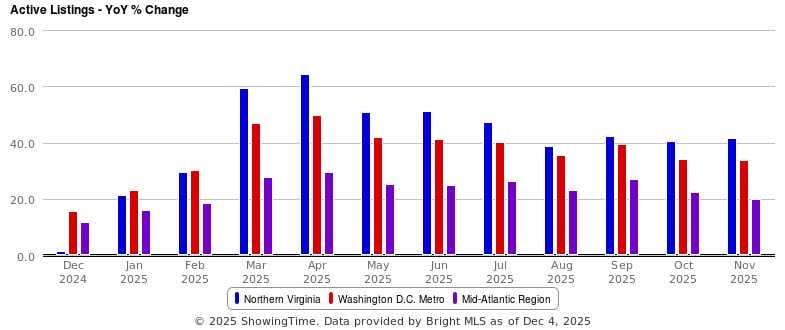
We still have many more homes for sale in Arlington (+38%) and Northern VA (+51%) compared to May 2024, but after five straight months of monthly increases to the year-over-year change in inventory levels, the trend reversed in May and I believe we’ll see another drop in the June data.

Sold Prices are Up Year-over-Year

The median price of sold homes in Northern VA are higher each month in 2025, despite lower demand and higher supply, hitting a 7% increase in March and most recently 4.6% in May, year-over-year.

But Unsold Home Prices are Down

Only tracking the price of sold homes doesn’t provide a full and transparent picture of actual market conditions because closed sales only account for the properties that buyers choose to purchase, not the properties that aren’t selling…and there are a lot more of those than usual. However, even the pricing on unsold inventory (active listings) isn’t terribly concerning, with the median price of active listings down just 1.1% in May, year-over-year.

If you’d like to discuss buying, selling, investing, or renting, don’t hesitate to reach out to me at [email protected].

Upcoming (pre-market) ERG Listings, Details and Additional Listings Available by Request

  • Reston – 4BR/3.5BA/3,000 sqft – End-unit townhouse (1993) – Hollow Timber Ct Reston VA 20194
  • Falls Church City – 4BR/4.5BA/3,000+ sqft – End-unit townhouse (1995) – Rees Pl Falls Church VA 22046
  • Rosslyn – 3BR/2.5A/2,400 sqft – Condo (2022) – 1781 N Pierce St Arlington VA 22209
  • Arlington Ridge/Aurora Hills – 3BR/2.5BA/2,450sqft – Detached Single Family (1961) – S Grove St Arlington VA 22202
  • Lorton – 3BR/1.5BA/1,120 sqft – Townhouse (1981) – Sheffield Village Ln Lorton VA 22079

This regularly scheduled sponsored column is written by Eli Tucker, Arlington-based Realtor and Arlington resident. If you would like to work with Eli and his team in Northern Virginia and the greater D.C. Metro area, you can reach him directly at Eli@EliResidential.com.

Eli and his team believe that your real estate needs should be managed by advisors, not salespeople. Their mission is to guide, educate, and advocate for their clients through real advice, hands-on support, and personalized service.

TL;DR Video Summary (5:18)

There is a fierce battle raging in the real estate industry over private/off-market listings, with two distinctly different opinions on consumer fairness.

Private/Off-Market Inventory is Back with Force

Between late 2019 and early 2020, MLS platforms (what is the MLS?) and the National Association of Realtors (NAR) introduced Clear Cooperation Policy (CCP) that required brokers to enter a property into the MLS within one business day of any public marketing (e.g. public-facing website, email blast, for sale sign, mailers, etc).

The idea behind CCP was to bring more fairness and strength to the market by eliminating numerous private and off-market channels so that buyers could rely on a single data source of homes for sale (from the MLS to consumer sites like Zillow and Homes.com) and sellers would receive top dollar by maximizing their exposure to buyers.

A by-product of last year’s class action settlements related to real estate commissions was the dismantling of CCP policy, leading to a rapid return to private/off-market inventory battles between agents, brokers, and online platforms. Buyers and agents can no longer get a full picture of the market by hoping on MLS, Zillow, Redfin, Homes.com, etc and must gather that information continuously from a more fragmented arrangement of public and private channels.

Consumer Fairness, For Sellers

CCP was eliminated from the weakening of “organized real estate” (rule creation and enforcement entities at the national and local level like NAR, local Associations, and MLSs) that resulted from recent class-action lawsuits and anti-trust pressure from the DOJ. In their eyes, CCP forced consumers and the brokers they hired through a single channel to sell a home and thus created an anti-competitive environment and anti-trust concerns.

Opponents of CCP (proponents of private marketplaces) believe that consumer fairness is about giving homeowners and the brokers they hire the freedom to market their homes in whatever way they believe will produce the best results. They argue that the best results are not always about price and sometimes about privacy, ease, and flexibility.

They also argue that private channels can produce better negotiation leverage and, sometimes, a better sale price than public markets, despite less exposure, because it creates demand through limited, VIP-like access and doesn’t burden sellers with days on market and price change tracking.

I have experienced first-hand, on multiple occasions, private/off-market listings create wins for sellers (and buyers) that were not possible through standard public MLS channels.

Consumer Fairness, For Buyers

CCP was established primarily as a standard of fairness for buyers. Home ownership plays such a critical role in the financial and emotional aspirations of Americans, one can reasonably argue that fair and organized access to for sale housing inventory is crucial to the American Dream.

Proponents of CCP (opponents of private marketplaces) believe that consumer fairness if about ensuring consumers can rely on a single source of data for all homes being offered for sale (MLSs are that source of record).

Proponents of CCP also argue that exposing listings to the full market via public channels will most often generate better results for homeowners and should not be diminished by infrequent use cases. They also argue that the aggregation of private listings is more beneficial to the broker/agent in the long-run than to the consumer and that private channels are too often recommended out of (brokerage) self-interest than consumer (seller) benefit.

The Fair Housing Component

There is an important conversation about fair housing (equal access to housing for those who meet equally applied financial requirements) in the CCP/private listing debate. When homes are listed on the MLS, everybody always has equal access to the listings, websites that receive MLS feeds are completely non-discriminatory.

When homes go through private channels, it is easy for those channels to be distributed to a homogenous group of people, even if the source (broker, agent, private platform) is not intentionally discriminating, it’s too easy for limited-access distribution channels to be unintentionally discriminatory which reduces equal access and brings about fair housing concerns.

Zillow Going to the Mat

The most significant escalation of this battle recently came from Zillow. Zillow has built a ~$17B business by publishing MLS listing feeds nationwide and repurposing them in a consumer-friendly, public format. A big part of Zillow’s success (it commands about half of real estate search traffic) is that buyers can trust they’re seeing close to 100% of the for sale market, but Zillow can’t capture private listing channels and the more those grow, the less buyers can rely on Zillow’s inventory, and the weaker its business gets.

The elimination of CCP and expansion of private listing channels presents a significant risk to Zillow’s business so they recently published their own standards for marketing homes for sale that are very similar to those of CCP – brokers must enter a listing into the MLS within one business day of public marketing. Zillow is threatening to ban a listing for the life of that listing if it determines pre-MLS marketing is in violation of these standards.

I have read/heard that Zillow has started issuing warnings and that they intend to enforce this new policy, setting of a potential knockdown battle between Zillow, anti-CCP brokers/agents, homeowners, and other industry players.

Is Consumer Fairness About Buyers or Sellers? My Opinion

When I think about issues like this, I try to look at them as an educated consumer, not as a self-interested Realtor. Like most issues, there are wide ranging trade-offs on this debate and there will always be strong arguments and use cases for both sides, but I prefer to form my positions based on which option produces the largest net benefit for everybody (most people will be buyers and sellers more than once in their lifetime).

While I feel strongly that sellers and their agent should have the flexibility to choose the marketing approach that works best for them, I think that the fragmentation of the for sale real estate market is a net negative for American consumers and the fundamental concept of CCP produces the highest net benefit. I think that the DOJ is anti-CCP for the right reasons (supports monopolistic brokerage and real estate industry structures), but the elimination of it produces the wrong results.

What do you think? Should consumer fairness in housing favor sellers or buyers? I’m not sure there’s a way to accomplish both.

If you’d like to discuss buying, selling, investing, or renting, don’t hesitate to reach out to me at [email protected].

Upcoming (pre-market) ERG Listings, Details and Additional Listings Available by Request

  • Reston – 4BR/3.5BA/3,000 sqft – End-unit townhouse (1993) – Hollow Timber Ct Reston VA 20194
  • Falls Church City – 4BR/4.5BA/3,000+ sqft – End-unit townhouse (1995) – Rees Pl Falls Church VA 22046
  • Rosslyn – 3BR/2.5A/2,400 sqft – Condo (2022) – 1781 N Pierce St Arlington VA 22209
  • Arlington Ridge/Aurora Hills – 3BR/2.5BA/2,450sqft – Detached Single Family (1961) – S Grove St Arlington VA 22202
  • Lorton – 3BR/1.5BA/1,120 sqft – Townhouse (1981) – Sheffield Village Ln Lorton VA 22079

This regularly scheduled sponsored column is written by Eli Tucker, Arlington-based Realtor and Arlington resident. If you would like to work with Eli and his team in Northern Virginia and the greater D.C. Metro area, you can reach him directly at [email protected].

Eli and his team believe that your real estate needs should be managed by advisors, not salespeople. Their mission is to guide, educate, and advocate for their clients through real advice, hands-on support, and personalized service.

Question: We would like to stay in our home for a few weeks after we settle, can you explain the rent-back concept?

Answer: A Seller’s Post-Settlement Occupancy, more commonly referred to as a rent-back, allows a homeowner to sell their home, collect the proceeds, and continue living in the home for a pre-determined period after closing.

Some common scenarios for a rent-back are:

  • You need the sale proceeds for the purchase of your next home
  • You want to ensure the sale closes before you move out
  • You want to wait-out the end of the school year or last day at a job

How Rent-Backs Are Structured

The Northern Virginia Association of Realtors contract (as well as other regional contracts) provides a standard form for a Seller’s Post-Settlement Occupancy Agreement so you don’t need to worry about hiring an attorney. It functions as a short-term lease including:

  • How much the seller will pay the buyer for the rent-back
  • How long the rent-back lasts
  • A security deposit
  • A penalty for staying past the rent-back period
  • Who is responsible for utilities and maintenance (sellers)
  • Who is responsible for major issues from flood, fire, acts of God (buyers)
  • Requirement for buyer and seller to maintain property insurance coverage

Pre-Settlement and Post-Occupancy Walk Throughs

Buyers will conduct a pre-closing walk-through before they purchase the home where they have all the rights provided to them in a normal sale. At the end of the rent-back, the new owners will conduct another walk-through once the previous owners move out, which is like that of a walk-through at the end of a normal rental period. If the previous owners cause damage during the move-out, leave junk behind, or fail other property delivery requirements, the new owners can make a claim against the security deposit, which is generally held by the Title Company who handled the sale.

Time Limitations

If the home is being purchased as a primary residence and the buyers are taking out a mortgage, most loans require that the buyer intend to move into the property within 60 days of the closing and thus any rent-back is limited to 60 days (I usually recommend 59, just to avoid an issue with underwriting).

If a home is being purchased with cash or as a secondary home/investment property with a loan, the 60-day limit doesn’t apply. However, the contract form you’ll use explicitly states that it’s meant to give the seller the temporary right to use the property after closing and not subject to the Virginia Residential Landlord Tenant Act, so avoid using this form in place of a legitimate lease if the Buyer/Seller intend on a long-term rent-back.

Not Without Risk

For the new owners, a rent-back carries with it some of the same risks as being a landlord. Disputes over security deposit, damage in excess of the security deposit, or trouble with the previous owners moving out on time are all realities that buyers need to consider.

As with many decisions in a real estate transaction, a buyer’s willingness to agree to a rent-back is a matter of risk and benefit. The risk of issues arising like those mentioned above versus the benefit of offering the seller a rent-back can be the difference between the seller accepting your offer or taking somebody else’s.

Free Rent-Backs?

In a normal market, the fee for a rent-back is usually calculated using the buyer’s carrying costs (mortgage + taxes + insurance), but in competitive markets, many buyers offer sellers a free rent-back to increase the competitiveness of their offer. A free rent-back isn’t worth much if the seller is asking for an extra week, but it adds up if the buyer has a mortgage and the seller is asking to stay for a few weeks or more past closing and can be a highly valued term in the offer.

If you’d like to discuss buying, selling, investing, or renting, don’t hesitate to reach out to me at [email protected].

Upcoming (pre-market) ERG Listings, Details and Additional Listings Available by Request

  • Reston – 4BR/3.5BA/3,000 sqft – End-unit townhouse (1993) – Hollow Timber Ct Reston VA 20194
  • Falls Church City – 4BR/4.5BA/3,000+ sqft – End-unit townhouse (1995) – Rees Pl Falls Church VA 22046
  • Rosslyn – 3BR/2.5A/2,400 sqft – Condo (2022) – 1781 N Pierce St Arlington VA 22209
  • Arlington Ridge/Aurora Hills – 3BR/2.5BA/2,450sqft – Detached Single Family (1961) – S Grove St Arlington VA 22202
  • Tara Leeway Heights – 7BR/7.2BA/8,000sqft/half acre/pool – Detached Single Family (2026) – 1500 N Harrison St Arlington VA 22205
  • Highland Park/Overlee Knolls – 6BR/5.5BA/5,000+ sqft – Detached Single Family (2025) – 22nd Rd N Arlington VA 22205

Question: Have you noticed more price reductions on homes than usual for this time of year?

Answer: Across the country, the number of homes with price reductions is on the rise. Zillow recently reported that nearly one in four homes listed on its website had a price cut in April. The markets seeing the highest rate of price cuts tend to be markets that saw the most significant appreciation during the COVID era housing boom like Phoenix, Tampa, Nashville, and Salt Lake City.

Price Cuts Increasing Across the DMV

The chart below shows the number of price cuts per month in the DC area. On one hand, it’s alarming to see the sharp increase in price cuts this year compared to previous years – it’s an accurate reflection of how the market has shifted this year. On the other hand, the first six months of the last three years (’22-’24) have been exceptionally strong markets that can make a normal market appear weak in comparison.

What Does the Summer Hold?

If you look at the pattern of price reductions through May compared to previous years and look at the seasonal pattern of higher rates of price reductions from June through October, one can easily forecast a significant rate of price reductions in the DMV on the horizon.

That may very well be our future, but it’s also possible that we’ve seen sellers in the DMV cutting prices faster than usual this year because of the onslaught of news about federal workforce and spending cuts. This could mean that spending cuts have been more front-loaded than usual, and the rate of price reductions may slow down (but will remain higher than previous years).

Will Seller Optimism Drop?

So far, sellers in Northern VA and the DC Metro have been optimistic going to market, with the average asking price of new listings up 1-4% year-over-year each of the last three months, per the chart below.


The chart below shows that some of those sellers have been rewarded for their optimism, with the average price of homes under contract with an asking price 1-5% more year-over-year (TBD what these properties actually sell for, but likely close to asking price).

On the flip side, the chart below shows us that many sellers are being punished for being overly optimistic, with the average list price of homes sitting on the market in April down 7% and 12% in the DC Metro and Northern VA, respectively.

If sellers become less optimistic and start going to market with lower asking prices, that may lead to fewer price reductions through the summer.

If you’d like to discuss buying, selling, investing, or renting, don’t hesitate to reach out to me at [email protected].

Upcoming (pre-market) ERG Listings, Details and Additional Listings Available by Request*

  • Reston – 4BR/3.5BA/3,000 sqft – End-unit townhouse (1993) – Hollow Timber Ct Reston VA 20194
  • Highland Park/Overlee Knolls – 6BR/5.5BA/5,000+ sqft – Detached Single Family (2025) – 22nd Rd N Arlington VA 22205
  • Rosslyn – 3BR/2.5A/2,400 sqft – Condo (2022) – 1781 N Pierce St Arlington VA 22209
  • Arlington Ridge/Aurora Hills – 3BR/2.5BA/2,450sqft – Detached Single Family (1961) – S Grove St Arlington VA 22202
  • Tara Leeway Heights – 7BR/7.2BA/8,000sqft/half acre/pool – Detached Single Family (2026) – 1500 N Harrison St Arlington VA 22205

View More Stories