Arlington’s title companies handle everything from title searches and insurance to settlement services, protecting your interests and guiding you through the closing process with professionalism.
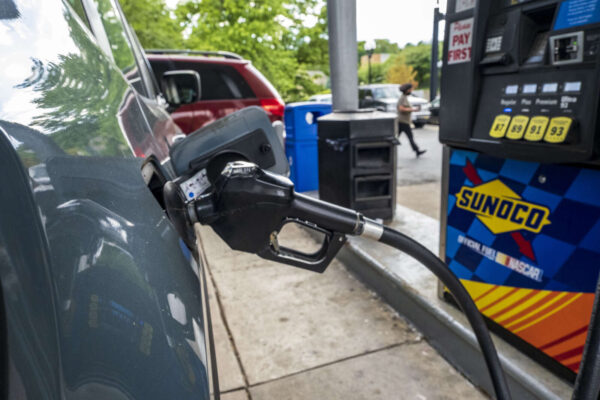
Pumping gas at a Sunoco on Columbia Pike (staff photo by Jay Westcott)
Gas prices in Virginia have crept past $4.30 a gallon on average, more than 40% higher than this time last year — and the squeeze at the pump shows no obvious sign of letting up.
AAA’s Virginia average for a gallon of regular sat at $4.322 on Monday, with the metro D.C. average just above $4.53. The national average has climbed roughly 25 cents in each of the last two weeks, according to WSLS, and the Virginia average is now about $1.31 above where it stood a year ago, Northern Virginia Magazine recently reported.
The cause isn’t a mystery.
Since the U.S. and Israel attacked Iran on Feb. 28 — drawing condemnation from Virginia’s Democratic congressional delegation — Iran has blocked access to the Strait of Hormuz, through which about a fifth of the world’s oil and liquefied natural gas typically passes. The Federal Reserve, which had been expected to cut interest rates this year, has turned cautious as it waits to see how long the conflict lasts.
The result has been the fastest run-up in consumer prices in three years. Federal data released last week showed inflation climbing 3.8% from April 2025 to April 2026, with gasoline prices up more than 28% year-over-year and real hourly wages falling for the first time in three years.
The economic ripples have already shown up in local coverage: the Iran conflict has complicated Arlington’s real estate market, cut flights out of Dulles, and prompted Northern Virginia housing markets to brace for a slower spring than expected.
How much pain is felt at the pump depends on how someone gets around. Arlington residents who commute by Metro, bike, e-bike, or electric vehicle, or who work from home, may barely notice the new price tag at the gas station. Others — those who drive daily for work, ferry kids to school and activities, or live in parts of the county less served by transit — are absorbing the increase fill-up by fill-up.
Earlier this spring, Virginia House Republicans proposed a 90-day suspension of the state’s gas tax, which would have shaved an estimated 30 cents per gallon off prices at a cost of roughly $125 million per month in lost transportation funding. Many Democrats opposed the idea on the grounds that it would shrink road and transit budgets. The proposal did not advance.
Last year, when DOGE-driven federal workforce cuts started to bite, 65% of poll respondents said they were “very worried” about the local economy. Two months later, most readers said they had already started pulling back on spending. With prices now rising faster than wages and gas leading the climb, we’re curious how directly all this is hitting home.
Arlington County government headquarters (file photo by Jay Westcott)
Last week, we asked ARLnow readers a straightforward question: if given a binary choice, would you rather see Arlington County raise taxes or cut services in next year’s budget?
Of the more than 1,200 votes counted as of this morning, about two-thirds favor cutting services, while the remaining third would rather see another tax hike.
The County Board, in the budget it adopted last month, went the other way and raised the property tax rate by two cents to preserve the Cherrydale library, the county’s competitive gymnastics program and the Barcroft Sports & Fitness Center, among other items in the budget.
Baked into that poll, however, was an assumption: that the primary levers available to the Board are tax rates and service levels.
There’s likely no easy, conventional way to squeeze much additional productivity out of the county government machinery — already relatively technology forward in its approach and having undergone years of trimming around the margins. But there’s at least one other possibility on the table: doing more with less by leaning on a technology that has been reshaping just about everything else.
Arlington County government has already started experimenting with artificial intelligence. Last summer, the county quietly rolled out AVA — the Arlington Virtual Assistant — a chatbot connected to the main county website plus specialized sites for the library system, elections and Arlington Transit. Residents can use it to ask questions about parking tickets, library card fees and the like. Before that, the county implemented AI-enabled routing of non-emergency calls.
That’s a modest start. The broader question is whether AI tools could eventually take on heavier lifts — automating permit reviews, responding to public records requests and other service queries, summarizing public comments, coding backend county systems, or handling other back-office work that today requires county staff.
All of that is possible with existing AI technology — and happening at business large and small — it’s just a matter of implementing it effectively and being willing to weather the inevitable blowback. At a time when there’s a lot of AI skepticism, even small-scale uses of the technology in a public setting — for instance, W-L’s plan to have AI read names at high school graduation — quickly become controversial.
The skeptics’ case ranges from doubts about AI’s actual capabilities to concerns about environmental and social impacts. AI systems can also be biased, can hallucinate confidently wrong answers and can carry significant privacy implications when fed government data. Replacing experienced civil servants with software risks degrading services in ways that aren’t obvious until something goes wrong.
Still, with another tough budget year on the horizon and personnel costs a major driver of county spending, it’s worth asking whether efficiency-via-AI is an option locals would theoretically support, if it meant being able to avoid service cuts and tax hikes.
Selling a home in Arlington means competing in one of the most active real estate markets in the country — and having the right agent can make the difference between a good outcome and a great one.
Here are the nominees for “Best Real Estate Agent for Sellers in Arlington” as part of our ARLnow Readers’ Choice awards.
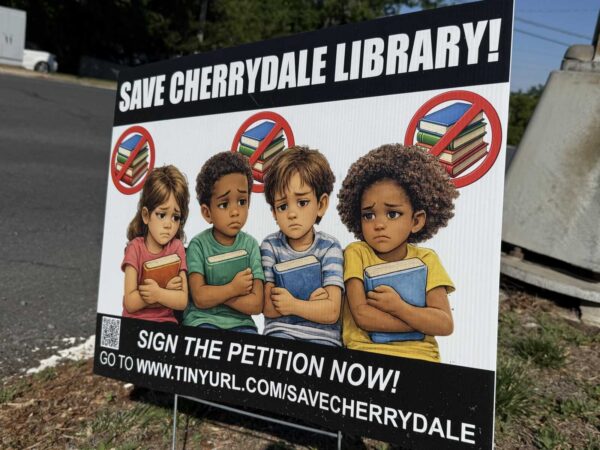
A "Save Cherrydale Library" sign at the intersection of N. Glebe Road and Old Dominion Drive (staff photo)
The response to the proposed closure of the Cherrydale library and the county’s competitive gymnastics program was swift and relentless.
Speakers lined up at County Board meetings, petitions were circulated, signs proliferated on local roadways, and local listservs and social networks lit up with calls to right what defenders saw as the injustice of cutting something beloved from the budget.
In the end, the County Board restored funding, keeping the Cherrydale library, the gymnastics program, and the Barcroft Sports & Fitness center, which was also on the chopping block. Instead, the Board balanced the budget by raising the property tax rate by two cents for commercial and residential properties in Arlington.
Neighboring Fairfax County, meanwhile, lowered the rate by $0.25 for every $100 in property value.
This is how many budget battles go in Arlington. Something people like is proposed for cuts, but then the Arlington Way kicks in, with lots of outcry about saving the thing that might be cut.
The last time Arlington‘s property tax rate was as high as it now will be — $1.053 per $100 assessed valuation — was 1980, when it was $1.12. It has fluctuated over the years since then, reaching a low of $0.765 per $100 in 1990 and 1991.
The process of cutting Arlington County‘s budget is not as easy as some might hope. You can perhaps trim administrative positions and contracts around the margins, but any low-hanging fruit was almost certainly pruned over the past few cycles, each their own “tough budget year.” (And making changes to county contracts with marginal fiscal benefits sometimes leads to undesired results.)
To really make a dent would take cutting something with a constituency, whether it’s a library, infrastructure improvements, affordable housing, nonprofit grants, and so on. And that’s not to mention core services like public safety, where costs have been increasing as recruitment challenges have led to increased pay, or Metro, investment in which continues to weigh heavily on local government budgets.
A budget is, in the end, a math equation. And if inflation continues rising above the annual increase in property values, that’s going to tend to push expenses higher than revenue. Already, county officials have been sounding warnings of another tough budget and additional tax hikes next year.
Meanwhile, the commercial property taxes on office buildings that used to prop up the county’s budget are down amid continued high office vacancy, so the burden for increased tax rates will fall on homeowners, whose property values have continued to rise, with no end in sight.
The need to make hard budgetary choices is nothing new. One of ARLnow’s early articles, from March 2010, noted the tension “between those who think taxes are high enough already and those who take an ‘increase my taxes, please’ approach.”
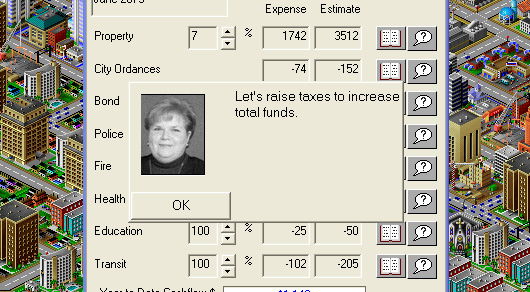
The article also included a faux graphic of former County Manager Barbara Donnellan in the classic municipal simulation game SimCity, where you often have to make unpopular decisions to balance your city’s budget — or risk disaster. You can underfund the fire department for awhile without public disapproval, but your city will eventually burn down.
SimCity photo illustration, featuring former County Manager Barbara Donnellan (by ARLnow)
Arlington County memorably took one of those budgetary shortcuts in the wake of the Great Recession. In 2009, just 25 lane miles of the county’s 974 miles of roadway were repaved. A few years and some hard winters later, county roads were littered with potholes and the public grumbling grew loud enough that the county bumped up the paving to 72 lane miles per year by 2014.
A return to crumbling streets seems unlikely, so next year’s budget will likely come down to the classic choice: you’ll have to increase taxes, cut services, or some middle-ground combination of the two.
Today we’re making it a binary choice, to see which ARLnow readers prefer. All things considered, and assuming that consequence-free cuts to administrative functions are not feasible, would you rather see the County Board cut services or raise taxes next year?
Whether you’re relocating across town or leaving Arlington for the first time, a reliable moving company can make all the difference—from the first call to the last box.
With flea and tick season approaching, Arlington is home to numerous veterinarians committed to keeping the community’s pets healthy and happy.
From longtime neighborhood clinics to certified hospitals, here are the nominees for “Best Veterinarian in Arlington” as part of our ARLnow Readers’ Choice awards.
Did we miss your favorite vet? Write it in!
Voting will close in two weeks.
Voting for Best Pediatrician Serving Arlington is still taking place. Be sure to cast your vote before voting closes next Friday at 8:30 a.m.
Arlington’s trusted pediatricians offer professional, compassionate care for children all the way from those first checkups on newborns to teenage sports physicals.
Whether you’re dealing with flickering lights, upgrading your electrical panel or installing new fixtures and outlets, there’s no substitute for a knowledgeable electrician.
Arlington Public Schools buses (staff photo by Jay Westcott)
The grumblings from Northern Virginia public school parents are getting louder.
Last week, the discontent broke out into the open, when 106.7 The Fan host Danny Rouhier went on a rant that ended up going viral on social media and prompting some news coverage. His message: kids are getting too many days off of school.
Danny is sick and tried of Fairfax County Schools consistenly having days off school. pic.twitter.com/pba4ZT1Zba
Arlington and Fairfax schools have added more student holidays in recent years.
Starting with the 2021-2022, Arlington Public Schools added several religious holidays to its calendar, including Rosh Hashanah, Yom Kippur, Diwali and Eid al-Fitr. This year Eid al-Adha was added, after a divided school board decided against a last-minute addition to the calendar last year.
Both Arlington and Fairfax, meanwhile, added next Tuesday — special election day for the state redistricting amendment — as an off day and APS is off today (Monday) for a grade prep day. (Over the past month, APS has been off March 13, 20, 30-31 and April 1-3, 10, and 13.)
FCPS has even more off days on its calendar than APS and the Fairfax school board has been considering removing some federal holidays next year to strike a better balance. From an April 8 FFXnow article:
As the current school year enters its final stretch, the Fairfax County School Board is considering tweaking the calendar for the next year in response to mounting complaints about disruptions to class schedules.
At the board’s meeting tomorrow (Thursday), members led by governance committee chair Melanie Meren will propose nixing Indigenous Peoples’ Day and Veterans Day as official student holidays and limiting the number of scheduled early release days to four per year.
“Partial school weeks function as an informal ‘childcare tax’ that falls hardest on our hourly-wage and most vulnerable households,” said Meren, whose committee has been discussing a new calendar policy. “My goal is to adjust the 2026-27 calendar to increase the number of five-day school weeks.”
If the motions are approved, Indigenous Peoples’ Day, which will fall on Oct. 12 this year, and Veterans Day — observed annually on Nov. 11 — would become standard instructional days for both students and staff going forward. Fairfax County Public Schools would implement a curriculum to teach students about the groups that the occasions are intended to recognize.
After an April 9 vote, only Veterans Day will be eliminated as a school holiday, FFXnow reported today.
While Arlington has fewer off days than FCPS, some parents are nonetheless feeling the burden of frequently having to find childcare for myriad off days and early release days.
Do you think APS should also consider removing some off days next year? Weigh in below.
Whether dealing with a dripping faucet or a full-blown pipe emergency, many homeowners eventually find themselves either leaning on a trusted plumber or wishing they had one.