

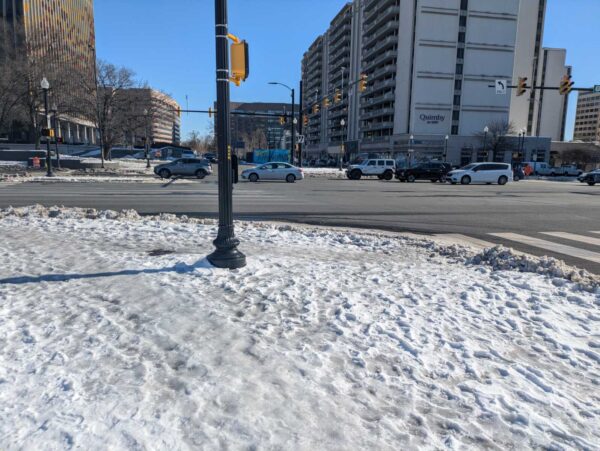
Members of a local advisory committee are looking for ways to make Arlington more walkable after snow falls.
In focus for the Pedestrian Advisory Committee this year are curb cuts leading from sidewalks into intersections, which often fill up with snow from plows and, at times, people shoveling sidewalks.
“These curb ramps are critical to transportation, but they sort of fall into no-man’s-land,” committee member John Armstrong said at the panel’s Dec. 10 meeting. “The plows come through and they inevitably block curb ramps.”
“It’s the same for overpasses over the highways,” added committee chair Eric Goodman.
Some of those overpasses are under the county government’s jurisdiction, while others are under the Virginia Department of Transportation or the federal government, making it difficult to determine who is in charge, Goodman said.
Issues related to snow pileups also occur around the county’s trails, he noted.
“In the process of clearing snow from the roads or some parts of the trails, they create barriers on the edge of the trails,” Goodman said. “So the trails themselves are OK, but getting on and off the trails is where there is a problem.”
When it comes to clearing sidewalks, the county’s snow-removal ordinance requires property owners to remove snow within 24 hours when accumulations are less than 6 inches and within 36 hours when higher than that.
There are some exceptions for homeowners physically incapable of removing snow from sidewalks adjacent to their property. Others face civil penalties of $50 to $100 for failure to abide by the rules, although the penalties are seldom enforced in Arlington.
Members of the Pedestrian Advisory Committee considered reaching out to civic associations in an effort to bring a spirit of camaraderie to snow removal from sidewalks and other areas pedestrians frequent.
“When you have neighborhoods that have a plan or some leadership in place … that works really, really well,” committee member David Earley said. “That grassroots approach is something worth encouraging.”
Committee member Ambar Pankaj detailed his experiences in the United Kingdom, where local governments would “put out boxes of salt and soot and sand where people could use it.”
One of the unique challenges for the D.C. area during the winter of 2024-25 was that a number of snow events were followed by deep freezes, causing the compacted snow to ice up.
“Last year was really challenging,” County Board Chair Takis Karantonis said at the Board’s Dec. 13 meeting. “We learned some lessons there.”
Committee members asked their chair to pen a letter to County Manager Mark Schwartz, outlining perceived problems and suggesting solutions to improve pedestrians’ experiences after snow falls. Contents of the draft letter will be considered at the committee’s January meeting.
