


Arlington’s summertime experiment using high tech to evaluate the state of sidewalks delivered mixed results.
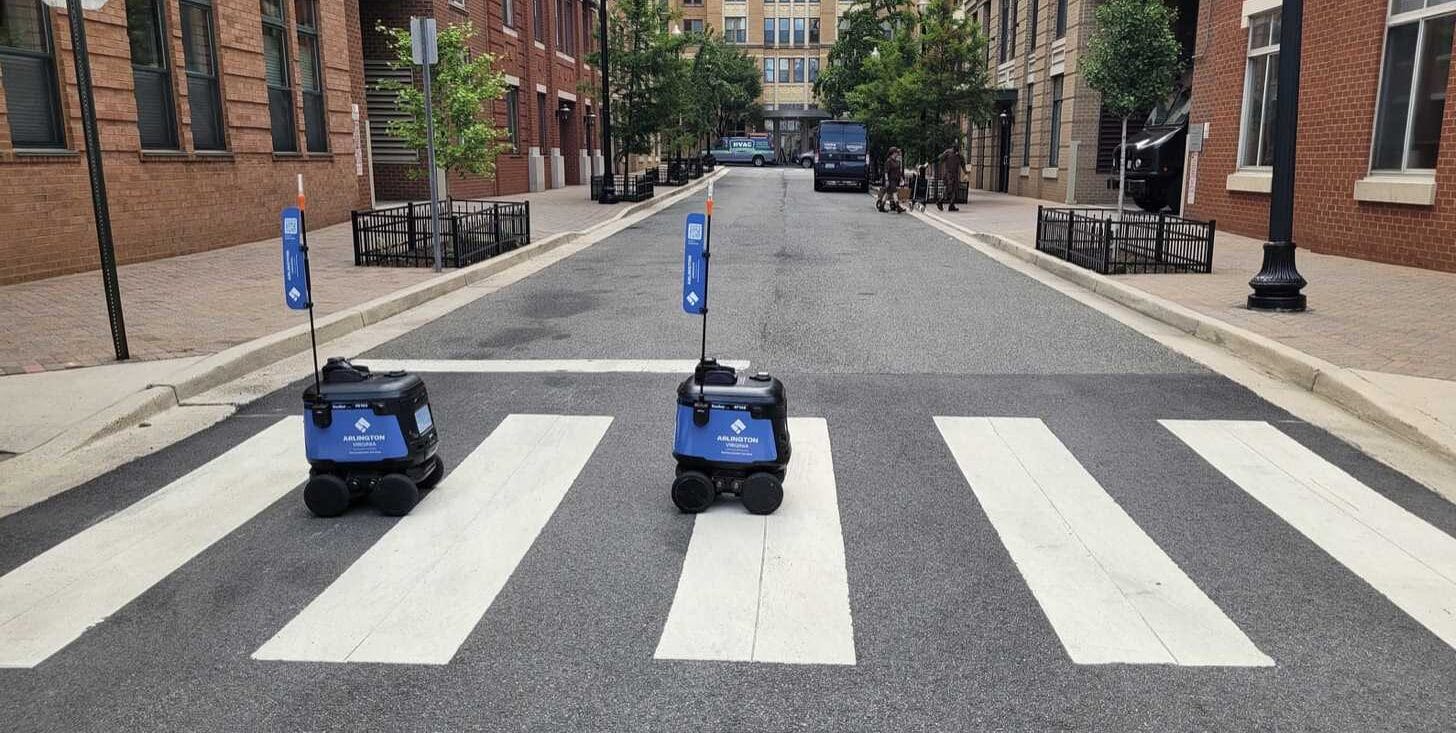
The county used Kiwibots — laser-equipped robots — to roll up and down the sidewalks of the Rosslyn-Ballston corridor for two weeks in July, assessing conditions.
There were positives and negatives coming out of the pilot program, said Jon Lawler, an engineer with the Department of Environmental Services who on Dec. 18 briefed the Information Technology Advisory Commission.
The good news included better resolution than had been achieved with other types of sidewalk-mapping efforts.
“It’s down so low, you can get really good imagery,” Lawler said of the robotic equipment.
And the robots didn’t get bossy as they made their way down sidewalks, he said.
“They were really good about navigating traffic [and] people,” Lawler told commission members. “They would stop and let kids pass, not to push people off the sidewalks.”
Among the challenges, the robots sometimes inadvertently wandered into building lobbies and parking garages, and their analysis of conditions was not always accurate when double-checked by humans.
“We found data-quality issues,” Lawler said, but on balance expressed the view that the $10,000 spent on the effort was worth it.
He added:
“This had never been done before in the country. Our goal is to see if this is a more cost-effective, accurate method [than previous efforts]. There’s still more work to be done. It can get a lot smarter — it just needs a lot more data points.”
In response, commission chair John Burke said perhaps the county, if it decides to use the equipment more frequently, could get a discount for passing along helpful feedback to the firm that designs the Kiwibots.
“We’re very supportive of pilots and driving technology forward,” he said. “But if we’re going to invest the time and energy, and our staff’s time and energy into doing that, we should be very clear-eyed about the value proposition.”
County staff turned to Kiwibot after a 2024 countywide sidewalk-inspection effort using a different contractor and human-driven mobile mapping was proven to be effective in many parts of the county, but not so strong its urban corridors.
In those urban areas, sidewalk-mapping efforts by a technology-laden truck that drove often were obscured by landscaping, trees, brick pavers, parked vehicles and outdoor seasons.
As a result, many sidewalks in the Rosslyn-Ballston corridor received condition assessments of “excellent” when a follow-up inspection by county staff revealed them to be in worse shape.
The drive-by method “wasn’t able to get that imagery good enough to analyze,” said Lawler, so the county turned to the Kiwibots.
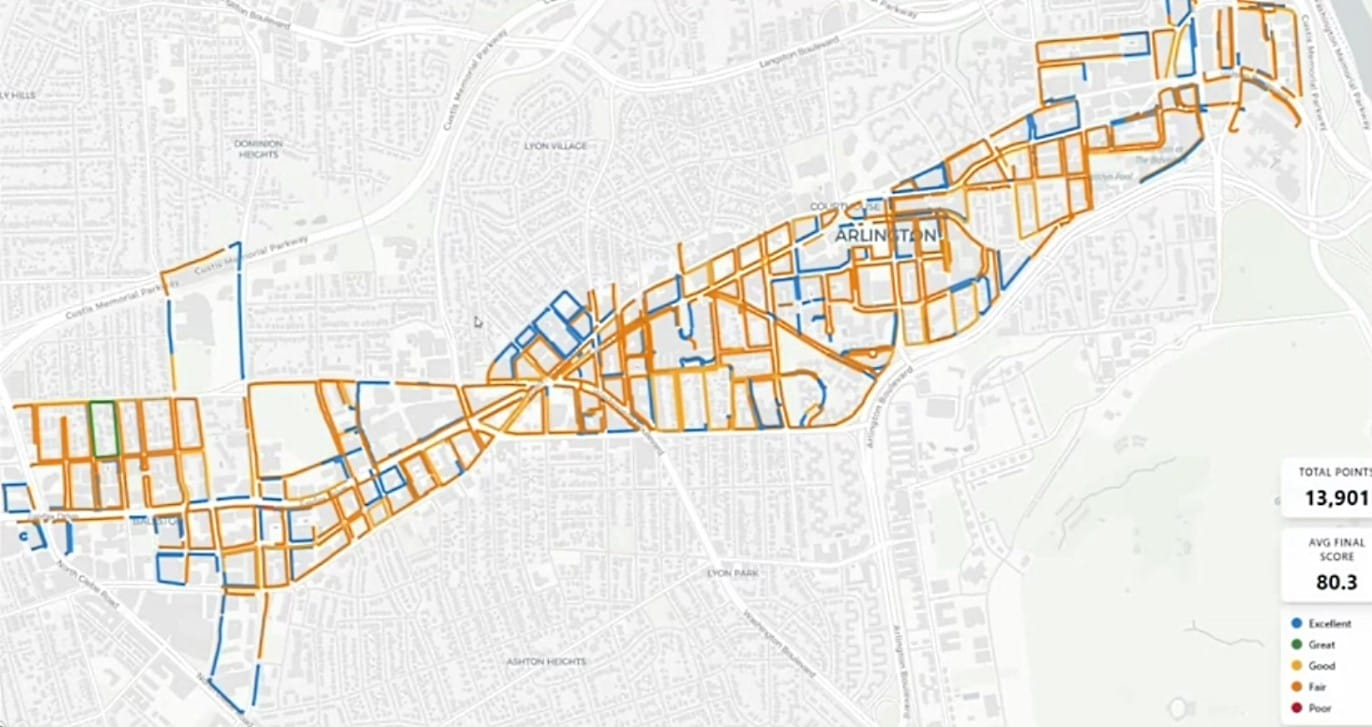
In the Kiwibot analysis, sidewalks in the Rosslyn-Ballston corridor averaged a rating of 80.3 on a 0-to-100 scale. Most streets in the corridor were rated “good” on a scale that included “excellent,” “great,” “good,” “fair” and “poor.”
While pleased with the creativity of staff in addressing the issue, commission member James Smith wanted to know how the different types of inspections trickled down to real-world applications.
“The ultimate question is: How is the data being used?” he asked. “How are the problems being seen being addressed?”
The county government divides sidewalk inspections and maintenance into 20 zones, with two addressed each year. A countywide sidewalk-condition assessment is conducted every five years, the most recent in 2024 and the next in 2029.
Data collected helps to determine where to dig more deeply and prioritize sidewalk reconstruction, Lawler said.
The 2024 countywide survey reported that 50% of Arlington’s sidewalk mileage was in excellent condition, 30% was reported as good, 16% as fair, 3% as poor and 1% as very poor.
