


Inconsistent policies on bus fares and enforcement are creating confusion among riders and challenges for transit in Northern Virginia, Metro’s top official says.
Washington Metropolitan Area Transit Authority CEO Randy Clarke critiqued the D.C. area’s patchwork of rules for where riders must pay to ride the bus, along with the limits placed on the Metro system’s ability to enforce its payment requirement.
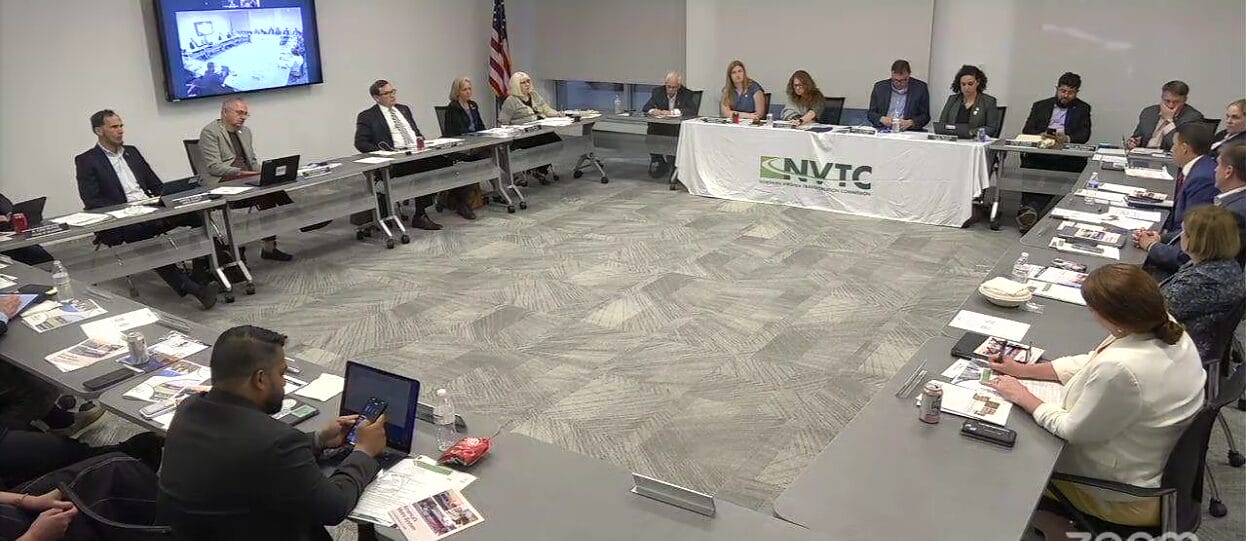
At the June 4 meeting of the Northern Virginia Transportation Commission (NVTC), Clarke suggested that riders aren’t entirely to blame for the region’s high rate of fare evasion — and that local leaders should do more to help.
“We’ve created a mess here, and we should figure out what we’re doing,” he said.
Clarke said many riders probably have little knowledge of which bus systems charge fares and which smaller bus networks run by localities have gone fare-free.
Over the past two years, a fare-evasion rate of 70% has been widely reported for Metrobus service. At the meeting, Clarke said that the figure includes some who may just be confused about whether to pay.
“Alexandria is free, Montgomery County went free, Prince George’s went free … Loudoun’s half-free, half-not,” Clarke told NVTC members.
Seniors in parts of Maryland and students in much of Virginia can ride Metrobus for free, but they are still required to tap their farecard upon boarding. If they don’t, Metro’s calculations consider them fare evaders.
The 70% figure also includes youth under 5, for whom payment is not required.
But that still leaves plenty of people who just don’t pay.
“I ride WMATA buses. I see people just going in — drivers can’t do anything about it,” said County Board member Takis Karantonis, one of Arlington’s representatives on the NVTC board.
Karantonis said it was important to determine who is refusing to pay.
“It matters to study the granularity, the demographics,” he said.
Clarke said WMATA has that information.
“We have very granular data. We know by route, generally geo-targeted. We are slowly but surely trying to break this down,” he said.
“We have the least amount of problems in Virginia,” Clarke said, while citing Rosslyn and Pentagon City as nonpayment hotspots. “Maryland is actually worse than D.C., and in D.C. it’s very much the further out we go, the more fare evasion.”
Clarke said he wasn’t criticizing leaders in jurisdictions who have made their local bus systems fare-free, but NVTC chair Sarah Bagley seemed to take it that way.
“The policy goal is to get as many people using transit as possible,” said Bagley, a member of the Alexandria City Council.
Alexandria’s local bus system — DASH — is fare-free, while Metrobuses, which often use the same stops, continue to charge fares.
Arlington Transit, better known as ART, charges fares, as does Fairfax Connector.
Clarke’s comments on a lack of coordination didn’t stop at fares. He said there is insufficient local buy-in on a regional response to fare evasion.
WMATA currently is prohibited from giving its civilian employees or contractors the power to issue citations.
“Right now, my only option is a sledgehammer — police,” he said. “We’re operating with one or two arms behind our back.”
Enforcement efforts on local bus systems appear haphazard, Clarke said.
“You have no idea what your fare-evasion rate is, and there’s no one doing fare enforcement [on ART buses],” he told Karantonis. “In Fairfax, it’s the same way. The Fairfax PD is not going out and doing fare enforcement like we are.”
The Metro CEO said he was willing to listen to ideas to improve the situation. “We will work with anybody,” he said.
There was no specific discussion at the NVTC meeting on how to move forward on addressing the concerns raised. However, Clarke seemed to have made his point.
“We will find a way,” said Fairfax County Supervisor Dan Storck (D-Mount Vernon).
