

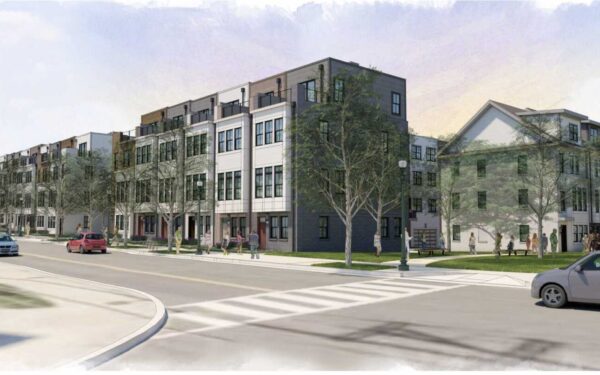
A controversial proposal to build 47 townhouses in the Waverly Hills neighborhood is returning for discussion at an upcoming County Board meeting.
Last month, Board members deferred a vote on the project, which staff opposes but neighborhood organizations and county advisory commissions largely support. It’s one of several items up for consideration at the Board meeting on Saturday.
Other planned discussion topics include a proposal to purchase a home to assist with stormwater management, new rules for electric vehicles’ parking spaces, potentially moving the police auditor to County Board control and more.
The townhouse project: Cherry Hill Ridge Investment LLC (a subsidiary of BCN Homes) is seeking to redevelop a parcel at 2134 N. Taylor Street, which has stood vacant for years except for several unoccupied homes.
The site, about two blocks south of Langston Blvd, is bounded by the Horizons Apartments to the north, Cherry Hill Road to the south, N. Taylor Street to the east and the Yorktown Condominiums to the west. Plans for the 2.8-acre site earlier called for constructing a senior-living facility, but that proposal fell through.
County staff opposes the redevelopment request, contending it falls well short of the goals of the Langston Boulevard Area Plan (LBAP).
“The proposal substantially deviates from LBAP guidance on land use, housing, public space and tree canopy,” staff said in a memo to Board members.
But the staff opposition is an outlier:
- The Planning Commission supported the project on a 5-2 vote
- The Transportation Commission backs the proposal
- The Langston Boulevard Alliance, an advocacy group, supports the project, as do the Waverly Hills Civic Association and Cherrydale Civic Association
The nearby Stoneridge Knolls Condominiums and Tazewell Place Homeowners Association have raised no overall objections to the redevelopment, but like some advisory commissions, they did have specific concerns about portions of the proposal.
Consideration of the rezoning plan is Item #34 on the Board’s May 16 meeting, with the first 32 items being part of the Board’s consent agenda. A public hearing will precede Board discussion and a potential vote.
Also at the May 16 meeting Board members are asked to support JBG Smith’s proposal to convert the office buildings at 1800 and 1901 S. Bell Street in Crystal City to residential use with a limited retail component.
Both buildings were constructed in the late 1960s and are part of the Crystal Mall development.
If approved, these will become the latest Arlington office buildings to transition to either apartment, condominium or hotel use, as property owners deal with ongoing challenges in commercial leasing.
“The proposed conversion of both office buildings would remove 489,708 square feet of vacant office space from the market and convert it to 315 residential units, reducing the Crystal City office-vacancy rate by 3.5 percentage points,” staff said in a memo to Board members.
The proposal has the support of county staff, the Planning Commission and the National Landing Business Improvement District. Both the Crystal City Civic Association and Aurora Highlands Civic Association have raised concerns about the adaptive-reuse concept in general and its specific implications in this case.
The item is Item #33 on the Board’s agenda, coming after a grouping of the first 32 items that are on its consent agenda. A public hearing will precede a final vote.
Other items of interest on the May 16 agenda include the following. These items all are on the Board’s consent agenda, meaning there will be no discussion or public testimony unless pulled off for discussion at the Board’s May 19 meeting.
House purchase to aid stormwater management: Board members are expected to ratify the purchase of a home at 5856 14th Street N. as part of ongoing stormwater-mitigation efforts.
The 1930s-era home, located on a 9,357-square-foot lot, backs to I-66 and is within the Torreyson Run watershed.
County staff said the property sustained significant flood damage in 2019. The purchase price is in line with an appraisal conducted for the county last month.
Staff said efforts are underway to potentially purchase adjacent properties:
“The property is directly in the overland relief flow path and will facilitate upgrades to the storm sewers that are located within the flow path. If the county is able to acquire the remaining identified properties and some additional easements, then the county would construct a more extensive project to mitigate flooding in the neighborhood.”
In addition to purchase costs for the 14th Street home, the county government expects to spend about $400,000 to remove the home and make landscaping improvements for stormwater-runoff mitigation. [Item #25]
New rules for EV-charging parking spaces: Board members are expected to advertise a public hearing for June 13 to consider new rules for parking in spaces designated for the charging of electric vehicles.
If enacted, code changes would make it a civil penalty to park in spaces designated for EV-charging on public property while not charging vehicles.
Violators would be subject to a $25 fine.
The proposal is in response to the use of EV-charging spaces for other purposes in places like Central Library and other county facilities. [Item #28]
Moving police auditor to County Board control: Board members are expected to set a public hearing for June 13 on a proposal to move the county’s independent policing auditor under its control.
Currently, the position reports to County Manager Mark Schwartz, but a recent change in state law allows the County Board to have direct oversight, as it has with county manager, county attorney, clerk to the board and the county’s independent auditor.
The June public hearing also will consider giving the Community Oversight Board access to additional police records. [Item #30]
Temporary changes to voting precincts: Board members are expected to ratify changes to both the polling place and satellite-voting office that will be out of commission during upcoming renovation of Madison Community Center.
The community center will close this summer for approximately a year. As a result, the county’s elections office has proposed relocating Precinct 135 to St. Peter’s Episcopal Church, about half a mile away, for the duration of construction work.
In addition, the elections office has proposed moving the early-voting site typically located at Madison Community Center to Langston-Brown Community Center, about three miles away.
The first election to be impacted by the change will be the Aug. 4 state primary. [Item #10]
Historic designation of Nelly Custis School: Board members are expected to set a public hearing for June on the request by the Historical Affairs and Landmark Review Board (HALRB) to designate a portion of the former Nelly Custis Elementary School as a local historic district.
Saturday’s vote is merely procedural in nature. Full consideration of the proposal, and a public hearing, will take place in June.
The split HALRB vote to support historic status for the oldest part of the building at 750 23rd Street S. came despite opposition from Melwood and Wesley Housing, which have won County Board approval to raze the proposal and construct affordable housing on the site. [Item #26]
Temporary conversion of apartments to hotel rooms: Board members are expected to modify a developer’s proposal to temporarily use future apartments at a new development in Rosslyn for hotel use.
The consortium redeveloping the former RCA office building site at 1901 N. Moore Street for use as a 27-story, 425-unit mixed-use project initially requested hotel use for up to 125 units for five years.
After concerns were raised by those living in the area, the developer proposed cutting that term to two years, terminating on May 31, 2028.
According to county staff, which supports the request, the 125 temporary hotel units would comprise the majority of the fifth, eighth and 12th floors of the building’s southern tower, “with the number of converted units for the temporary hotel use varying between each floor and will contain a mix of unit types.”
Temporarily using future apartment units for hotel stays has become increasingly common across the county in recent years. It provides developers cash flow as they undertake the leasing up the units. [Item #1]
