

Superintendent Francisco Durán has laid out a quarter-billion-dollar plan to renovate and expand two middle schools.
Downplaying concerns that the projects could crowd out needed improvements at other buildings, Durán on Thursday night described plans for Thomas Jefferson Middle School and Swanson Middle School. They include the following.
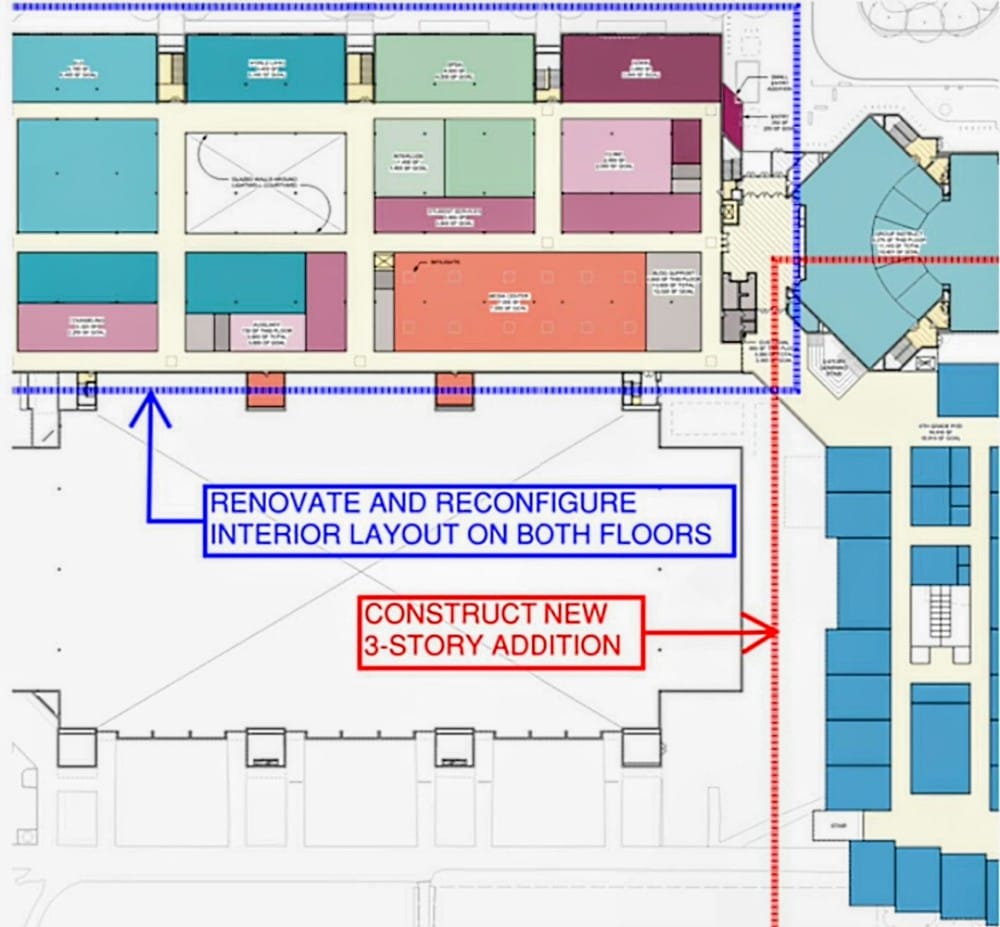
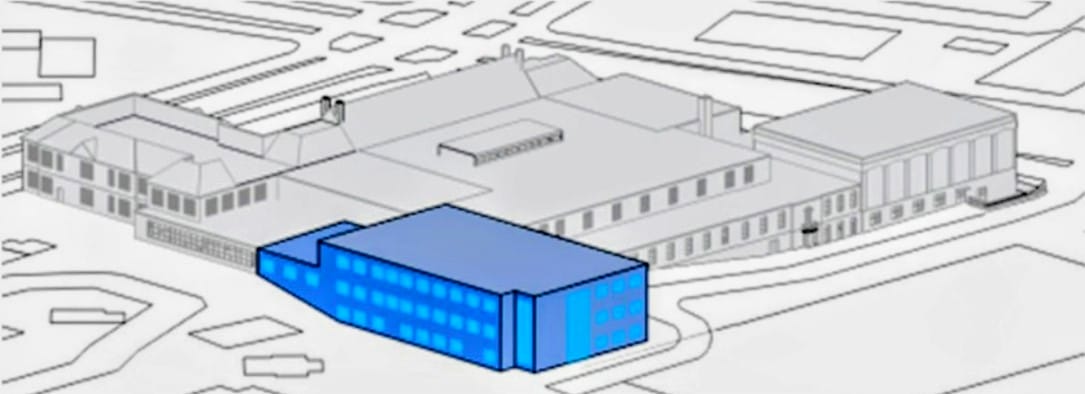
- A three-story, 87,750-square-foot addition to Thomas Jefferson Middle, plus major renovations to existing facilities: estimated to cost $167.5 million to $184.9 million
- A three-story, 25,485-square-foot addition to Swanson Middle School coupled with realignment of interior spaces: estimated to cost $87.7 million to $93.7 million
Durán’s plan also calls for moving Montessori Public School of Arlington students into the nearby Arlington Career Center building now that it is being vacated, then razing the existing Montessori school and using the site as open space.
The proposals, and others contained in the superintendent’s fiscal 2027-36 Capital Improvement Plan, rely in large part on nearly $500 million in bonds being approved by voters in five referendums to be held between this November and 2034.
Under the proposed timeline, the Thomas Jefferson project would be completed first, by 2031, with the Swanson rehabilitation to follow. But many details remain to be fleshed out.
Constructed in the 1970s, Thomas Jefferson requires “a much-needed and transformational modernization,” Durán told School Board members.
“This project is not about increasing capacity” but is “focused on improving the quality, the functionality and the long-term sustainability for the educational spaces,” he said.
“It is focused, really, on aging infrastructure,” Durán said.
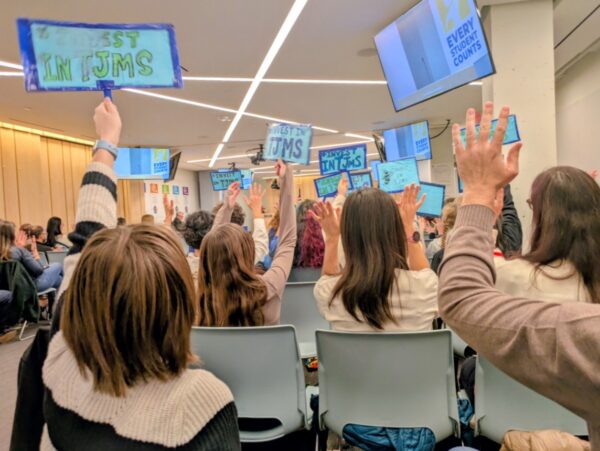
One Thomas Jefferson faculty member who spoke to the School Board on May 14 said the proposal was welcomed but not fully fleshed out.
“We have a lot of questions,” Catrina Tangchittsumran-Stumpf, the school’s band director, told School Board members. “We are eager to learn more and provide input.”
The three-story Thomas Jefferson addition would be located on open space near Thomas Jefferson Community Center. Based on schematic drawings, it would be connected to the main school building by interior corridors through Thomas Jefferson Community Theatre.
The cost to renovate the Arlington Career Center building for use as a Montessori facility is estimated at $40.5 million. The Career Center is being vacated this summer as students move next door to the new Grace Hopper Center.
The Career Center, Grace Hopper Center and Montessori buildings share space with the Columbia Pike Library on a single large parcel adjacent to S. Walter Reed Drive. Durán said his plan would “support the overall campus vision as well as broader sustainability goals.”
The proposal now goes through a month of review by School Board members, with approval of a final package slated for June 18.
In December, School Board members directed Durán to come back with renovation plans for the two middle schools that would not exceed a combined $150 million, although that guidance did give him leeway to consider other options.
At the May 14 meeting, School Board members reacted with a degree of caution to the proposals before them:
- Miranda Turner acknowledged that “the need is real” for upgrades, but she was concerned about the scope of the two middle-school projects and wanted to see further options in line with guidance the School Board had given staff last fall
- Zuraya Tapia-Hadley said School Board members would need to juggle tradeoffs. “There are going to be pros and cons to all options,” she said
- Kathleen Clark acknowledged “friction points” when it comes to determining which projects get approved and where they are placed on the timeline. “There is literally no way that we are going to make every community member happy,” she said
- Monique “Moe” Bryant said school leaders needed to “be honest about the fiscal realities” the community is facing while making “thoughtful, sustainable decisions”
- School Board Chair Bethany Zecher Sutton pressed for a sense of shared purpose over the next month. “We — both the Board and the staff — need to be vigilant about doing our work diligently, collaboratively, respectfully and transparently,” she said
As for the question of the proposal being too expensive, Zecher Sutton said the superintendent’s plan maintained school-system debt costs under 10% of the total annual budget, as required by the county government.
The draft capital plan as unveiled May 14 drew criticism from Michael Beer, a veteran community activist on education issues. He complained that the school system, facing flat enrollment, shouldn’t be prioritizing new construction over maintenance of existing facilities.
“Financial restraints are becoming more severe,” Beer told School Board members. “APS must swiftly move to halt the building of new seats and now consolidate and renovate many failing buildings.”
He said the Career Center building represents “an obvious swing space” to handle middle-school students, while “Montessori classes can be moved to various under-used schools.”
Jean Henceroth, vice president of the Arlington County Civic Federation, brought School Board members a resolution that federation delegates passed on May 12, citing the need to provide maintenance on existing facilities.
Durán’s plan “doesn’t appear fully funded” and seems not to reflect existing realities, Henceroth said.
“Enrollment, cost and funding have changed greatly since the current plans were written,” she told School Board members.
Henceroth said Civic Federation support for future bond referendums would be contingent on School Board members clearly detailing why projects to be funded are the most important to county students.
“The community deserves to understand your tradeoffs and priorities,” she said.
Durán said his proposal was just one part of a package that will see other school-facility needs addressed.
“We’re not forgetting about them,” he said. “We’re having to think about how we prioritize all of them.”
Also responding to Civic Federation concerns, Zecher Sutton said there were ways to improve transparency and collaboration with the organization and its member groups.
“We appreciate the opportunity for engagement,” she said. “They are critical partners.”
Durán’s proposal would require an ongoing series of bond referendums placed before voters: $60 million this year, $163 million in 2028, $80 million in 2030, $122 million in 2032 and $50 million in 2034.
It also seeks General Assembly authority for localities to increase the local sales tax 1% to pay for school construction, which would provide Arlington Public Schools with approximately $50 million per year.
And it calls for consideration of public-private partnerships to support some of the projects, but it is light on specifics. Tapia-Hadley in particular said she wanted to see more specifics on that topic before being willing to consider it.
Also part of the superintendent’s plans are a number of upgrades to security features at multiple schools, as well as several elementary-school kitchen upgrades.
A variety of roof-replacement and HVAC projects are sought as part of the package.
Durán also proposes four synthetic-turf replacements — at Gunston (2028), Wakefield (2031), Washington-Liberty (2032) and Williamsburg/Gunston (also 2032).
The cost of field replacements are split with the county government. APS’s estimated cost for the four is $4.6 million.
