

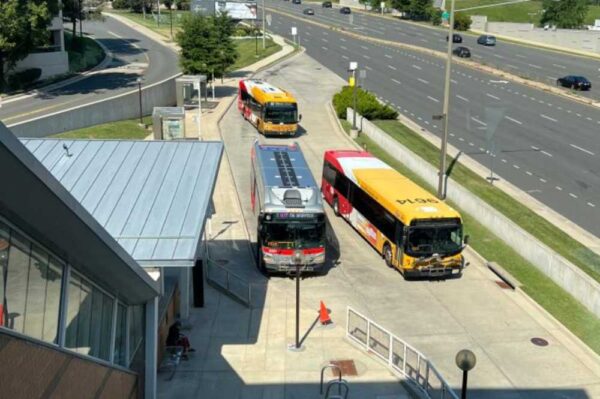
Falls Church officials are pressing for a fast-tracked effort to create a bus rapid transit (BRT) route running through the city’s core.
At the same time, City Council members Justine Underhill and David Snyder are seeking attention to detail and careful branding for the BRT line planned to run down Route 7 from Tysons to Alexandria.
“I’m very anxious to have this move into the finance stage,” Snyder said at the Oct. 1 meeting of the Northern Virginia Transportation Commission (NVTC) board of directors.
Underhill, who, like Snyder, represents the city on the panel, concurred.
“I completely agree with doing this quickly … [to] build something that’s usable and good and fast for people,” she said.
At the same time, regional leaders need to be “making sure we are keeping high goals for ourselves, as we did when we were putting in Metro,” Underhill said.
To do so, regional leaders will need to hold “these really difficult conversations and push ourselves to do as much as possible while still trying to do it quickly,” she said.
Falls Church officials were not the only regional leaders champing at the bit to move the Envision Route 7 initiative from the planning phase into construction.
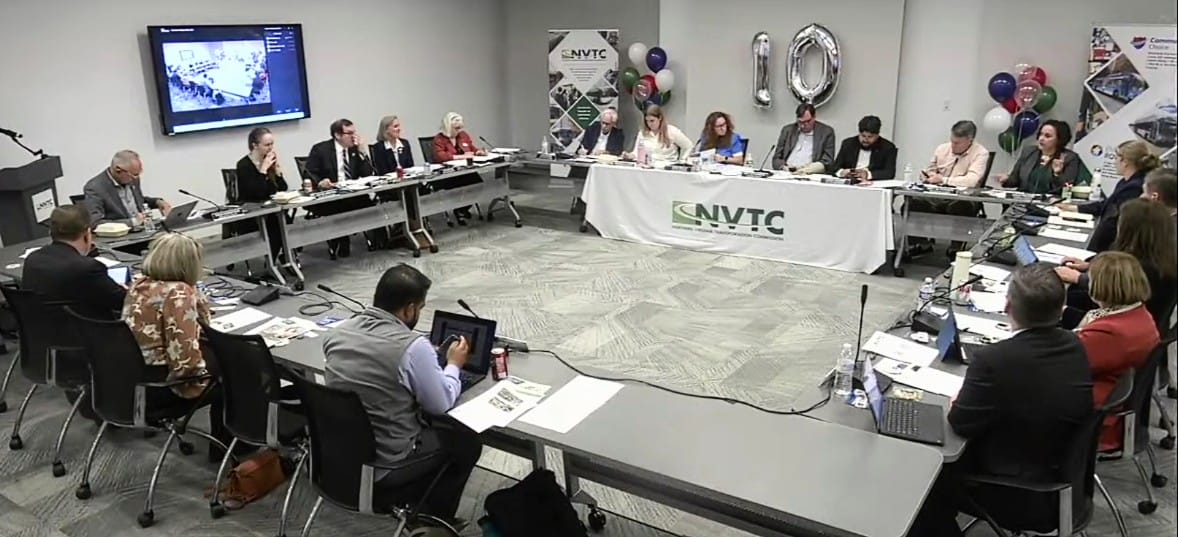
“If there’s only one thing I hope to see in my lifetime, it’s this project,” said a half-joking Fairfax County Supervisor Dalia Palchik (D-Providence) at the NVTC board meeting.
The meeting included another update on the Envision Route 7 effort, which aims to connect Tysons to Alexandria via a modern bus network, with as much of it as possible running on dedicated lanes down Leesburg Pike (Route 7).
“This is a big deal,” said Fairfax County Supervisor Walter Alcorn (D-Hunter Mill), who is an NVTC board member along with Palchik.
The planned route of the upgraded corridor is home to nearly 60,000 residents and is served by more than 40 bus lines spread across Metrobus and local systems.
NVTC staff have spent years evaluating possibilities in the corridor, a process that is nearly complete.
“The efficiency of the roadway is a key way to help traffic move more efficiently through the region,” said Vikram Sinha, an NVTC project manager and top staff member on the initiative.
With studies mostly complete, attention will soon turn to coordinating development of the BRT line — and how to pay for it.
Those could be complicated discussions, Sinha acknowledged.
“What works in Falls Church may not work in Fairfax County or in Arlington County or in the city of Alexandria, and vice versa,” he said. “We want to work with all the jurisdictions and all the bus operators on realizing these improvements.”
One way to help fund the project would be for the state government to get further involved.
Perhaps to entice state leaders, NVTC Chair Sarah Bagley is promoting the Route 7 effort as a “landmark project” that others will be able to learn from.
“It can be replicated in Hampton Roads, in Richmond, in the western portion of the state — we all have bus service,” said Bagley, who serves as vice chair of the Alexandria City Council.
To gin up enthusiasm, the transit line needs a snazzy name, Snyder said.
“There ought to be an identity here,” Snyder said.
His Falls Church colleague Underhill agreed. “‘Bus priority’ seems a little bit weak” for descriptive purposes, she said.
There are local precedents for creating a creative persona for transit service, with Fairfax officials branding the planned billion-dollar Richmond Highway BRT project as “The One.” Arlington and Alexandria officials call their Crystal City BRT line “Metroway.”
Fairfax Supervisor Jimmy Bierman (D-Dranesville) said branding was important but not the top concern at the moment.
“I don’t care what you call it or how you sell it — the priority should be getting it done sooner rather than later,” he said.
Making incremental progress on improving transit service in the corridor would begin to entice more riders, Bierman suggested. Efforts could then build, but “you’ve got to get them on the bus first,” he said.
Arlington County Board member Takis Karantonis agreed, calling reliable frequency a “gateway drug” that will get riders hooked on bus service.
“If I see my bus coming again and again and again, I will ride the bus more often,” he said.
Elected leaders from across the region have been invited to take part in a bus tour of the eastern half of the BRT project corridor, running from Seven Corners to Alexandria.
Set for later this month, the tour will give those leaders the opportunity to see both the opportunities and challenges that currently exist, Sinha said.
In December, the NVTC board will be asked to accept the staff report related to the project, another procedural hurdle on the way to eventual construction.
The Route 7 BRT project is one of dozens expected to criss-cross Northern Virginia in the coming decades. Three of those proposed lines would run through Falls Church.
