Rosslyn skyline, with Tysons in the background (Flickr pool photo by Kevin Wolf)
Arlington is a county, not a city — a technicality that surprises plenty of newcomers who assume a place this dense and urban must be one.
Whether it should stay that way is now an open question. As part of a broader review of its form of government, some advocates have floated dropping the county label and becoming Virginia’s newest independent city.
In Virginia, independent cities aren’t part of any county — they run their own courts, schools, roads and tax collection. Arlington already does nearly all of that. It maintains its own streets (one of the few Virginia counties that does), runs its own buses and provides a full slate of urban services, so the practical differences may be smaller than the label suggests.
There are catches. County Attorney Ryan Samuel cautioned the County Board that Arlington’s county manager plan — a form of government unique to Arlington, in place since 1932 — grants it powers other localities don’t have, and that some could be lost in a switch to a city or another structure. His 33-page report flagged both seen and hidden risks in making the leap.
There’s also a timing problem: a longstanding state moratorium on creating new Virginia cities runs through at least 2032, so the switch couldn’t happen before then even if Arlington wanted it.
Cityhood is only one option on the table. The governance review is also weighing changes like expanding the five-member County Board, electing its chair separately, adding district-based seats and ending Arlington’s practice of electing a board member every year. A preliminary report is due by the end of October — and the debate has surfaced before, including a near-overhaul back in 1970.
Despite the moratorium — and with any real change years off regardless — it’s a question that seems to resonate with locals, as one of last week’s most-read stories. So today we’re asking: should Arlington become a city?
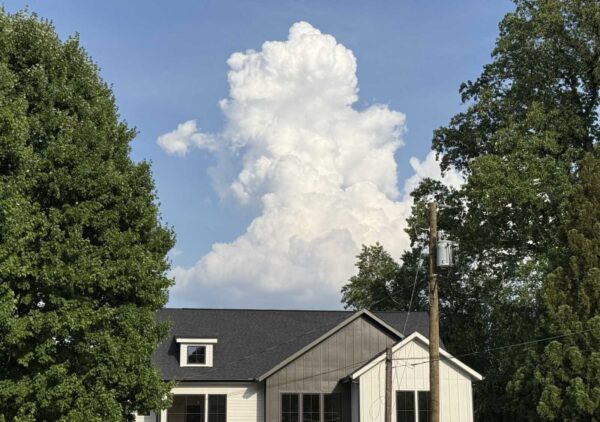
A towering cloud behind a North Arlington home, as storms build to the west (staff photo)
If it feels like the weather forecast has been letting you down lately, a growing number of meteorologists say you may not be imagining it.
They point to a quieter problem playing out well above our heads: the National Weather Service has been launching fewer weather balloons, and the resulting gaps in data may be making forecasts less reliable — especially for severe weather.
Weather balloons carry instruments called radiosondes that measure temperature, humidity, pressure and wind as they rise through the atmosphere. That information is among the most valuable data forecasters have. A recent NASA analysis found balloon readings did more to reduce errors in 24-hour forecasts than any single satellite instrument or aircraft data across the Northern Hemisphere.
The Weather Service began scaling back launches in March 2025, citing staffing shortages, and more than 25 sites are now routinely pushing their morning launches to midday, according to Capital Weather. The agency has lost roughly 600 employees to layoffs and buyouts over the past year, CBS News reported.
Forecasters say the missing morning data is most worrisome on days when severe storms are possible.
Meteorologists and an emergency manager told Politico that absent balloon data likely contributed to a poorly predicted tornado outbreak near Kansas City in April. Many Great Plains offices delayed morning launches to noon that day, NBC News reported, too late for the models that run shortly after 7 a.m. — and a tornado watch went up only about 30 minutes before the first twister.
Arlington-based meteorologist Matthew Cappucci, who recently broke down the issue on Fox 5, didn’t mince words on X:
Have weather forecasts seemed less accurate lately? There's a major contributing factor: nearly half the morning weather balloons in the Lower 48 are "missing."
This is an ongoing crisis that is degrading critical severe weather forecasts that we all rely on. It's having real,… pic.twitter.com/xMajo4MzUs
How much any of this affects forecasts here is up for debate. Because weather generally moves west to east, some meteorologists argue a missed launch out West can ripple downstream and dent forecasts on the East Coast. Others counter that balloons are a small slice of the data feeding modern models, and that the biggest effects are likely felt closer to the Plains.
The Weather Service, for its part, disputes that forecasts have suffered. A spokesperson told Capital Weather the agency has seen “no evidence of degradation” in its models, pointing to satellites, aircraft and other sensors that help fill the gaps.
Arlington readers have had reason to keep an eye on the forecast lately, from a snowy winter to tornado watches this spring and the threat of severe storms earlier this week. Whether local forecasts have actually slipped is hard to prove — but some seem to have a gut feeling one way or the other.
So today we’re asking: have you noticed weather forecasts getting less accurate recently?
One of them will be for the 2028 presidential race. Although party chair Paul Ruiz acknowledged it was “way too early” to be focusing that, he said adding the straw poll will be a worthwhile addition to the summer gathering.
Rendering of proposed arch near Memorial Bridge (via Commission of Fine Arts)
The Trump administration’s plan for a 250-foot “triumphal arch” near Memorial Bridge keeps advancing — even as opposition across Northern Virginia keeps growing.
Pitched as a monument to the nation’s 250th anniversary, the arch would rise more than two and a half times the height of the Lincoln Memorial at the western end of Arlington Memorial Bridge. Critics have questioned both its historical basis and its place in the protected vista between the Lincoln Memorial and Arlington National Cemetery.
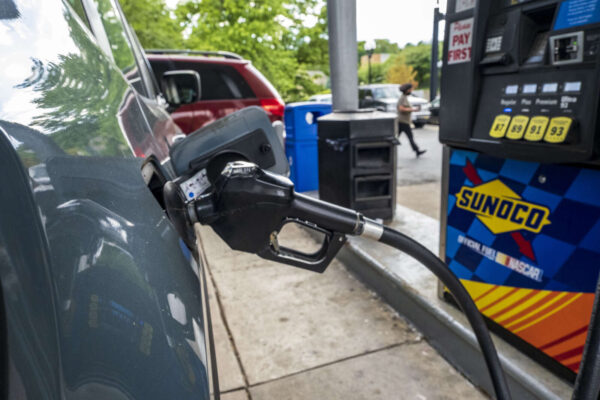
Pumping gas at a Sunoco on Columbia Pike (staff photo by Jay Westcott)
Gas prices in Virginia have crept past $4.30 a gallon on average, more than 40% higher than this time last year — and the squeeze at the pump shows no obvious sign of letting up.
AAA’s Virginia average for a gallon of regular sat at $4.322 on Monday, with the metro D.C. average just above $4.53. The national average has climbed roughly 25 cents in each of the last two weeks, according to WSLS, and the Virginia average is now about $1.31 above where it stood a year ago, Northern Virginia Magazine recently reported.
The cause isn’t a mystery.
Since the U.S. and Israel attacked Iran on Feb. 28 — drawing condemnation from Virginia’s Democratic congressional delegation — Iran has blocked access to the Strait of Hormuz, through which about a fifth of the world’s oil and liquefied natural gas typically passes. The Federal Reserve, which had been expected to cut interest rates this year, has turned cautious as it waits to see how long the conflict lasts.
The result has been the fastest run-up in consumer prices in three years. Federal data released last week showed inflation climbing 3.8% from April 2025 to April 2026, with gasoline prices up more than 28% year-over-year and real hourly wages falling for the first time in three years.
The economic ripples have already shown up in local coverage: the Iran conflict has complicated Arlington’s real estate market, cut flights out of Dulles, and prompted Northern Virginia housing markets to brace for a slower spring than expected.
How much pain is felt at the pump depends on how someone gets around. Arlington residents who commute by Metro, bike, e-bike, or electric vehicle, or who work from home, may barely notice the new price tag at the gas station. Others — those who drive daily for work, ferry kids to school and activities, or live in parts of the county less served by transit — are absorbing the increase fill-up by fill-up.
Earlier this spring, Virginia House Republicans proposed a 90-day suspension of the state’s gas tax, which would have shaved an estimated 30 cents per gallon off prices at a cost of roughly $125 million per month in lost transportation funding. Many Democrats opposed the idea on the grounds that it would shrink road and transit budgets. The proposal did not advance.
Last year, when DOGE-driven federal workforce cuts started to bite, 65% of poll respondents said they were “very worried” about the local economy. Two months later, most readers said they had already started pulling back on spending. With prices now rising faster than wages and gas leading the climb, we’re curious how directly all this is hitting home.
Arlington County government headquarters (file photo by Jay Westcott)
Last week, we asked ARLnow readers a straightforward question: if given a binary choice, would you rather see Arlington County raise taxes or cut services in next year’s budget?
Of the more than 1,200 votes counted as of this morning, about two-thirds favor cutting services, while the remaining third would rather see another tax hike.
The County Board, in the budget it adopted last month, went the other way and raised the property tax rate by two cents to preserve the Cherrydale library, the county’s competitive gymnastics program and the Barcroft Sports & Fitness Center, among other items in the budget.
Baked into that poll, however, was an assumption: that the primary levers available to the Board are tax rates and service levels.
There’s likely no easy, conventional way to squeeze much additional productivity out of the county government machinery — already relatively technology forward in its approach and having undergone years of trimming around the margins. But there’s at least one other possibility on the table: doing more with less by leaning on a technology that has been reshaping just about everything else.
Arlington County government has already started experimenting with artificial intelligence. Last summer, the county quietly rolled out AVA — the Arlington Virtual Assistant — a chatbot connected to the main county website plus specialized sites for the library system, elections and Arlington Transit. Residents can use it to ask questions about parking tickets, library card fees and the like. Before that, the county implemented AI-enabled routing of non-emergency calls.
That’s a modest start. The broader question is whether AI tools could eventually take on heavier lifts — automating permit reviews, responding to public records requests and other service queries, summarizing public comments, coding backend county systems, or handling other back-office work that today requires county staff.
All of that is possible with existing AI technology — and happening at business large and small — it’s just a matter of implementing it effectively and being willing to weather the inevitable blowback. At a time when there’s a lot of AI skepticism, even small-scale uses of the technology in a public setting — for instance, W-L’s plan to have AI read names at high school graduation — quickly become controversial.
The skeptics’ case ranges from doubts about AI’s actual capabilities to concerns about environmental and social impacts. AI systems can also be biased, can hallucinate confidently wrong answers and can carry significant privacy implications when fed government data. Replacing experienced civil servants with software risks degrading services in ways that aren’t obvious until something goes wrong.
Still, with another tough budget year on the horizon and personnel costs a major driver of county spending, it’s worth asking whether efficiency-via-AI is an option locals would theoretically support, if it meant being able to avoid service cuts and tax hikes.
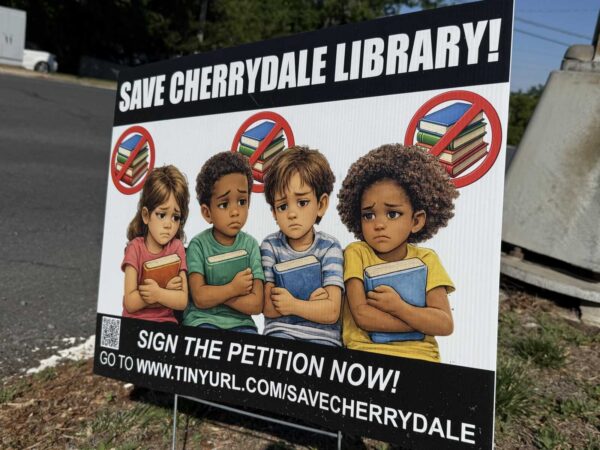
A "Save Cherrydale Library" sign at the intersection of N. Glebe Road and Old Dominion Drive (staff photo)
The response to the proposed closure of the Cherrydale library and the county’s competitive gymnastics program was swift and relentless.
Speakers lined up at County Board meetings, petitions were circulated, signs proliferated on local roadways, and local listservs and social networks lit up with calls to right what defenders saw as the injustice of cutting something beloved from the budget.
In the end, the County Board restored funding, keeping the Cherrydale library, the gymnastics program, and the Barcroft Sports & Fitness center, which was also on the chopping block. Instead, the Board balanced the budget by raising the property tax rate by two cents for commercial and residential properties in Arlington.
Neighboring Fairfax County, meanwhile, lowered the rate by $0.25 for every $100 in property value.
This is how many budget battles go in Arlington. Something people like is proposed for cuts, but then the Arlington Way kicks in, with lots of outcry about saving the thing that might be cut.
The last time Arlington‘s property tax rate was as high as it now will be — $1.053 per $100 assessed valuation — was 1980, when it was $1.12. It has fluctuated over the years since then, reaching a low of $0.765 per $100 in 1990 and 1991.
The process of cutting Arlington County‘s budget is not as easy as some might hope. You can perhaps trim administrative positions and contracts around the margins, but any low-hanging fruit was almost certainly pruned over the past few cycles, each their own “tough budget year.” (And making changes to county contracts with marginal fiscal benefits sometimes leads to undesired results.)
To really make a dent would take cutting something with a constituency, whether it’s a library, infrastructure improvements, affordable housing, nonprofit grants, and so on. And that’s not to mention core services like public safety, where costs have been increasing as recruitment challenges have led to increased pay, or Metro, investment in which continues to weigh heavily on local government budgets.
A budget is, in the end, a math equation. And if inflation continues rising above the annual increase in property values, that’s going to tend to push expenses higher than revenue. Already, county officials have been sounding warnings of another tough budget and additional tax hikes next year.
Meanwhile, the commercial property taxes on office buildings that used to prop up the county’s budget are down amid continued high office vacancy, so the burden for increased tax rates will fall on homeowners, whose property values have continued to rise, with no end in sight.
The need to make hard budgetary choices is nothing new. One of ARLnow’s early articles, from March 2010, noted the tension “between those who think taxes are high enough already and those who take an ‘increase my taxes, please’ approach.”
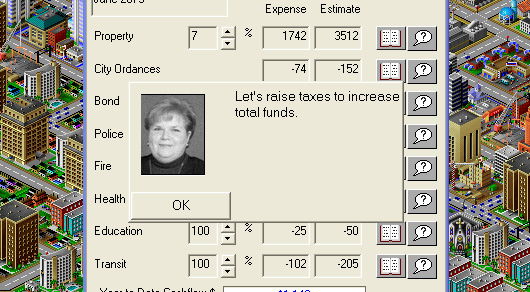
The article also included a faux graphic of former County Manager Barbara Donnellan in the classic municipal simulation game SimCity, where you often have to make unpopular decisions to balance your city’s budget — or risk disaster. You can underfund the fire department for awhile without public disapproval, but your city will eventually burn down.
SimCity photo illustration, featuring former County Manager Barbara Donnellan (by ARLnow)
Arlington County memorably took one of those budgetary shortcuts in the wake of the Great Recession. In 2009, just 25 lane miles of the county’s 974 miles of roadway were repaved. A few years and some hard winters later, county roads were littered with potholes and the public grumbling grew loud enough that the county bumped up the paving to 72 lane miles per year by 2014.
A return to crumbling streets seems unlikely, so next year’s budget will likely come down to the classic choice: you’ll have to increase taxes, cut services, or some middle-ground combination of the two.
Today we’re making it a binary choice, to see which ARLnow readers prefer. All things considered, and assuming that consequence-free cuts to administrative functions are not feasible, would you rather see the County Board cut services or raise taxes next year?
Arlington Public Schools buses (staff photo by Jay Westcott)
The grumblings from Northern Virginia public school parents are getting louder.
Last week, the discontent broke out into the open, when 106.7 The Fan host Danny Rouhier went on a rant that ended up going viral on social media and prompting some news coverage. His message: kids are getting too many days off of school.
Danny is sick and tried of Fairfax County Schools consistenly having days off school. pic.twitter.com/pba4ZT1Zba
Arlington and Fairfax schools have added more student holidays in recent years.
Starting with the 2021-2022, Arlington Public Schools added several religious holidays to its calendar, including Rosh Hashanah, Yom Kippur, Diwali and Eid al-Fitr. This year Eid al-Adha was added, after a divided school board decided against a last-minute addition to the calendar last year.
Both Arlington and Fairfax, meanwhile, added next Tuesday — special election day for the state redistricting amendment — as an off day and APS is off today (Monday) for a grade prep day. (Over the past month, APS has been off March 13, 20, 30-31 and April 1-3, 10, and 13.)
FCPS has even more off days on its calendar than APS and the Fairfax school board has been considering removing some federal holidays next year to strike a better balance. From an April 8 FFXnow article:
As the current school year enters its final stretch, the Fairfax County School Board is considering tweaking the calendar for the next year in response to mounting complaints about disruptions to class schedules.
At the board’s meeting tomorrow (Thursday), members led by governance committee chair Melanie Meren will propose nixing Indigenous Peoples’ Day and Veterans Day as official student holidays and limiting the number of scheduled early release days to four per year.
“Partial school weeks function as an informal ‘childcare tax’ that falls hardest on our hourly-wage and most vulnerable households,” said Meren, whose committee has been discussing a new calendar policy. “My goal is to adjust the 2026-27 calendar to increase the number of five-day school weeks.”
If the motions are approved, Indigenous Peoples’ Day, which will fall on Oct. 12 this year, and Veterans Day — observed annually on Nov. 11 — would become standard instructional days for both students and staff going forward. Fairfax County Public Schools would implement a curriculum to teach students about the groups that the occasions are intended to recognize.
After an April 9 vote, only Veterans Day will be eliminated as a school holiday, FFXnow reported today.
While Arlington has fewer off days than FCPS, some parents are nonetheless feeling the burden of frequently having to find childcare for myriad off days and early release days.
Do you think APS should also consider removing some off days next year? Weigh in below.
While the past 24 hours might be particularly extreme — National Airport recorded a record high of 86 yesterday, and now it’s 33 degrees in North Arlington and snowing — the temperature roller coaster isn’t done.
Monday’s expected high temperature of 70 will be followed by a predicted low of 28 on Tuesday, according to forecasts.
That brings us to our poll question: What do you think about the snow today? Given the following two poll options, which one are you choosing?
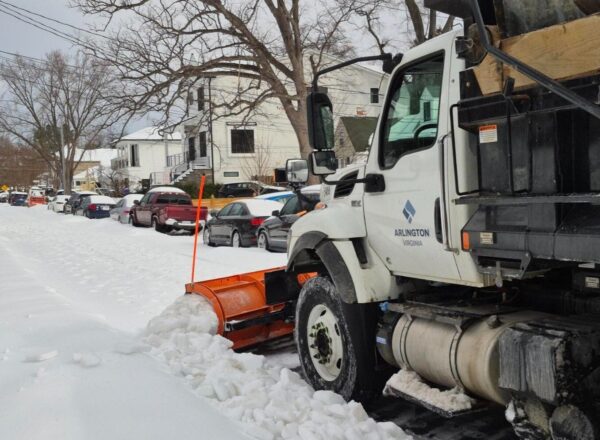
Arlington County snow plow working to clear a neighborhood street after "snowcrete" storm of 2026 (via Arlington DES/X)
As the snow removal operations from the Jan. 25 snow and sleet storm wind down, we’re wondering how locals would grade the effort.
This winter storm was uniquely challenging, with five inches of snow falling before getting covered by 2-3 inches of icy sleet — what would have otherwise been 1-2 feet of total accumulation should it have kept falling as snow. Then we had nearly 10 straight days of frigid conditions, with temperatures not rising above freezing and allowing the “snowcrete” to soften.
The scale of the removal operation in Arlington alone is notable. From our reporting yesterday:
Crews have hauled more than 5,000 truckloads of snow — weighing roughly 55,000-75,000 tons, in total — from Arlington’s commercial areas since the snowstorm. They’ve deposited these at five locations around Arlington, at 14th Street N., Fairfax Drive, N. Quincy Street, Long Bridge Park and 601 S. Carlin Springs. […]
They’ve cleared more than 1,000 miles of roads, 10 miles of protected bike lanes and 63,000 feet of sidewalk, working 14 consecutive 12-hour shifts beginning on Jan. 24.
For some, the effort did not go far enough, leaving neighborhood streets covered to harden into an impassable icy surface that remained for days. For others, crews worked long hours and did their best despite very challenging conditions.
All things considered, how would you grade Arlington’s snow removal effort?
A still snow-covered sidewalk near Claremont Elementary (courtesy Joel Weger)
School buses are crisscrossing county streets and students are steeling themselves for the first day of school in 11 days.
Yes, class is back in session this morning for Arlington Public Schools students, to the great relief of many beleaguered parents.
The decision to keep schools shuttered all last week, while piles of “snowcrete” covered the sidewalks (and in some cases, roads) near schools, prompted acceptance from some and grumbles from others. Why, some asked, had conditions around schools not been addressed earlier in the week, potentially making it harder to clear now?
The grumbles grew louder this week, amid Monday’s closure and today’s two-hour delay. Some questioned whether it’s even safe now for kids to go back.
“As of 7:30 A.M. there is no safe approach to Claremont Elementary or Wakefield High School from S Columbus St.,” local resident Joel Weger wrote this morning. “There has been no snow cleared on S. Chesterfield Rd for the entire length of school property. For Claremont snow has been cleared from only one side of the school.”
That was echoed by another local resident who lives near Wakefield.
“I’m not a parent but I see the kids walking to school everyday and parents taking their littles ones to the bus pick up spots,” wrote Julia Itani. “While walking my dog in the neighborhood there were many times I almost fell and we couldn’t walk safely. I can’t imagine students walking every morning while there’s piles of ice.”
Others suggested that a loss of learning outweighs what they see as marginal safety improvements from keeping schools closed longer. Even today’s delay was too much for some.
“I am writing to express my deep disappointment and continued frustration with the county’s repeated school closures and delayed openings due to snow and ice,” wrote Gregory Cohen, a “concerned and gobsmacked parent,” in an email this morning. It was one of several addressed to the County Board and School Board that ARLnow was CCed on in recent days.
“From a parent’s perspective, these decisions do not appear to be data-driven, outcome-oriented, or transparent. Delays in particular seem to accomplish little beyond creating unnecessary hardship for working families,” Cohen wrote. “A two-hour delay does not meaningfully improve road conditions, does not reduce childcare challenges, and often results in the same ultimate outcome: lost instructional time with no measurable safety benefit.”
What do you think — did APS strike the right balance by staying closed for five school days (Friday was a scheduled off day) and opening on a delay today? (Neighboring Fairfax notably took the same approach.)
Or should schools have opened up earlier? Or stayed closed longer? Let us know below.
Groundhog Club handler A.J. Dereume holds Punxsutawney Phil, the weather prognosticating groundhog, during the 140th celebration of Groundhog Day on Gobbler's Knob in Punxsutawney, Pa., Monday, Feb. 2, 2026. Phil's handlers said that the groundhog has forecast six more weeks of winter. (AP Photo/Barry Reeger)
After a frigid and snow covered past week and a half — and yet another APS snow day — you might be ready for a big warm-up.
Bad news: we have at least another week of mostly freezing temperatures, according to the forecast, and six more weeks of winter, according to Punxsutawney Phil.
The groundhog saw his shadow this morning in the woods of Pennsylvania.
PUNXSUTAWNEY, Pa. (AP) — Punxsutawney Phil predicted six more weeks of wintry weather Monday, a forecast sure to disappoint many after what’s already been a long, cold season across large parts of the United States.
His annual prediction and announcement that he had seen his shadow was translated by his handlers in the Punxsutawney Groundhog Club at Gobbler’s Knob in western Pennsylvania.
The news was greeted with a mix of cheers and boos from the tens of thousands who braved temperatures in the single-digits Fahrenheit to await the annual prognostication. The extreme cold kept the crowd bundled up and helped keep people on the main stage dancing.
Usually guests can come up on stage and take pictures of Phil after his prediction, but this year the announcer said it was too cold for that and his handlers were afraid to keep him out too long. Instead, the audience was asked to come to the stage, turn around and “do a selfie.”
The club says that when Phil is deemed to have not seen his shadow, that means there will be an early spring. When he does see it, it’s six more weeks of winter. Phil tends to predict a longer winter far more often than an early spring.
Is cabin fever setting in, after one of the longest stretches of very cold temperatures in recent memory? Are you in desperate need of a warm weather escape while winter still rages here in Arlington?