

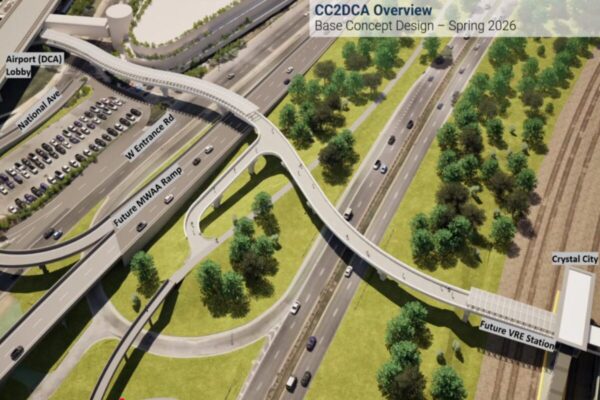
Plans to cover only a portion of a quarter-mile pedestrian bridge between Crystal City and Reagan National Airport are raising concerns among some local residents.
Officials from Arlington’s Department of Environmental Services have proposed to cover the CC2DCA multimodal connection on the western portion as it passes above rail lines, then on the eastern portion as it approaches the airport. For aesthetic reasons, however, the current plan is to leave the bridge open to the sky as it passes over GW Parkway.
Not all local leaders are happy with the proposal.
“This needs to be covered. This is not a useful project if it’s not covered,” said Meg Flores, a member of the Crystal and Pentagon Cities Council.
At the advisory group’s quarterly meeting on March 9, council members received a status update on the project, which currently is in the design stage.
Flores represents the Transportation Commission on the panel. Others who spoke up, like Gary Shinners of the Park and Recreation Commission, also voiced support for covering the entire length of the pathway.
Kyle Kling, the project manager, said the National Park Service is concerned about visual impacts for drivers along the GW Memorial Parkway. However, he said plans could change based on public feedback and negotiations.
“We’ll really come back to the public sometime in 2027 with a higher focus on architectural components for people to weigh in on,” Kling said.
The pedestrian/bicyclist bridge will run above the parkway on its planned route from a new Virginia Railway Express station in the 2000 block of Crystal Drive to the airport.
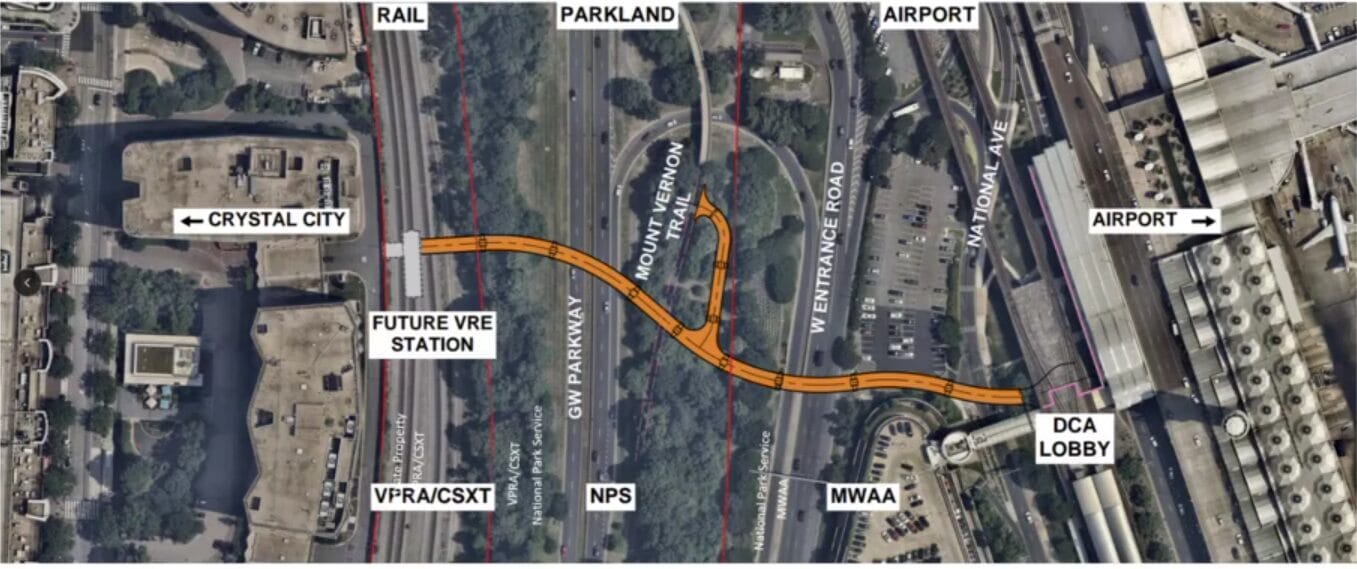
Some council members also discussed interactions between pedestrians and bicyclists on the 20-foot-wide bridge, which will also connect to the Mount Vernon Trail.
“You have people trying to get from the airport with tons of luggage and people that are biking between them, in a pretty closed space,” said Alexander Chakrin, an Aurora Highlands Civic Association representative to the council.
Kling said there has been no formal decision on whether to separate pedestrians and bicyclists, but staff was “leaning toward” no physical separation.
Council chair Ben D’Avanzo said the council would communicate with county officials, outlining concerns and preferences expressed at the meeting.
“I am delighted on the consensus on a lot of things,” he said. “We’ll work on a letter that will reflect that.”
Kling told council members the bridge’s high point would be at the new rail station. As it moves east toward the airport, its grade would be between 2.4% and 3.8% — well below the 5% maximum allowable under the Americans with Disabilities Act.
Five years ago, studies estimated that about 5,000 people per day might use the bridge, but Kling acknowledged that could be overly optimistic. At least one council member wondered whether the project was essential in the current economic environment.
“It’s beautiful and we all love it, but in practical terms, especially with the way the economy has shifted, I kind of have to question it at this point,” said Emily Norton, a representative of the Crystal City Civic Association.
“Who are the users?” Norton asked. “I’m not going to walk from my apartment in Crystal City to the airport.”
Others on the panel said the project would prove a success both as a transportation link and for economic development across National Landing.
“From a transportation perspective, this 100% aligns to our goals as a county,” Flores said.
Whatever its ultimate usage numbers, “the bridge sounds like it’s moving forward,” D’Avanzo said.
