

Arlington Public Schools’ region high per-student spending came under scrutiny as County Board and School Board members last month sat down for budget discussions.
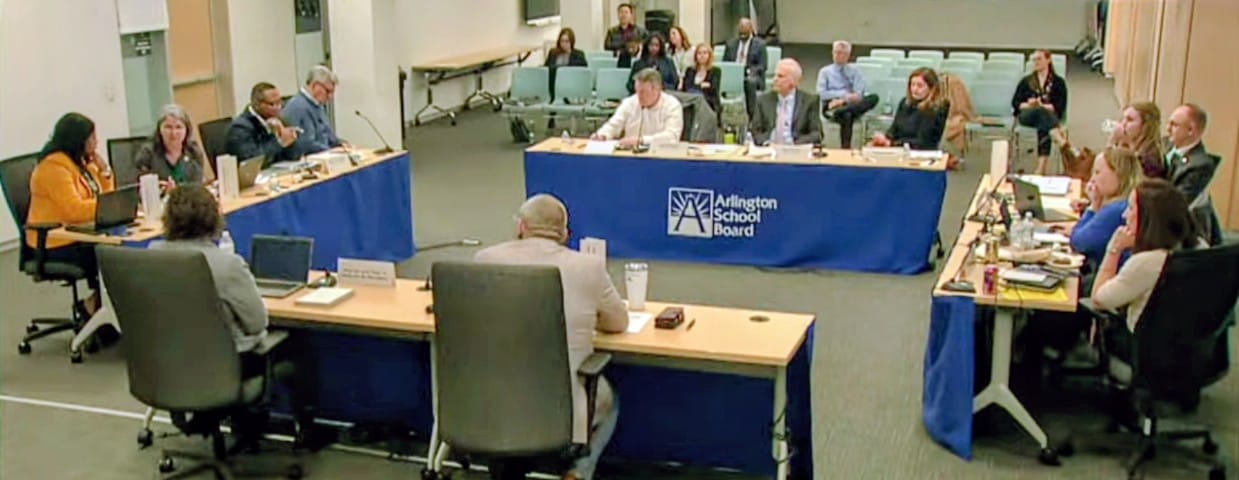
“We’re spending significant money,” County Board member Julius “JD” Spain, Sr., said at the March 12 discussion between the two elected bodies.
“Do we meet the mark” in attaining “bang for the buck,” Spain asked school leaders.
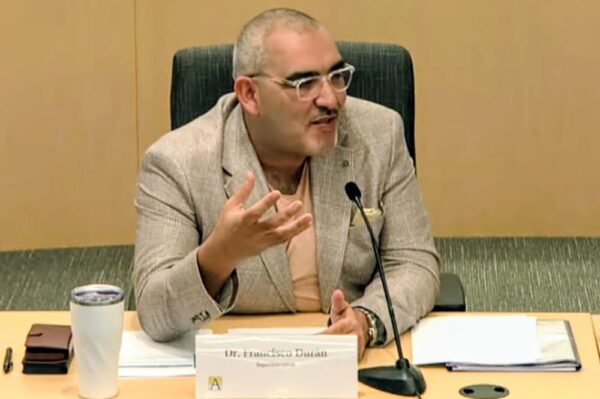
“Yes, and no,” Superintendent Francisco Durán replied.
Durán acknowledged the high spending figure, but said there are several reasons it is so high.
“Our cost per pupil gets elevated because of some of the specialty programs, which I think are very important programs for our county,” he said.
The specialty school programs have an overall per-student cost of $56,738 this school year. That’s more than twice the average $25,406 per-student cost countywide.
The $56,738 cost includes Arlington Community High School, the Arlington Career Center (Grace Hopper Center), Langston Continuation High School, New Directions Alternative School and the Eunice Kennedy Shriver Program. The cost per student runs from $33,845 to $92,166, depending on the program.
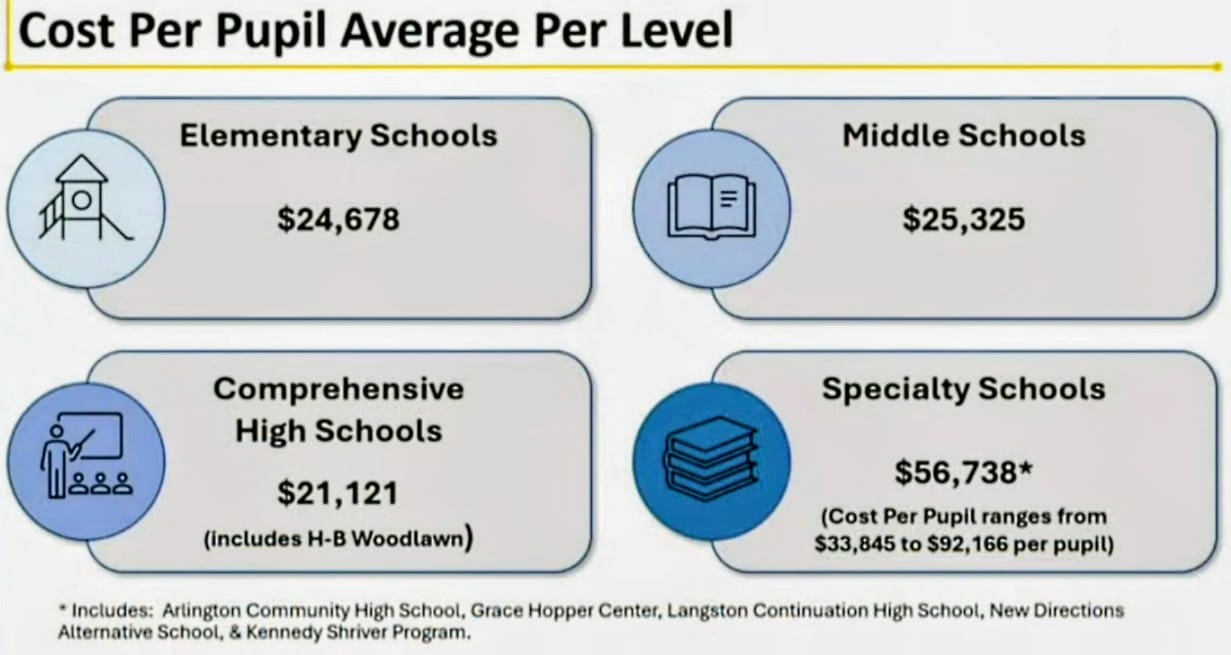
By comparison, costs of general education average $24,678 in county elementary schools, $25,325 in middle schools and $21,121 in high schools, according to data provided to County Board members at the meeting.
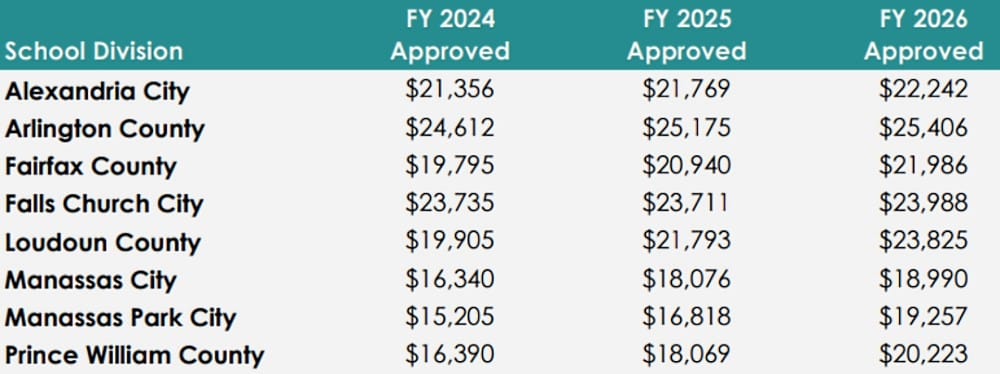
Over the past two decades, Arlington Public Schools typically has led Northern Virginia school districts in per-student costs, sometimes running second behind the much smaller Falls Church district. Figures are compiled by the Washington Area Boards of Education, which releases an annual report dissecting school-system finances.
For 2025-26, Falls Church ranks behind Arlington as second most expensive at $23,988, followed by $23,835 per student in Loudoun County. Alexandria City Public Schools is spending $22,242, while per-student costs are $21,986 in Fairfax County and $20,233 in Prince William County.
School Board Chair Bethany Zecher Sutton acknowledged that being at the front of the spending pack brings controversy.
“It has historically been a criticism of the school system, but there are reasons why the number is what it is,” she said.
Some other local school districts include funding for adult education, teen parenting and high-school-completion programs in their government budgets, while in Arlington, that funding is included in the school budget, Durán said.
While Arlington Public Schools spends the most on a per-student basis, the rate of that growth over the past five years has been more toward the middle of the pack, Durán told county officials.
In those five years, APS per-student costs have grown 23%, according to figures presented. Though higher than Falls Church (16.9%) and Alexandria (17%), the trajectory is lower than in Fairfax (31.9%), Loudoun (39.2%) and Prince William (49.4%) counties.
The joint meeting came relatively early in the fiscal 2027 budget session. County Manager Mark Schwartz is seeking a 1.5-cent increase in the county’s real-estate tax, but recommended the additional funding not be included as part of the revenue-sharing agreement that sends about 43% of county General Fund revenue to the school system.
With that extra funding left out, the proposed county transfer to schools totals $650.3 million, up marginally (0.5%) from the current fiscal year’s transfer.
Leaving additional funding out of revenue sharing apparently was not communicated to school leaders before it was announced publicly. County Board Chairman Matt de Ferranti expressed a degree of regret about that.
“There’s a failure, and I’ll own it, to communicate early enough and often enough,” he said.
In Virginia, school divisions do not have independent taxing authority. In wealthier localities such as Arlington, the local government provides the majority of a school system’s revenue. In the 2027 proposal, county funding accounts for 76% of the school system’s overall $855.7 million budget proposal.
In his own proposed budget, Durán stayed within Schwartz’s $650.3 million transfer proposal.
This year, Durán also listed about $19 million in unfunded priorities that could be funded if extra money materializes. School Board members agreed with that list when, on March 26, they accepted the superintendent’s budget package as their own and sent it out for public review.
During the March 12 discussion between the two boards, County Board member Susan Cunningham said it would be up to the School Board to determine how to spend the funding, regardless of the final total.
“We give you money — it’s your obligation to decide where to put it,” Cunningham said. “I don’t think that’s our role, and we try hard not to overstep that line.”
Cunningham lauded the school system’s efforts in funding programs for special education and English-language learners. But, she said, that didn’t mean extra money would always be available.
Arlington’s revenue-sharing agreement between the county government and schools has provided some predictability in budgeting — and has avoided, to an extent, the annual battles between governing bodies and school boards that happen in some nearby counties and cities.
This year, with rough regional economic conditions impacting local governments, “I don’t think any of them are funding the [full] requests of their school boards,” Coffey said.
Last year, Fairfax County’s school leadership complained bitterly about the amount of the county government’s transfer, but in the end got no more than originally proposed.
At the start of the current budget cycle, Fairfax County Executive Bryan Hill urged school leaders to submit a “budget of reality” rather than risk a repeat of the preceding year. During the current budget season, Fairfax’s School Board and Board of Supervisors seem to have tamped down on the rhetoric and are working somewhat more collaboratively.
In Arlington, County Board members will adopt the local government’s fiscal year 2027 budget and set tax rates on April 22. At that point, school leaders will know how much local revenue they can expect, and will then work to finalize their own budget in May.
Both budgets go into effect July 1.
