


Backers of ranked-choice voting (RCV) believe this fall’s congressional races may bolster their case for changing the format of statewide elections.
If Virginia voters approve the congressional redistricting constitutional amendment on April 21, crowded ballots in many parts of the state could lead to future representatives being selected by an unusually small sliver of the overall electorate.
Some supporters of RCV believe this could lead to discontentment with the traditional winner-take-all format, providing an opportunity for their cause.
“When you have a large number of candidates for a position or for the nomination to that position, it’s very possible that someone who is not broadly backed by a large number of the voters squeaks through, because voters not in sympathy with that candidate divide their votes between a number of similar candidates they like better,” Dave Schutz, who advocates for a switch to ranked-choice voting across all elections, told ARLnow.
“This is a real danger in the new 7th District, if the referendum passes and we have a cast of dozens running for the nomination,” said Schutz, who chairs the form-of-government subcommittee of the Arlington County Civic Federation but was speaking only for himself.
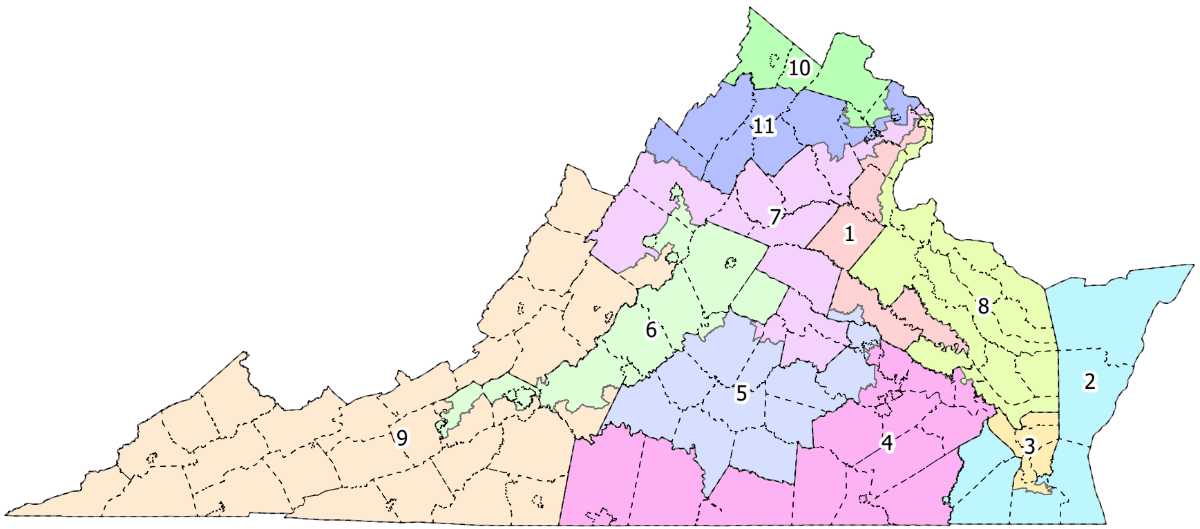
The proposed 7th Congressional District would run from Arlington west to the West Virginia line and south to the west of the Richmond area. It is part of a Democratic effort to maximize the number of seats they could win in November.
The northern 60% of Arlington would be included in the new proposed district. Because of its unusual shape, the proposed 7th has become known as the “lobster district.”
Arlington voters would comprise about 20% of the new district’s voting-age population, according to data from the Virginia Public Access Project. Falls Church would add 2% and Fairfax County an additional 34% before the district moves into more rural areas.
“If you look at a color-coded map, the lobster looks red due to all the rural territory, but it’s really blue, politically speaking. This is a +8.3 Democratic district,” Cardinal News noted in its analysis of how districts would change.
That will benefit Democrats in November, if the new districts are implemented. But as Schutz pointed out, with the winner-take-all (plurality) voting currently in place, the 11 eventual winners statewide could be determined by a relatively small percentage of the voters.
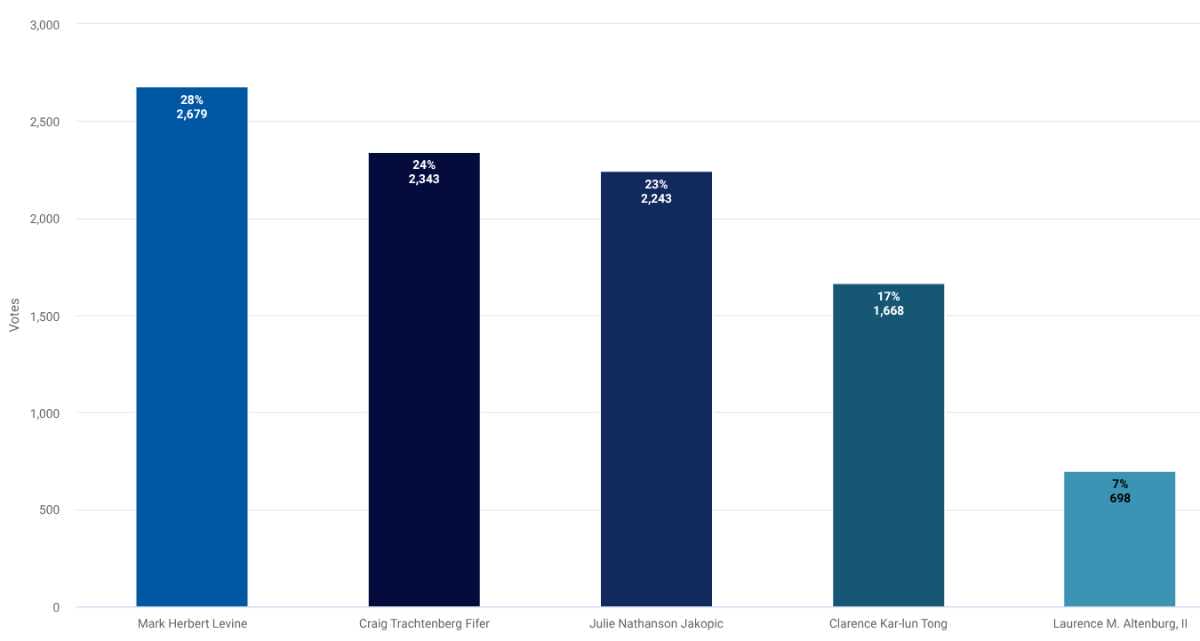
Consider the case of the former 45th House of Delegates District, which included portions of southern Arlington.
In the 2015 Democratic primary for the open seat, five candidates sought the office in the winner-take-all competition.
Mark Levine came out on top, but won just 28% of the vote. Two others received 24% and 23%, respectively, while a fourth picked up 17%.
“Ranked-choice voting avoids that situation, and you have a much better chance that the winner will be someone who is widely favored,” Schutz said.
Because the district was a Democratic fortress, Levine won the subsequent general election and held the seat until being ousted by Elizabeth Bennett-Parker in the 2021 Democratic primary.
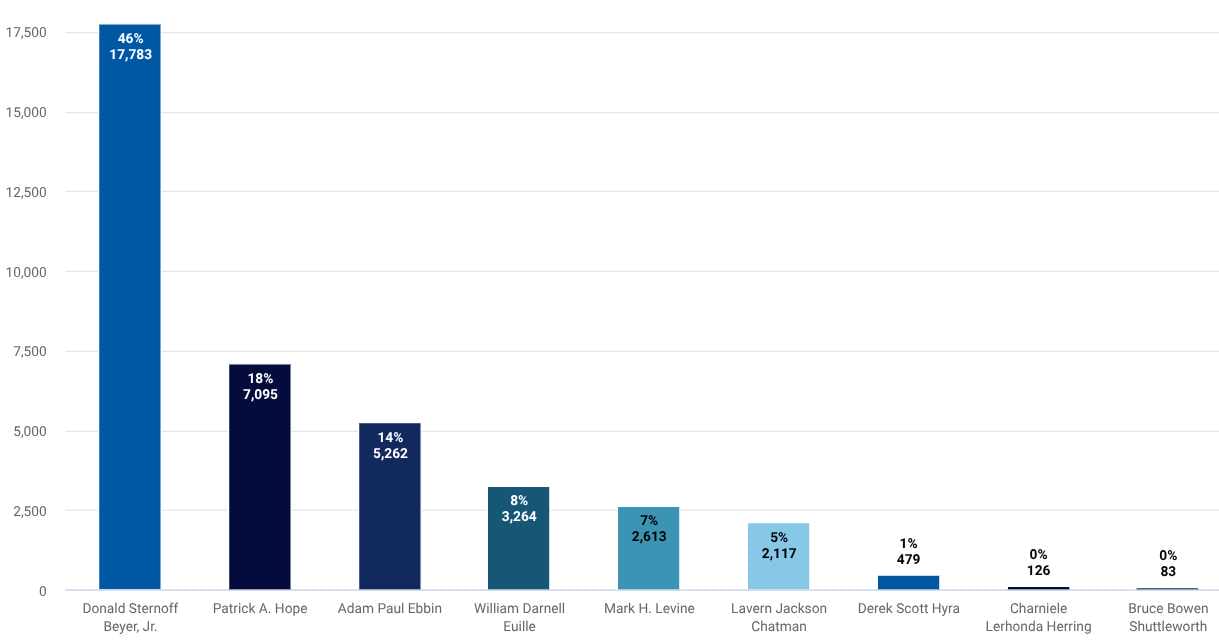
A year earlier, a 10-candidate Democratic field — including Levine — emerged to vie for the 8th Congressional District after Rep. Jim Moran announced his retirement.
Don Beyer won that primary with 46% of the vote. His closest competitors were Patrick Hope (18%) and Adam Ebbin (14%).
The margin of victory made it likely that, had ranked choice been in effect then, Beyer would have been victorious eventually.
Even though voters have yet to decide whether to adopt redistricting, multiple Democrats and some Republicans have announced candidacies for the 7th District. More are expected on Wednesday night (April 8) at the Arlington County Democratic Committee’s monthly meeting.
Large fields emerging in many districts
That situation is playing out statewide, said Sally Hudson, a former state legislator who heads Ranked Choice Virginia.
“Among Democrats, nine of the 11 seats have three or more declared candidates so far,” she said. “Some of the results will likely mirror the wide field in VA10 last cycle, where Suhas Subramanyam — a strong ranked-choice supporter! — won the nomination with just 30% of the vote. That means more than two-thirds of the voters chose someone else.”
“Republicans also have wide fields in at least two seats so far,” Hudson said.
County Board member Susan Cunningham said ranked-choice voting “would be a terrific tool for statewide races like District 7.”
“More candidates, especially those affiliated with a political party, would be encouraged to run without the concern of splitting the vote,” she told ARLnow. “And, successful candidates benefit from more popular support — even if they were not everyone’s top choice, most voters had some preference for them.”
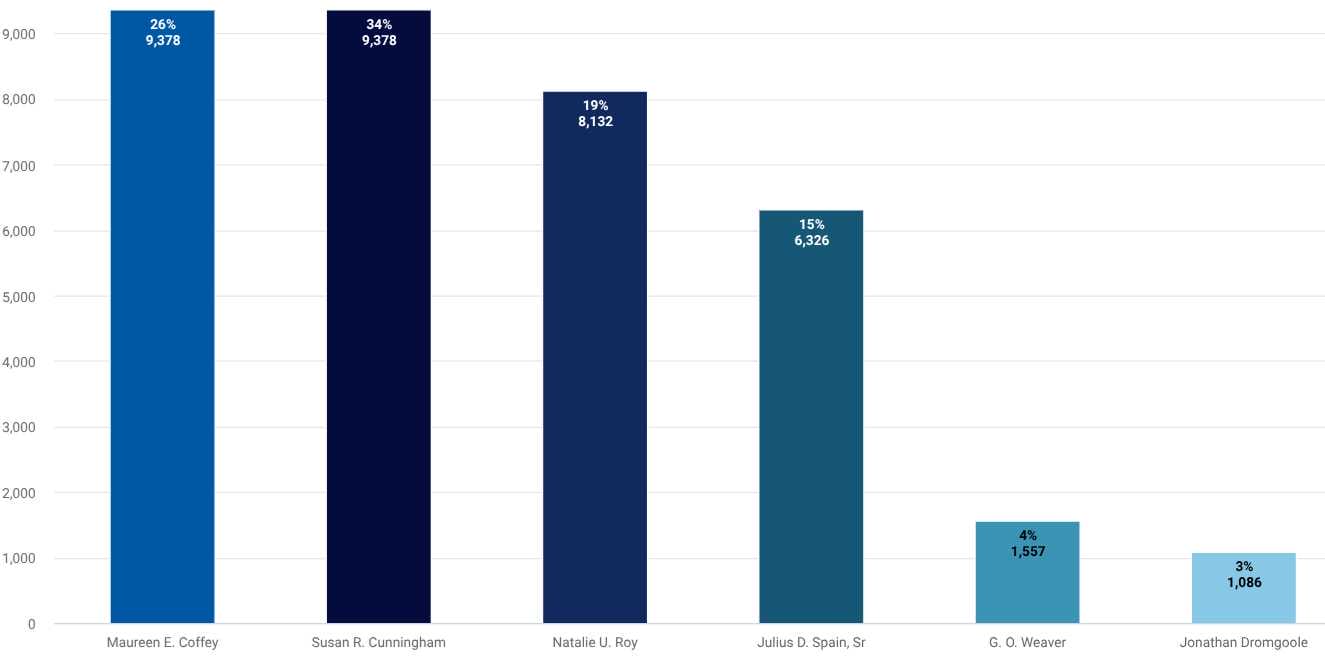
In her successful 2023 bid for County Board, Cunningham ran in a Democratic primary that was held under ranked-choice rules. That November’s general election was held under the more traditional rules, with Cunningham and fellow Democrat Maureen Coffey finishing in the top two slots.
Current state law only permits ranked-choice voting for local governing bodies, and so far only Arlington and Charlottesville have moved to make the switch.
Both communities have shown some hesitancy, with both having enacted it permanently only for primaries. Arlington County Board members earlier this year extended ranked choice as the method for County Board general elections, but only for the next two years.
RCV boosters look to General Assembly
Allowing other general-election races, including congressional races, to be conducted using ranked-choice “would require legislation from the General Assembly,” Hudson said.
“I do expect we’ll see that bill introduced in 2027,” she said, though in the past Hudson has expressed the view that incumbent legislators are unlikely to move quickly in changing the status quo.
For nominating contests, parties still have some flexibility in voting methods, Hudson told ARLnow.
“If parties forego state resources for choosing their nominee and conduct conventions or ‘unassembled caucuses,’ they’re already free to use whatever voting method they wish — including RCV,” she said, adding:
“The VA10 and VA11 GOP district committees used RCV in party-run primaries back in 2022. RCV has seen less use among Virginia Republicans since then, but the local GOP committees appear to be warming back up to it. The Lynchburg GOP just announced they’ll be using RCV in their upcoming firehouse primary for City Council.”
“After the losses in last fall’s election, they may be eager for a way to elevate consensus candidates and defuse infighting, as with Youngkin et al., who were nominated for their statewide races via RCV in 2021.”

Beyer may face far different election map
If redistricting wins voter support on April 21 and survives legal challenges, the 8th Congressional District also will see significant alterations. It will lose most of Arlington and all of Falls Church, and instead of being compact will meander as far south as the Williamsburg area.
The final outcome in the 8th Congressional District most likely is less up in the air than in the 7th. Incumbent Beyer, who lives in Alexandria, is likely to emerge victorious in either the existing district or the proposed new one, despite challenges both in the Democratic primary and general election.
Since first winning election in 2014, Beyer has picked up general-election and occasional primary challenges, but has never seen his grip on the seat imperiled.
In Congress, Beyer with Rep. Jamie Raskin (D-Md.) have cosponsored legislation to require states to adopt multi-member congressional districts and the use of ranked-choice voting. But, Hudson acknowledged, “it’s unlikely to see any real action in Washington anytime soon.”
Among those who supports the Beyer bill — and ranked-choice voting more broadly — is County Board member Julius “JD” Spain, Sr.
“As an elected official who has previously run as a candidate in two ranked-choice local elections, I fully support educating the electorate and implementing ranked-choice voting in all local, statewide, and congressional races,” he said.
“It ensures our elections reflect the true will of the majority, not just the loudest plurality, and strengthens both voter confidence and the legitimacy of our democratic process,” Spain said.
Barring federal intervention, a final say on expanding options for voting methods would rest with the legislature and governor.
While supportive of expanding ranked-choice options, Cunningham said it may be an uphill climb just to implement it for local races.
“It seems unlikely we’ll get there quickly in Virginia,” she said.
“Coordinating across 133 local elections offices may take some time — from convincing the General Assembly to mandate it, to making sure voting machines allow ranking and agreeing on tabulation methods,” Cunningham said. “It is probably not a coincidence that the two states that have used RCV for statewide offices, Alaska and Maine, also have relatively small populations.”
In the interim, “I hope the General Assembly will seriously consider allowing RCV for school board and constitutional-officer elections,” she said.
Civic Federation preps candidate forum
The Arlington County Civic Federation will host a candidates’ forum for both County Board and U.S. House of Representatives on Tuesday, May 12 at 7 p.m. at Virginia Hospital Center.
“Depending on the outcome of the April 21 referendum, we will host either the 8th Congressional District candidates or both the 7th and 8th District candidates,” Civic Federation president Nick Giacobbe said.
All candidates who are running in the Aug. 4 Democratic primaries or have filed to run in the general election will be invited to participate.
“With a large field expected, we anticipate a lively and substantive discussion,” Giacobbe said. “This will be an important opportunity for members to hear directly from those seeking to represent Arlington at the county and federal levels.”
The event is open to the public, and will be livestreamed via Facebook.
