

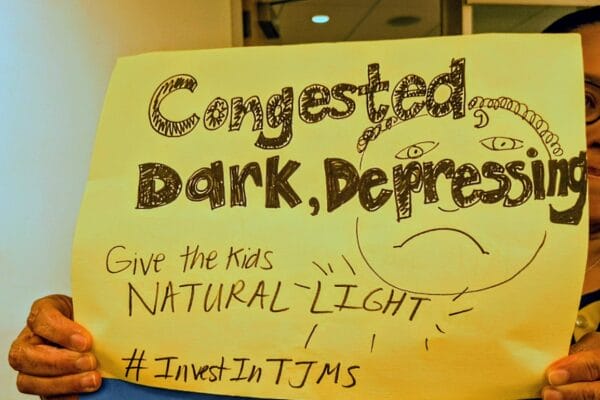
Significant divisions appear to remain among School Board members on the scope of a planned renovation and addition to Thomas Jefferson Middle School.
Three design concepts — with costs of $130 million, $140 million and $168 million — are still on the table, while at least one School Board member has not given up on the possibility of a complete replacement.
“TJ needs an entirely new school,” Board member Zuraya Tapia-Hadley said at a June 2 work session focused on the school system’s capital improvement plan, where the project took center stage.
At the meeting, which got mildly testy at times, Tapia-Hadley and Monique “Moe” Bryant pushed back on the idea that renovation was the only option worth considering.
Bryant voiced concerns that unforeseen challenges with a renovation project might push the cost closer to the estimated cost for a completely new building, $220 million.
“I can’t feasibly make a budget decision without knowing that information,” she said.
The school system’s planning staff reiterated skepticism about building a new facility in an era of little to no growth in student population and many other capital needs in the pipeline. An expansion to the 1970s-era middle school facility “is probably the most cost-effective option,” said Jeffrey Chambers, the school system’s director of design and construction.
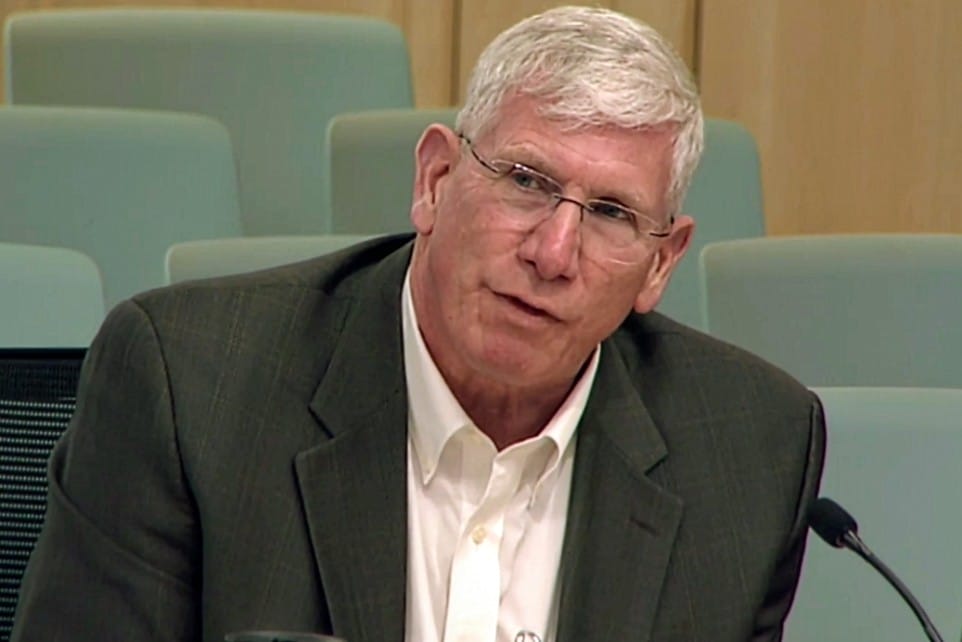
School Board Chair Bethany Zecher Sutton, referencing community criticism of the $182 million cost of the new Grace Hopper Center, predicted asking for tens of millions more for a new middle school was a nonstarter.
“We would then be building a middle school for $220 million with [an existing] middle school sitting there that we would have no use for,” she said.
She was backed by Superintendent Francisco Durán.
“The cost of a new building would be exorbitant,” he said, with implications rippling through the entire capital budget.
Beyond cost, the other question would be where to locate a new school in a county with so little open land.
The county government, not the school system, owns the remainder of the Thomas Jefferson parcel, and might be unwilling to part with it.
If the plan morphs into tearing down the existing school and building on its footprint, an alternative space for TJ students would need to be found for up to three years of a construction project.
The school system potentially could have used the existing Arlington Career Center building for that purpose, but for plans to move students from Montessori Public School of Arlington to the Career Center building.
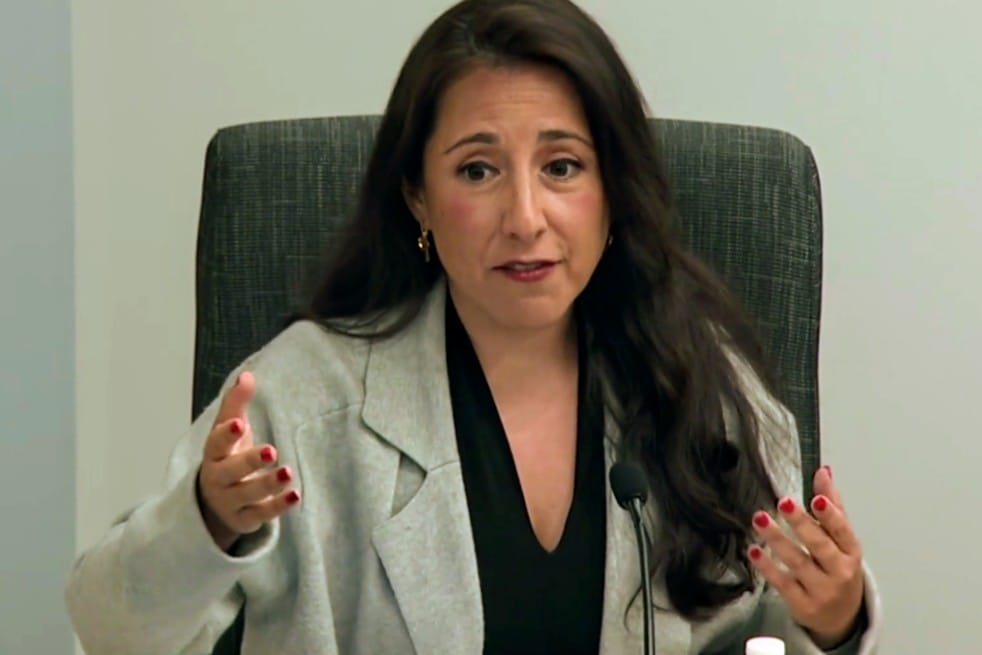
In remarks at the June 2 meeting, Tapia-Hadley criticized Durán and staff for not providing information on the possibility of using a public-private partnership to finance and construct new facilities.
“We asked for this — I would have appreciated a proposal to this effect maybe months ago, or weeks ago at the very least,” said Tapia-Hadley.
The superintendent replied that School Board members last year asked for an analysis of public-private partnerships for elementary schools, but said nothing about middle schools.
“I brought it up [on a computer] to make sure I read it correctly: It did not say ‘middle school,'” Durán said.
While public-private partnerships, known as P3s or PPPs, are potential tools for future construction, Durán said it would be “more appropriate” for completely new buildings rather than renovations and expansions.
That view was amplified by Cathy Lin, the school system’s director of facilities and operations.
“P3 works best for new construction,” she said. “If we do it on renovations and on modifications, it is much more challenging.”
For the public, the discussion on June 2 may not have provided a lot of clarity on where the Thomas Jefferson project is headed. But it did provide information needed to aid decision-making, Bryant said.
“This is what work sessions are for,” she said.
School Board members have set June 18 as the deadline to adopt an updated capital-improvement plan. At a June 2 public hearing held after the work session, members heard from a contingent of Thomas Jefferson parents and staff, urging them not to cut corners on the school’s future.
