

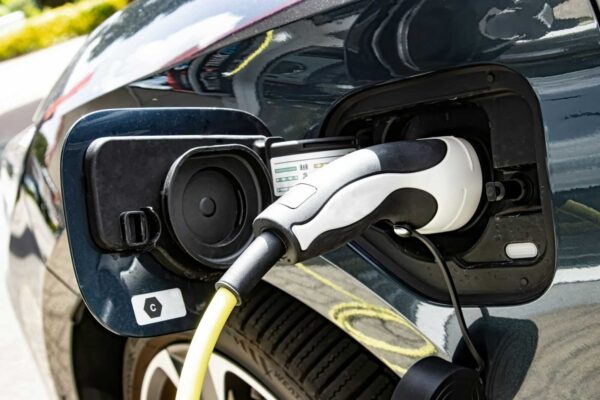
Owners of electric vehicles may have to pay more for a charge at Arlington County facilities starting later this year.
The County Board has directed staff to prepare an ordinance to increase charging rates from the current 17.46 cents per kilowatt-hour (kWh) to 30 cents per kWh.
The increase would cover higher electricity costs and allow the county government to recoup more of its administrative and capital costs for providing charging stations, officials said on July 21.
Arlington’s fee structure was last updated in December 2024. Beyond the cost of electricity, vehicles pay a “dwell fee” of $3 per hour, not to exceed $25 — a cost designed to encourage turnover in spaces once vehicles are fully charged.
An increase of about 4.5 cents per kWh, up 26%, is already planned for Arlington’s government charging stations, to reflect the higher cost of purchasing electricity through the Virginia Energy Purchasing Governmental Association.
Any increase beyond absorbing the extra wholesale cost of energy would require a local ordinance change to enact. Staff was directed to come back with recommendations in the fall.
“There is some work ahead of us” to determine the appropriate rate, County Board Chair Matt de Ferranti said at the July 21 meeting.
In June, Board member Susan Cunningham proposed considering a rate increase. She thanked her colleagues for taking the step at the July 21 meeting.
“It’s a small dollar amount, but I think it’s important in these times to make sure we understand the full carrying cost” of providing charging stations, Cunningham said.
A rate of 30 cents per kWh would bring Arlington in line with governments operating charging stations in Fairfax and Prince William counties, according to a spreadsheet provided by county leaders.
It also would represent a policy change, as county leaders in the past justified the lower rates as a way to incentivize the purchase of electric vehicles and hybrids.
The city of Falls Church’s EV-charging stations provide the first hour of charging free, then charge 20 cents per kWh, Arlington officials said.
Government charging stations are designated Level 2 equipment, a mid-range power source that can charge a light-duty vehicle from empty to full in four to 10 hours, county officials say.
County charging stations can be found at Arlington Mill Community Center, Aurora Hills Community Center, Central Library, Courthouse Plaza, Fairlington Community Center, Irving Street Group Home, Long Bridge Aquatics Center, Lubber Run Community Center and Madison Community Center.
Charging stations remain open at Madison community center despite ongoing renovation of the center.
In addition to potentially losing access to below-market-rate electricity, EV and hybrid owners also this year lost the benefit of lower car-tax rates.
As part of the fiscal 2027 budget, Board members equalized rates between clean-energy vehicles and other types at 13% of the first $20,000 of a vehicle’s assessed valuation. That’s down from a 24% rebate for standard vehicles and down from 50% for clean-fuel vehicles.
For the owner of a clean-fuel vehicle assessed at $20,000, the change will result in a tax increase of $271, to $696, when car-tax bills are due in October.
While electric vehicles represent just 5% of all vehicles registered in Arlington, the number of electric and plug-in hybrid vehicles has grown 90% in the past two years, county staff said in March.
Photo via Marek Studzinski/Unsplash
[Updated on July 28 to note that charging stations at Madison Community Center remain open during the facility’s renovation.]
